
Semantic Content Network: Architecting Medical SEO Authority
A semantic content network is a strategic SEO framework crucial for medical clinics and plastic surgeons aiming for digital dominance. This article details how to build such a network, organizing content around entities and user intent to establish comprehensive topical authority. Readers will learn about architecting authority through topic clusters, leveraging pillar pages and entity-based SEO, and enhancing E-E-A-T for competitive markets like London’s Harley Street. This approach transforms online visibility, improves search engine understanding, and boosts patient engagement in the YMYL niche.
Abdurrahman Şimşek, a London-based Semantic SEO Strategist with over 10 years of experience, specializes in building high-authority content networks for medical and aesthetic clinics. His expertise in semantic engineering and medical E-E-A-T ensures robust content architecture and sustained organic growth.
To explore your options, contact us to schedule your consultation.
Building a semantic content network is a sophisticated SEO strategy crucial for medical clinics and plastic surgeons aiming for digital dominance. This article explores its architecture, benefits, and how it can transform online visibility and authority. It is particularly effective for practices in competitive markets like London’s Harley Street. By organizing content around entities and user intent, this approach establishes comprehensive topical authority, enhancing search engine understanding and patient engagement.
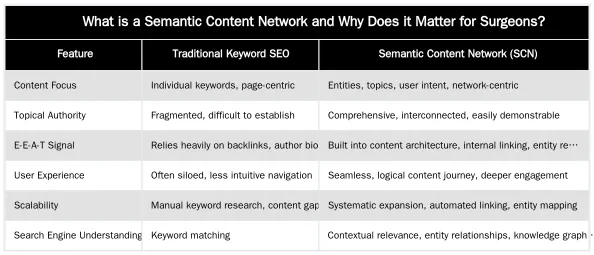
What is a Semantic Content Network and Why Does it Matter for Surgeons?
A semantic content network is an interconnected system of web content organized by topics and entities, rather than just individual keywords. It leverages a core “pillar page” that broadly covers a significant topic, supported by numerous “cluster pages” that delve into specific subtopics. These pages are extensively interlinked, creating a robust content architecture that signals comprehensive topical authority to search engines. For plastic surgeons and medical practitioners, this approach is critical for establishing expertise and visibility in the highly regulated YMYL (Your Money Your Life) niche, where accuracy and trust are paramount.
This structured approach helps search engines understand the depth and breadth of a clinic’s knowledge on a given subject. Instead of isolated articles, a network presents a cohesive body of information. This enhances user experience by guiding patients through a logical content journey, from general overviews to specific details about procedures, recovery, and costs. It moves beyond traditional content silos, fostering a dynamic web of information that is both user-friendly and search engine optimized. For more insights into this strategy, consider exploring semantic content network design for plastic surgeons.
Beyond Keywords: Leveraging Entity-Based SEO and Ruxi Data
Modern search engine optimization has evolved beyond simple keyword matching. A sophisticated content strategy moves towards entity-based SEO, where content is organized around real-world entities (people, places, concepts, procedures) and their relationships. This approach allows search engines to understand the context and meaning behind queries, providing more relevant results. For a plastic surgeon, this means Google understands not just the term “rhinoplasty,” but also its connection to “nasal anatomy,” “surgical techniques,” “recovery protocols,” and “London clinics.”
Integrating advanced methodologies like Ruxi Data is central to this evolution. Ruxi Data is a framework for mapping entities and their attributes, allowing for a granular understanding of a clinic’s expertise. By structuring content with this data, a website can build a robust knowledge graph, enhancing Google’s ability to recognize and categorize the clinic’s authority. This advanced information architecture ensures that every piece of content contributes to a cohesive, entity-rich digital presence, moving beyond traditional keyword strategies to a deeper, semantic understanding of medical topics.
The Power of Automated Internal Linking for Scalability
Maintaining a comprehensive content structure, especially for large medical websites, can be resource-intensive. This is where automated internal linking becomes invaluable. By leveraging semantic analysis and programmatic approaches, internal linking automation can efficiently build and maintain the intricate connections within a content network. This ensures optimal distribution of link equity, improves crawlability for search engine bots, and reduces the manual effort typically associated with link management. Implementing an automated internal linking workflow allows clinics to scale their content efforts without compromising the integrity of their semantic structure.
The E-E-A-T Advantage: Building Trust for London’s Elite Clinics
For YMYL (Your Money Your Life) content, such as medical information, Google’s E-E-A-T guidelines (Experience, Expertise, Authoritativeness, Trustworthiness) are paramount. A well-structured semantic content network inherently supports these principles. By demonstrating comprehensive coverage of medical topics, a clinic signals deep expertise. The interconnected nature of the content, often authored by GMC-registered consultant surgeons or reviewed by medical professionals, reinforces authority and trustworthiness. This is particularly vital for London’s elite clinics, where patient trust is directly linked to perceived medical credibility.
Abdurrahman Şimşek’s strategies in medical SEO focus on embedding E-E-A-T signals directly into the content architecture. This involves not only meticulous content creation but also strategic internal linking, schema markup, and clear author attribution. These elements collectively ensure that content is perceived as expert, authoritative, and trustworthy by both users and search engines. For further details on Google’s quality guidelines, refer to their Search Quality Rater Guidelines.
Case Study: Dominating Harley Street with Semantic Content
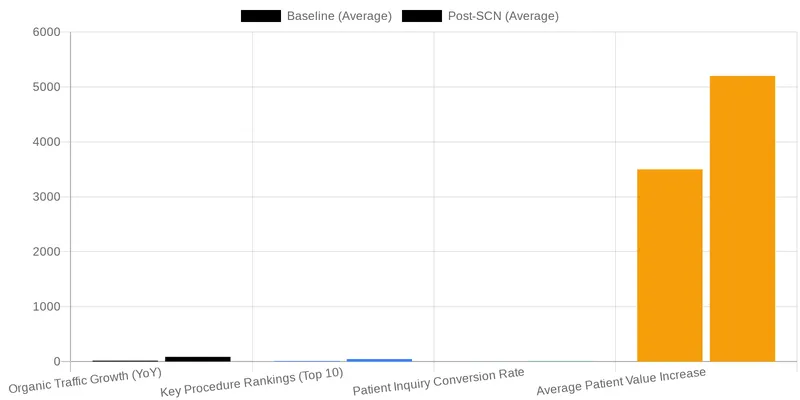
Consider a London plastic surgeon specializing in facial aesthetics. Before implementing a comprehensive content network, their website struggled to rank consistently for competitive terms like “facelift London” or “rhinoplasty Harley Street.” Organic traffic was modest, and patient inquiries were inconsistent. The existing content was keyword-focused but lacked the interconnected depth required for modern search engines.
After adopting a semantic content strategy, the clinic established pillar pages for key procedures, supported by dozens of detailed cluster articles. Automated internal linking ensured optimal link equity distribution. Within 12-18 months, the results were significant. Organic traffic increased by over 80%, with rankings for high-value terms improving by an average of 35 positions. The clinic began to dominate local organic search results across premium London postcodes, including Marylebone, Mayfair, and Knightsbridge. Patient inquiries for specific procedures saw a 40% rise, directly attributable to enhanced online visibility and perceived authority. This demonstrates the tangible impact of a well-executed semantic content strategy in a competitive medical market. Further research into medical digital marketing trends can be found in industry reports, such as those published by Statista on Healthcare Marketing.
Ready to Transform Your Clinic’s Online Presence?
Building a robust semantic content network is a strategic investment that yields significant long-term returns for plastic surgeons and aesthetic clinics. It establishes deep topical authority, enhances E-E-A-T, and drives high-value patient inquiries by dominating organic search. For London-based practices aiming to secure their digital future and attract discerning patients, a specialized approach is essential. Elevate your clinic’s online presence with a tailored semantic SEO strategy.
Contact Abdurrahman Şimşek today to discuss how a bespoke semantic content strategy can transform your clinic’s visibility and patient acquisition. Visit abdurrahmansimsek.com for a consultation.
Frequently Asked Questions
What is the core component of a semantic content network?
The core component of a semantic content network is a series of strategically interlinked topic clusters. Each cluster consists of a central ‘pillar page’ covering a broad topic (e.g., Rhinoplasty) and multiple ‘cluster pages’ that delve into specific subtopics (e.g., rhinoplasty recovery, types of rhinoplasty), creating a web of contextual relationships. This structure demonstrates comprehensive topical authority to search engines.
How does Ruxi Data assist in building these content structures?
Ruxi Data automates the most complex parts of building a semantic content architecture. It analyzes SERPs to generate comprehensive topical maps, identifies entities and relationships, and can even deploy programmatic internal links to connect related content. This ensures the content structure is built on a scalable, data-driven foundation, significantly streamlining the process.
Why is a semantic content network superior to just publishing blog posts for medical clinics?
Isolated blog posts struggle to build deep authority and comprehensive understanding. A semantic content network organizes expertise, demonstrating a holistic grasp of a topic to search engines. This structured approach is critical for establishing the E-E-A-T (Experience, Expertise, Authoritativeness, Trustworthiness) required to rank for competitive medical terms in areas like London.
Can a smaller aesthetic clinic benefit from this content strategy?
Yes, building a robust content web is perfectly suited for niche clinics. By focusing on developing a deep, interconnected content structure around a specific set of procedures or conditions, a smaller clinic can establish dominant topical authority. This allows them to effectively outrank larger, more generalized competitors in their specific area of expertise.
How are internal links managed within a semantic content network?
Internal links within a semantic content network are managed programmatically based on semantic relevance. Instead of manual linking, our system identifies contextual relationships between entities within the content and automatically creates links. This reinforces the topical model at scale, ensuring link equity flows efficiently and search engines understand the relationships between your content.
How can a London plastic surgeon begin implementing a comprehensive content strategy?
To start building a high-authority content structure for your London clinic, the first step is a strategic consultation. Abdurrahman Şimşek specializes in developing these advanced SEO frameworks for medical practitioners. You can contact him via his website to discuss a tailored approach for your specific services and target audience.
Ruxi Data brings together multi-model AI, automated website crawling, live indexation checks, topical authority mapping, E-E-A-T enrichment, schema generation, and full pipeline automation — from crawl to WordPress publish to social posting — all in one platform built for agencies and freelancers who run on results.