
Topic Cluster Architecture Medical: Enhancing Patient Acquisition for Clinics
Topic cluster architecture medical SEO organizes website content around broad pillar pages and specific cluster content, establishing comprehensive topical authority for medical practices. This semantic approach moves beyond individual keywords, creating interconnected content hubs that guide potential patients through their journey. By leveraging robust internal linking and semantic relationships, clinics enhance user experience, improve search engine visibility, and drive patient acquisition by becoming definitive resources on medical topics. This strategy is crucial for dominating organic search and building E-E-A-T.
Abdurrahman Şimşek, a Semantic SEO Strategist with 10+ years of experience, specializes in building high-authority semantic content networks for medical clinics. His expertise in information architecture and E-E-A-T principles ensures medical content strategies are optimized for Google’s YMYL landscape.
To explore your options, contact us to schedule your consultation.
In the highly competitive digital landscape of private healthcare, standing out requires more than just good content; it demands strategic organization. This article explores how a robust topic cluster architecture medical SEO can transform your online presence, guiding potential patients from initial awareness to booking a consultation. This semantic approach builds topical authority, enhances user experience, and ultimately drives patient acquisition for your clinic. Understanding this framework is crucial for medical practices aiming to dominate organic search results in 2026 and beyond.
What is Topic Cluster Architecture in Medical SEO?
Topic cluster architecture in medical SEO organizes website content around a central, broad topic (the pillar page) and links it to multiple, more specific subtopics (cluster content). This structure establishes comprehensive topical authority, signaling to search engines that your site is a definitive resource on a subject. For medical practices, this means creating a clear, navigable knowledge hub for potential patients.
This content strategy moves beyond individual keyword optimization. Instead, it focuses on covering entire topics in depth. A pillar page acts as the central hub, offering a high-level overview of a medical condition or procedure. Supporting cluster content then delves into specific aspects, questions, or related conditions, all interconnected through a robust internal linking structure. This systematic organization improves both search engine understanding and user experience.
The Core Components: Pillar Pages & Cluster Content
In a medical context, a pillar page might cover a broad procedure like “Breast Augmentation” or a condition such as “Acne Treatment.” This page provides foundational information, answering common initial questions. It serves as the authoritative anchor for the entire topic. For more detailed insights into developing these foundational pages, explore pillar page SEO strategy.
Cluster content pages then expand on specific facets. For “Breast Augmentation,” cluster articles could include “Types of Breast Implants,” “Breast Augmentation Recovery Timeline,” or “Cost of Breast Augmentation in London.” Each cluster page offers in-depth information on its specific subtopic and links back to the main pillar page, reinforcing its central authority. This creates a semantic network that guides users and search engines through related information.
How Does Topic Cluster Architecture Drive Patient Acquisition for Medical Practices?
A well-implemented topic cluster architecture directly aligns with the patient journey, guiding individuals from initial symptom awareness to booking a consultation. Medical decisions are often complex and involve extensive research. This content structure addresses patient needs at every stage, building trust and positioning your practice as an authoritative resource. It systematically funnels users through informational content towards high-intent conversion points.
By providing comprehensive answers to a wide range of queries, medical practices can capture potential patients at various points in their decision-making process. This includes those just beginning to research symptoms, individuals comparing treatment options, and patients ready to choose a specialist. The interconnected nature of the content ensures a seamless user experience, reducing bounce rates and increasing engagement.
Mapping the Patient Journey with Semantic Content
The patient journey typically involves several stages: awareness, consideration, and decision. At the awareness stage, patients might search for broad symptoms or conditions. A pillar page on “Dermatology Conditions” or “Facial Rejuvenation” addresses these initial queries. As they move to consideration, they seek specific treatments or procedures. Cluster content like “Non-Surgical Facelift Options” or “Treatments for Rosacea” becomes relevant.
Finally, at the decision stage, patients look for details about clinics, specialists, and what to expect. Content on “Choosing a Plastic Surgeon in London” or “What to Expect During a Consultation” directly supports this. Each piece of content within the cluster is designed to answer specific questions, building confidence and moving the patient closer to conversion.
From Informational Queries to High-Intent Conversions
The strategic linking within a content hub facilitates a natural progression from informational searches to transactional actions. A patient researching “acne scar removal” might first land on a pillar page detailing various treatments. From there, they can navigate to cluster pages discussing specific procedures like “Laser Resurfacing for Acne Scars” or “Microneedling for Scar Reduction.”
These specific cluster pages can then include calls-to-action (CTAs) to book a consultation or learn more about a particular service. This systematic approach ensures that users are always presented with relevant next steps, guiding them efficiently through the conversion funnel. This is particularly effective for high-value medical procedures where patient education is paramount.
Building Your Medical Topic Cluster: A Step-by-Step Guide
Implementing a successful topic cluster strategy for a medical website requires careful planning and execution. The process begins with identifying core services and patient needs, followed by meticulous content creation and strategic internal linking. This structured approach ensures that your content effectively addresses patient queries and builds search engine authority.
Start by auditing existing content to identify potential pillar pages and gaps. Then, conduct thorough keyword research to understand the full spectrum of patient queries around your chosen topics. This includes long-tail keywords that represent specific patient questions and concerns. For further guidance on structuring these content networks, consider resources on building topic clusters.
Identifying High-Value Pillar Topics for Medical Procedures
Pillar topics should align directly with your medical practice’s core services and patient demand. For a plastic surgery clinic, high-value pillars might include “Rhinoplasty,” “Facelift,” or “Body Contouring.” For a dermatology clinic, “Eczema Management” or “Anti-Aging Treatments” could be strong pillars. These topics are broad enough to encompass numerous subtopics but specific enough to define a clear area of expertise.
Consider the volume of related search queries and the competitive landscape. Prioritize topics that offer significant patient acquisition potential and where your practice possesses genuine expertise. This ensures that your content efforts are focused on areas that will yield the greatest return in terms of organic visibility and patient engagement.
Strategic Internal Linking for Semantic Authority
Internal linking is the backbone of any effective topic cluster. Every cluster content page must link back to its central pillar page, typically using relevant, descriptive anchor text. The pillar page, in turn, links out to all its supporting cluster pages. This creates a clear, hierarchical structure that signals to search engines the semantic relationships between your content pieces.
Anchor text should be varied and contextually relevant, avoiding generic phrases like “click here.” For example, a cluster page on “Rhinoplasty Recovery” might link back to the “Rhinoplasty” pillar page with anchor text such as “learn more about rhinoplasty procedures.” This strengthens the pillar page’s authority and helps distribute link equity throughout the cluster. For advanced strategies, refer to an automated internal linking guide.
Beyond Basic Clusters: Leveraging Semantic Engineering for Medical E-E-A-T
For medical clinics, particularly in competitive markets like London and Harley Street, a basic topic cluster is merely the starting point. Advanced semantic engineering elevates this strategy, building unparalleled topical authority and E-E-A-T (Experience, Expertise, Authoritativeness, Trustworthiness). This involves moving beyond simple keyword matching to truly understanding and representing medical entities and their relationships within your content.
Abdurrahman Şimşek, with over a decade of experience as a Semantic SEO Strategist, specializes in integrating sophisticated semantic infrastructure for medical professionals. This approach ensures that content not only answers patient questions but also demonstrates profound medical understanding, crucial for Your Money Your Life (YMYL) topics. Google’s Search Quality Rater Guidelines emphasize E-E-A-T, making it a cornerstone of medical SEO success. For more on this advanced approach, see Semantic Content Network Design for Plastic Surgeons.
Integrating Ruxi Data for Enhanced Entity Understanding
Advanced semantic engineering, often leveraging tools like Ruxi Data, allows for the creation of rich Entity-Attribute-Value (EAV) models. This means structuring content and data in a way that clearly defines medical entities (e.g., “Botox,” “Dr. John Smith,” “Harley Street Clinic”) and their attributes (e.g., “Botox: active ingredient = botulinum toxin, use = wrinkle reduction”). This granular understanding helps search engines accurately interpret and rank complex medical information.
By integrating such data structures, a medical website can present a comprehensive and unambiguous knowledge graph to search engines. This goes beyond simple text, allowing Google to connect concepts, procedures, and specialists with greater precision. This level of semantic clarity is a significant differentiator in highly specialized medical fields.
Establishing Unrivaled E-E-A-T in YMYL Niches
In YMYL (Your Money Your Life) niches like healthcare, demonstrating E-E-A-T is paramount. Semantic engineering helps achieve this by explicitly linking content to verified medical professionals, their qualifications, and their experience. Strategies include robust author profiles with GMC registration details, structured data markup for medical organizations and practitioners, and citations of authoritative medical research.
Content should reflect genuine clinical experience and expertise, not just theoretical knowledge. This involves referencing peer-reviewed studies, adhering to medical best practices, and presenting information in a clear, unbiased manner. For instance, linking to official medical bodies like the General Medical Council (GMC) or reputable research institutions further reinforces trust and authority.
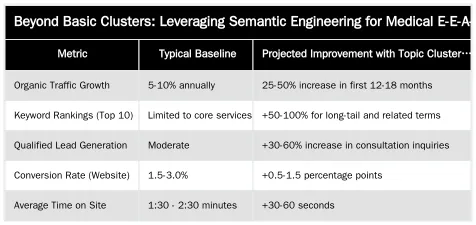
What Results Can Medical Practices Expect from a Robust Topic Cluster Strategy?
Implementing a robust topic cluster architecture medical strategy yields significant, measurable results for medical practices. These benefits extend beyond simple keyword rankings, encompassing improved organic visibility, increased qualified patient leads, and higher conversion rates. The structured nature of content hubs also contributes to long-term SEO resilience, making your website less susceptible to algorithm updates.
Practices can expect to see their website rank for a broader array of relevant keywords, including long-tail queries that indicate high patient intent. This leads to a more targeted influx of traffic, as visitors are actively seeking the specific services your clinic offers. Enhanced user experience, driven by clear navigation and comprehensive information, further supports these positive outcomes.
Measuring Success: Key Performance Indicators for Medical SEO
To assess the effectiveness of a topic cluster strategy, medical practices should monitor several key performance indicators (KPIs). These include organic traffic growth, particularly to pillar and high-intent cluster pages. Tracking keyword rankings for both broad pillar terms and specific cluster keywords provides insight into topical authority gains. Lead generation metrics, such as contact form submissions, phone calls, and online appointment bookings, are crucial for evaluating patient acquisition.
Conversion rates for consultations or specific procedures offer direct evidence of the strategy’s impact on business goals. Additionally, engagement metrics like time on page, bounce rate, and pages per session indicate improved user experience. Regularly analyzing these KPIs allows for continuous optimization and refinement of the content strategy.
Transform Your Medical Practice’s Online Presence with Semantic SEO
Achieving dominance in the competitive medical digital landscape requires more than just content; it demands a sophisticated, semantically driven approach. Implementing a robust topic cluster architecture, coupled with advanced semantic engineering, is the pathway to attracting high-value patients and establishing your practice as an undisputed authority.
If your medical clinic, skin clinic, or plastic surgery practice in London, Harley Street, or beyond is ready to elevate its online presence, a specialized SEO strategist can make a significant difference. Partner with an expert who understands the nuances of medical SEO and can build a high-converting semantic content network tailored to your unique goals. Discover how targeted strategies can drive patient acquisition and long-term organic growth for your practice.
Ready to build a high-authority semantic content network for your medical practice? Connect with Abdurrahman Şimşek to discuss a tailored strategy.
Conclusion
The strategic implementation of a topic cluster architecture is fundamental for medical SEO success in 2026. This approach moves beyond individual keyword targeting to build comprehensive topical authority, enhancing both search engine visibility and the patient experience. By organizing content around pillar pages and supporting cluster articles, medical practices can effectively guide potential patients through their journey, from initial research to booking a consultation.
Leveraging advanced semantic engineering, as championed by experts like Abdurrahman Şimşek, further amplifies these benefits, ensuring that medical content meets stringent E-E-A-T requirements. This holistic strategy not only improves organic rankings and drives qualified leads but also establishes a resilient and authoritative online presence. For medical professionals aiming to thrive in competitive markets, embracing this semantic content framework is no longer optional, but essential.
Frequently Asked Questions
How does a topic cluster architecture medical drive patient acquisition for clinics?
A topic cluster architecture medical approach strategically guides potential patients from broad, informational queries, addressed by a pillar page, to specific, high-intent procedure pages within the cluster. This systematic progression moves them through the awareness, consideration, and decision stages of their patient journey, ultimately leading to bookings. It establishes your clinic as a comprehensive authority, building trust and relevance with search engines and users alike.
What is the ideal structure for a medical pillar page in a topic cluster architecture medical strategy?
A medical pillar page should serve as a definitive, comprehensive guide on a broad topic, such as “Breast Augmentation.” It must be meticulously structured with a clear table of contents, offering an overview of all major subtopics. This central page then links out to more detailed cluster pages, covering specific aspects like ‘recovery protocols,’ ‘cost breakdowns,’ and ‘implant types,’ ensuring a seamless user experience.
How many internal links should a cluster page have within a topic cluster architecture medical framework?
Each cluster page must include at least one contextual link back to its main pillar page, reinforcing the topical connection. Furthermore, it should link to other highly relevant cluster pages within the same content hub, creating a robust, semantically interconnected network. This internal linking strategy strengthens the overall authority of the cluster and improves navigation for users and search engines.
Can an existing medical website be restructured using a topic cluster architecture medical approach?
Absolutely. Restructuring an existing medical website into a topic cluster architecture medical involves a thorough content audit to identify potential pillar pages and group existing related articles into cluster pages. Subsequently, new content is created to address any identified topical gaps, ensuring comprehensive coverage. A meticulous 301 redirect strategy is crucial to preserve SEO value during this transition.
Is implementing a topic cluster architecture medical a one-time setup for medical SEO?
No, a topic cluster architecture medical is a dynamic and evolving approach, not a one-time setup. As new patient questions arise, treatment innovations emerge, or search trends shift, new cluster pages should be continuously added and existing content updated. This ongoing maintenance is vital to sustain and deepen your clinic’s topical authority and relevance over time.
How can Abdurrahman Şimşek help implement a robust topic cluster architecture medical strategy for my practice?
Ab
Ruxi Data brings together multi-model AI, automated website crawling, live indexation checks, topical authority mapping, E-E-A-T enrichment, schema generation, and full pipeline automation — from crawl to WordPress publish to social posting — all in one platform built for agencies and freelancers who run on results.