
Plastic Surgery Topical Authority: Building Expertise for Aesthetic SEO Success
Plastic surgery topical authority is essential for aesthetic practices seeking dominant online visibility. This article outlines a strategic blueprint for surgeons to establish comprehensive expertise, moving beyond individual keywords to demonstrate holistic understanding across aesthetic medicine. Readers will learn how semantic SEO, content clusters, and E-E-A-T principles build trust and drive higher rankings in competitive YMYL niches. Achieving plastic surgery topical authority signals to search engines that a site is a definitive, reliable resource, attracting high-value patients through organic search.
Abdurrahman Şimşek, a Semantic SEO Strategist, guides practices in developing robust content architecture. This methodology optimizes for semantic understanding, building a cohesive knowledge base that demonstrates deep expertise to search engines and aligns with E-E-A-T guidelines for medical SEO success.
To explore your options, contact us to schedule your consultation. You can also reach us via: Book a Semantic SEO Audit, Direct WhatsApp Strategy Line: +90 506 206 86 86
Building a dominant online presence for plastic surgery practices requires more than just keywords; it demands plastic surgery topical authority. This article will define what topical authority means in the context of aesthetic medicine, explain why it’s crucial for ranking in competitive YMYL niches, and outline a strategic blueprint for surgeons to establish unparalleled expertise online. Understanding this framework is essential for any practice aiming to attract high-value patients through organic search in 2026 and beyond.
Implementing a Content Network: Practical Steps for Clinics
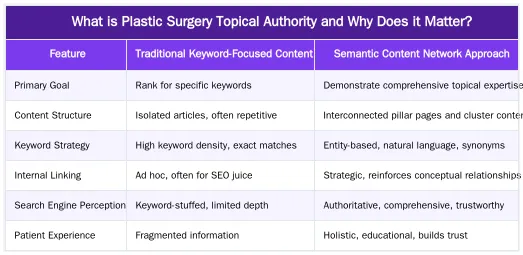
Building a robust content network for a plastic surgery practice involves strategic planning and execution. It begins with identifying core cosmetic procedure content areas and then expanding into supporting articles that address specific patient education needs. This approach ensures that every query a potential patient might have is answered comprehensively on your site. Effective internal linking is crucial, connecting pillar pages (broad guides) to cluster content (detailed sub-topics) to reinforce topical relevance. This structured information architecture benefits both patient understanding and search engine indexing.
Structuring Content for Comprehensive Coverage
For a cosmetic procedure, a pillar page might be “The Complete Guide to Breast Augmentation.” This page would cover the procedure broadly. Supporting articles, or cluster content, would then delve into specific aspects like “Saline vs. Silicone Implants: A Detailed Comparison,” “Understanding Breast Augmentation Recovery Timelines,” or “Choosing the Right Implant Size for Your Body Type.” Each supporting article links back to the pillar page, and the pillar page links to all supporting articles, forming a cohesive content cluster for surgeons. This systematic approach ensures thorough coverage and strengthens the site’s overall authority. Learn more about building topic clusters effectively.
Leveraging Ruxi Data & EAV for Unmatched Expertise
Establishing deep topical authority for medical sites, especially in the competitive London private healthcare market, requires advanced methodologies. Abdurrahman Şimşek specializes in Entity-Attribute-Value (EAV) modeling for surgical procedures. EAV structures data by defining entities (e.g., “Rhinoplasty”), their attributes (e.g., “anesthesia type,” “duration,” “cost range”), and the specific values for those attributes. This provides granular, structured data that search engines can easily process, significantly reducing their Cost of Retrieval (CoR) and enhancing understanding of your site’s expertise. This level of detail is crucial for establishing strong E-E-A-T for surgeons and for optimizing for Generative Engine Optimization (GEO), where AI models synthesize information from authoritative sources.
Ruxi Data, a semantic engine, plays a pivotal role in this process. It automates the creation of detailed topical maps and content briefs, ensuring comprehensive coverage and identifying semantic gaps. This automation accelerates the authority-building process, allowing clinics to scale their content efforts without compromising on quality or accuracy. By integrating EAV with Ruxi Data, clinics can present their medical knowledge in a format that is highly digestible for search engines, leading to superior rankings and visibility.
Automating Topical Maps and Content Briefs with Ruxi Data
Ruxi Data analyzes search engine results pages (SERPs) to identify the entities, attributes, and relationships that define a topic. It then generates automated content briefs that outline precisely what information needs to be covered to achieve comprehensive topical authority. This includes suggested headings, subheadings, key entities to mention, and even internal linking opportunities. This data-driven approach ensures that every piece of content contributes to the overall semantic network, effectively addressing query networks and strengthening the site’s content architecture. The automation capability of Ruxi Data allows for scaling content production efficiently, ensuring that medical writers receive clear, actionable guidance to create high-quality, E-E-A-T-compliant content. Discover more about this process in our topic cluster strategy workflow.
Achieving Tangible Growth: What Results Can Surgeons Expect?
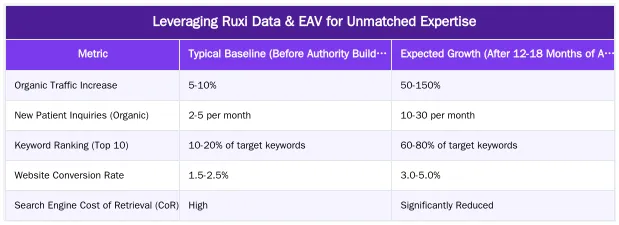
Investing in strong plastic surgery topical authority yields measurable benefits for aesthetic clinics. Improved organic rankings are a direct outcome, as search engines favor sites that demonstrate comprehensive expertise. This leads to a significant increase in qualified patient leads, as your content appears for a broader range of relevant and high-intent queries. Enhanced brand trust is another critical result; patients are more likely to choose a surgeon or clinic perceived as a definitive authority in their field. Furthermore, a robust semantic content network provides resilience against algorithm updates, future-proofing your digital presence.
Measuring the ROI of Topical Authority
Tracking the return on investment for building topical authority extends beyond simple ranking reports. Key performance indicators (KPIs) should include the volume of patient inquiries, consultation bookings directly attributed to organic search, and ultimately, the revenue generated from these organic leads. Tools like Google Analytics and CRM integrations can provide data on patient acquisition costs and lifetime value. By focusing on these tangible business outcomes, clinics can clearly see the value of building trust online and establishing themselves as the go-to resource for aesthetic procedures. For further insights into medical marketing analytics, consider resources like Medical Marketing & Management.
Partner with a Specialist for Dominant Online Presence
For plastic surgeons and aesthetic clinics in the competitive London private healthcare market, achieving a dominant online presence requires specialized expertise. Abdurrahman Şimşek, a London-based Semantic SEO Strategist with over 10 years of experience, specializes in building high-authority Semantic Content Networks for medical clinics. By leveraging advanced semantic SEO, EAV modeling, and the Ruxi Data automation engine, practices can significantly enhance their digital footprint, attract high-value patients, and secure top rankings across Harley Street and premium London postcodes. This approach ensures your clinic stands out in a crowded digital landscape.
Ready to transform your online presence? Book a Semantic SEO Audit or connect directly via WhatsApp Strategy Line: +90 506 206 86 86.
Conclusion
Establishing robust topical authority is no longer an option but a necessity for plastic surgery practices aiming for sustained online growth. By moving beyond traditional keyword strategies to embrace semantic SEO, content networks, and advanced methodologies like EAV modeling and Ruxi Data, clinics can demonstrate unparalleled expertise to both patients and search engines. This strategic approach ensures higher organic rankings, increased patient trust, and a resilient digital presence in the competitive medical landscape. Partnering with a specialist who understands the nuances of the London private healthcare market is crucial for implementing this blueprint effectively. Take the next step in securing your clinic’s digital future. Contact us today to discuss a tailored semantic SEO strategy. You can also Book a Semantic SEO Audit or reach out directly via WhatsApp Strategy Line: +90 506 206 86 86.
Frequently Asked Questions
What is the core principle of building plastic surgery topical authority?
The core principle is to comprehensively cover every aspect of your specialized procedures, from initial patient questions to post-operative care. This is achieved by creating a structured network of content, not just isolated blog posts, that demonstrates unparalleled expertise and establishes strong plastic surgery topical authority.
How many supporting articles are typically needed for one ‘pillar’ procedure page to build plastic surgery topical authority?
The number varies depending on the procedure’s complexity, but a major pillar page like ‘tummy tuck’ usually requires 15-25 detailed articles. These articles cover subtopics such as candidates, recovery, costs, risks, and types of incisions, all contributing to robust plastic surgery topical authority.
How does building plastic surgery topical authority help attract high-value patients?
High-value patients conduct extensive research before choosing a surgeon. By providing a deep, authoritative resource that answers all their questions, your practice builds immense trust and credibility. This strong plastic surgery topical authority positions your clinic as the premier choice even before a consultation.
Can Ruxi Data generate a complete content blueprint for plastic surgery topical authority?
Yes, Ruxi Data is specifically designed to generate this comprehensive blueprint for achieving plastic surgery topical authority. It analyzes a core procedure, identifies the entire query network, and structures this into a topical map of pillar pages and supporting articles, providing a complete roadmap for content creation.
How do you balance promotional content with educational content when establishing topical authority in plastic surgery?
The blueprint follows an 80/20 rule: 80% of the content is purely educational and patient-centric to build trust and expertise. The remaining 20%, primarily on main service pages, focuses on conversion with clear calls-to-action for consultations, ensuring a balanced approach to topical authority.
How can I get started with Abdurrahman Şimşek to build my clinic’s online authority?
You can begin by booking a Semantic SEO Audit through Abdurrahman Şimşek’s website to assess your current online presence and develop a tailored strategy. For direct strategic guidance, you can also reach out via WhatsApp at +90 506 206 86 86.
Ruxi Data brings together multi-model AI, automated website crawling, live indexation checks, topical authority mapping, E-E-A-T enrichment, schema generation, and full pipeline automation — from crawl to WordPress publish to social posting — all in one platform built for agencies and freelancers who run on results.