
Image Optimization Medical: Enhancing Speed & Patient Trust
Effective image optimization medical websites is crucial for private healthcare providers to enhance site speed, meet accessibility standards, and improve search engine visibility. This guide details strategies for balancing high-quality visuals, such as before-and-after photos and facility tours, with technical performance. Readers will learn about mastering image compression, adopting next-gen formats like WebP and AVIF, crafting effective alt text for medical images, and optimizing galleries for Core Web Vitals. Implementing these practices builds patient trust and strengthens a clinic’s online presence, directly impacting patient acquisition and retention.
Abdurrahman Şimşek, a Semantic SEO Strategist specializing in medical clinics, provides expert guidance on technical web development and holistic SEO. His 10+ years of experience in semantic engineering ensures that image optimization strategies align with broader topical authority and information retrieval goals for healthcare providers.
To explore your options, contact us to schedule your consultation.
Effective image optimization medical websites is a fundamental requirement for private healthcare providers aiming to build patient trust, enhance user experience, and secure strong search engine visibility. This guide explores how to balance high-quality visuals with performance, ensuring your clinic’s imagery speeds up your site, meets crucial accessibility standards, and strengthens your overall online presence. Understanding these principles is key to attracting and retaining patients in a competitive digital landscape.
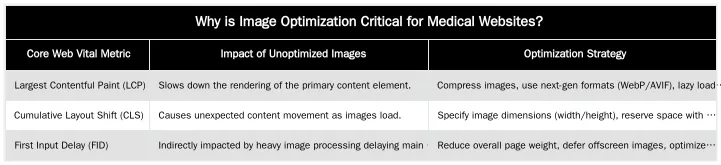
Why is Image Optimization Critical for Medical Websites?
Image optimization involves reducing image file sizes without compromising visual quality, ensuring faster website loading times. For medical websites, this is crucial because high-resolution images of procedures, facilities, and before-and-after results are essential for building patient trust and conveying expertise. Unoptimized images, however, can significantly slow down a site, leading to poor user experience, higher bounce rates, and negative impacts on search engine rankings. Balancing visual fidelity with technical performance directly influences how prospective patients perceive a clinic’s professionalism and reliability.
Balancing Visual Quality with Performance for Patient Trust
High-quality visuals are indispensable for medical practices. Patients often rely on images to visualize treatment outcomes, understand complex procedures, or get a sense of a clinic’s environment. Before-and-after photos, for instance, are powerful tools for demonstrating a surgeon’s skill. Facility tours offer transparency and comfort. Yet, these visually rich assets can be large, consuming significant bandwidth and slowing page load speeds. A slow-loading website can erode patient trust, suggesting a lack of attention to detail or outdated technology. Optimizing these images ensures they load quickly, maintaining a seamless and trustworthy user experience while contributing positively to search engine optimization (SEO).
Mastering Image Compression & Next-Gen Formats for Speed
Effective image compression and the adoption of modern image formats are technical pillars of a fast medical website. These strategies directly address the “Cost of Retrieval” for image assets, minimizing the data transfer required for each page load. By implementing the right techniques, medical professionals or their web development teams can significantly improve site speed without sacrificing the clarity needed for clinical imagery.
Choosing the Right Compression for Clinical Imagery
Image compression techniques fall into two main categories: lossless and lossy. Lossless compression reduces file size without discarding any image data, making it suitable for diagnostic images or intricate diagrams where every detail is critical. Lossy compression, conversely, removes some image data, resulting in smaller files but potentially a slight reduction in quality. For most website imagery, such as facility photos or general procedure illustrations, a carefully applied lossy compression can achieve substantial file size reductions with imperceptible quality loss. Tools like ImageOptim, TinyPNG, or online compressors can help achieve optimal balance. The key is to test and ensure that medical accuracy and detail remain intact, especially for images directly related to patient care or outcomes. This careful approach is vital for optimizing for Core Web Vitals on medical sites.
Adopting WebP and AVIF: The Future of Medical Image Delivery
Traditional image formats like JPEG and PNG are widely supported but often less efficient than newer alternatives. Next-gen image formats such as WebP and AVIF offer superior compression capabilities, often reducing file sizes by 25-50% compared to JPEGs, while maintaining comparable or even better visual quality. WebP, developed by Google, is broadly supported across modern browsers. AVIF, a newer format, offers even greater compression but has slightly less universal browser support in 2026. Implementing these formats typically involves converting existing images and using HTML’s <picture> element to serve the most efficient format supported by the user’s browser, falling back to JPEG or PNG if necessary. This strategy ensures that medical images load faster for the majority of users, contributing to a snappier website experience.
Crafting SEO-Friendly Alt Text & Captions for Medical Images
Beyond technical optimization, the textual context surrounding medical images plays a significant role in both accessibility and search engine optimization. Thoughtful application of alt text and captions helps search engines understand the image content and provides valuable information to users, reinforcing the expertise, experience, authoritativeness, and trustworthiness (E-E-A-T) of the medical practice.
Alt Text for Accessibility, SEO, and E-E-A-T
Alt text (alternative text) serves two primary purposes: it describes an image for visually impaired users relying on screen readers, and it provides context to search engines that cannot “see” images. For medical images, descriptive alt text is paramount. It should accurately convey the image’s content and purpose, incorporating relevant keywords naturally. For example, instead of “patient photo,” use “Rhinoplasty before and after results by Dr. [Surgeon Name] at [Clinic Name] in London.” This not only aids accessibility but also helps search engines categorize the image for relevant searches and reinforces the surgeon’s E-E-A-T. Effective image SEO for medical images relies heavily on this practice.
Image Captions: Enhancing Context and User Engagement
Image captions appear directly below an image and provide additional context visible to all users. They offer an opportunity to elaborate on the image’s content, explain its relevance, and integrate further keywords. For medical websites, captions can clarify complex diagrams, provide details about a procedure shown, or offer patient testimonials related to before-and-after photos. When using patient imagery, captions are also a critical place to include disclaimers about individual results varying and to confirm that appropriate patient consent has been obtained, adhering to privacy regulations.
Optimizing Medical Image Galleries for Core Web Vitals
Medical websites, particularly those featuring extensive procedure galleries or before-and-after sections, are often image-heavy. Abdurrahman Şimşek’s expertise in Core Web Vitals for medical sites highlights how unoptimized imagery can severely impact key performance metrics. Addressing these issues is crucial for maintaining a positive user experience and strong search rankings, especially for high-value pages showcasing surgical results or clinic facilities.
Lazy Loading vs. Eager Loading: A Strategic Approach
Lazy loading defers the loading of images until they are needed, typically when a user scrolls them into the viewport. This technique is highly effective for image-heavy medical galleries, where only a few images are visible upon initial page load. By lazy loading images below the fold, the browser prioritizes critical content, significantly improving initial page load times. Conversely, “eager loading” is appropriate for images that are immediately visible (above the fold), such as a hero image on a service page. Strategically applying lazy loading to non-critical images and eager loading to essential visuals helps optimize page speed and resource allocation, directly impacting Core Web Vitals for Surgeons.
Impact on Largest Contentful Paint (LCP) and Cumulative Layout Shift (CLS)
Unoptimized images are major contributors to poor Largest Contentful Paint (LCP) and Cumulative Layout Shift (CLS) scores. LCP measures the time it takes for the largest content element on the page to become visible. If this element is a large, unoptimized image, LCP will be high. CLS measures unexpected layout shifts during page loading. Images without specified dimensions can cause content to jump as they load, leading to a poor CLS score. Solutions include specifying explicit width and height attributes for all images, using responsive image techniques (srcset and sizes) to serve appropriately sized images, and preloading critical above-the-fold images. These technical adjustments ensure a stable and fast visual experience for patients.
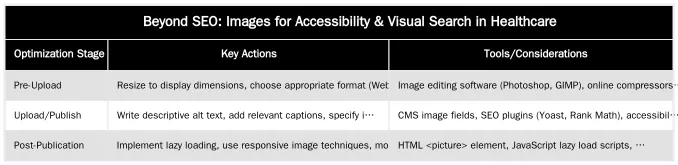
Beyond SEO: Images for Accessibility & Visual Search in Healthcare
While SEO and speed are critical, the role of images extends to broader considerations of user inclusivity and future search trends. Ensuring medical images are accessible to all users and optimized for emerging visual search technologies provides a significant advantage for private healthcare providers.
Ensuring Inclusive Access: ADA & WCAG Compliance for Medical Images
Accessibility is a legal and ethical imperative. The Americans with Disabilities Act (ADA) and Web Content Accessibility Guidelines (WCAG) mandate that websites be usable by individuals with disabilities. For medical images, this means going beyond just alt text. Considerations include ensuring sufficient contrast ratios for any text overlaid on images, avoiding flashing or rapidly moving images that could trigger seizures, and providing transcripts or descriptions for complex visual information like infographics or diagrams. Adhering to these guidelines ensures that vital medical information and visual demonstrations are available to the widest possible audience, fostering trust and compliance. WCAG 2.1 guidelines provide comprehensive details on these requirements.
Preparing for the Visual Search Revolution in Medicine
Visual search, powered by tools like Google Lens, is transforming how users find information. Patients may use their smartphone cameras to identify symptoms, compare treatment results, or even locate nearby clinics by pointing at a building. For medical websites, optimizing for visual search involves high-quality, clear imagery, accurate alt text, and structured data that provides context about the image content. For instance, using ImageObject schema markup can help search engines understand the subject, creator, and usage rights of a medical image. Clear, well-labeled before-and-after photos, images of specific medical devices, or detailed anatomical diagrams can become discoverable assets in this evolving search landscape. This proactive approach ensures your clinic remains visible as search habits shift. Google’s image best practices offer further guidance.
Implementing a Robust Image Optimization Strategy: Your Next Steps
Developing a comprehensive image optimization strategy requires a systematic approach, from initial assessment to ongoing maintenance. Medical clinics can integrate these practices into their regular content workflows to ensure long-term benefits in speed, accessibility, and search engine performance.
Auditing Your Current Medical Website Imagery
The first step is to conduct a thorough audit of your existing website imagery. This involves identifying all images, checking their file sizes, formats, and whether they have descriptive alt text. Tools like Google PageSpeed Insights, Lighthouse, or dedicated image optimization plugins can help identify unoptimized images and highlight opportunities for improvement. Focus on high-traffic pages, image-heavy galleries, and any pages that are underperforming in Core Web Vitals reports. This audit provides a baseline and prioritizes the most impactful changes.
Integrating Image Optimization into Your Content Workflow
For sustainable results, image optimization must become an integral part of your content creation and publication process. This means establishing clear guidelines for image dimensions, file formats, compression levels, and alt text requirements before images are even uploaded. Training content creators and web administrators on these best practices ensures consistency. Regular monitoring of site performance metrics, particularly after adding new imagery, helps identify and address any new optimization needs. This proactive approach ensures that every new image added to your medical website contributes positively to its overall performance and patient experience.
Elevate Your Clinic’s Online Presence with Expert Image SEO
Optimizing images for medical websites is a nuanced process that requires technical skill and an understanding of healthcare-specific needs. From ensuring patient privacy in before-and-after galleries to leveraging advanced formats for speed, every detail matters. If your London-based clinic or practice seeks to enhance its digital footprint, improve patient acquisition, and achieve top search rankings, expert guidance is invaluable. Partnering with a specialist in semantic SEO and web development can transform your online presence. Discover how a tailored strategy can help your clinic dominate local organic search and attract high-value patients. Visit abdurrahmansimsek.com to learn more.
Conclusion
The strategic implementation of image optimization for medical websites is a multifaceted endeavor that significantly impacts site speed, accessibility, and search engine visibility. By prioritizing efficient compression, adopting next-gen formats, crafting descriptive alt text, and optimizing for Core Web Vitals, medical practices can ensure their visual content enhances patient trust and engagement. Beyond technical aspects, considering accessibility and preparing for visual search trends positions clinics for future success. A holistic approach to image optimization is not merely a technical task; it is a critical component of a robust digital strategy, ensuring your clinic’s online presence is both high-performing and patient-centric.
Frequently Asked Questions
What is the most important aspect of image optimization medical websites should focus on?
The primary focus for image optimization medical sites is balancing high-quality visuals with efficient file sizes. Patients require clear, detailed images of procedures and facilities to build trust, but these must be compressed and delivered in modern formats like WebP to ensure rapid page loading and excellent Core Web Vitals scores. This balance is crucial for user experience and SEO.
How should alt text be written for clinical ‘before and after’ images, especially for image optimization medical purposes?
Alt text for clinical images should be descriptive and factual, avoiding promotional language. For example, “Before and after photos of a rhinoplasty procedure on a female patient, showing a refined nasal bridge and tip.” This approach aids accessibility for visually impaired users and helps search engines accurately understand the image content, contributing to effective image optimization strategies for medical sites.
Does effective image optimization medical websites implement truly impact Google rankings?
Absolutely. Image optimization medical sites directly influences Google rankings by improving page speed, a known ranking factor. Furthermore, well-optimized images with descriptive file names and alt text can rank in Google Image Search, driving highly relevant organic traffic to your clinic’s website. This dual impact makes it a vital SEO component.
What is lazy loading, and is it beneficial for a medical clinic’s website?
Lazy loading is a technique where images located further down a webpage only load as a user scrolls into their view. Yes, it is highly beneficial for medical websites, especially those with extensive image galleries or long content pages, as it significantly improves initial page load speed and overall user experience. This helps meet Core Web Vitals.
How can Abdurrahman Şimşek’s expertise assist my clinic with advanced image optimization medical strategies?
Our approach to image optimization medical websites is comprehensive, integrating automated compression, conversion to next-gen formats like WebP, and intelligent lazy loading. We ensure your imagery enhances site speed, accessibility, and SEO without requiring manual effort from your staff. This holistic strategy is part of our broader semantic SEO services for medical clinics.
Ruxi Data brings together multi-model AI, automated website crawling, live indexation checks, topical authority mapping, E-E-A-T enrichment, schema generation, and full pipeline automation — from crawl to WordPress publish to social posting — all in one platform built for agencies and freelancers who run on results.