
Mobile Page Speed Local SEO: Boost ‘near Me’ Search Visibility
Mobile page speed local seo is crucial for clinics aiming to dominate ‘near me’ searches and attract high-value patients. Google prioritizes fast-loading mobile websites, directly impacting local pack visibility and organic rankings. This article details how optimizing Core Web Vitals, such as LCP and INP, enhances user experience and signals website quality to Google. Understanding these local search ranking factors is essential for improving patient acquisition and ensuring your Google Business Profile stands out in competitive markets like Harley Street.
Abdurrahman Şimşek, a Semantic SEO Strategist, emphasizes that integrating mobile page speed optimization with broader semantic SEO strategies is vital for establishing digital authority and improving E-E-A-T signals for medical entities. This approach ensures comprehensive online visibility.
To explore your options, contact us to schedule your consultation. You can also reach us via: Book a Semantic SEO Audit, Direct WhatsApp Strategy Line: +90 506 206 86 86
Your clinic’s mobile website speed determines its visibility in local ‘near me’ searches. For London’s private healthcare sector, mobile page speed local seo is critical to attracting high-value patients. Understanding mobile-first indexing strategies is foundational, as Google prioritizes mobile experiences for ranking.
What is Mobile Page Speed’s Role in Local ‘Near Me’ SEO?
Mobile page speed is a direct ranking factor for local ‘near me’ searches. Google favors fast-loading mobile websites, so a slow site can cause your clinic to be outranked by competitors, even if you’re physically closer. This impacts your visibility in the local pack and organic results, making speed a critical local search ranking factor.
Understanding ‘Near Me’ Search Intent for Patients
Patients making ‘near me’ searches often have urgent needs or are ready to decide. They expect immediate access to information like clinic hours, contact details, and treatments. Google’s algorithms prioritize websites that deliver this information quickly on mobile devices, recognizing the query’s immediacy. A slow loading site creates friction and hinders the patient’s journey.
The Direct Connection to Local Pack Rankings
The local pack, the list of businesses at the top of search results, is influenced by website performance. Google’s algorithm uses signals like site speed to determine which businesses offer the best mobile experience. Clinics with optimized mobile loading times are more likely to appear in the local pack, driving local traffic and enquiries.
How Core Web Vitals Shape Your Local Search Visibility
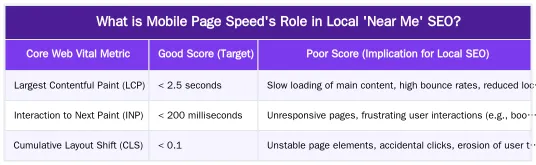
Core Web Vitals are metrics Google uses to quantify webpage user experience. These metrics—Largest Contentful Paint (LCP), Interaction to Next Paint (INP), and Cumulative Layout Shift (CLS)—directly influence local SEO performance. For medical clinics, good Core Web Vitals scores signal a high-quality website, which Google rewards with improved visibility in local search results.
Largest Contentful Paint (LCP) and First Input Delay (INP) for Patient Journeys
LCP measures the loading performance of the largest content element in the viewport, such as a surgeon’s bio or a procedure image. A slow LCP makes patients wait for vital information, causing frustration. INP, which replaced First Input Delay (FID) in March 2024, measures page responsiveness to user interactions. Delays when clicking a booking button or menu negatively impact the patient journey and perception of your clinic’s professionalism.
Cumulative Layout Shift (CLS) and User Trust
CLS quantifies unexpected layout shifts. For example, a patient tries to click a ‘Book Consultation’ button, but a late-loading image shifts the button, causing an accidental click. This experience is frustrating and erodes trust. For medical websites, where stability is paramount, a high CLS score signals a lack of professionalism, negatively impacting user experience and Google’s quality assessment.
Practical Strategies to Boost Mobile Speed for Local Clinics
Improving mobile website speed requires technical optimizations that directly impact loading times. For medical clinics, these strategies are crucial for the patient experience, from search to consultation. A mobile-first approach in development and content is fundamental to optimal performance.
Optimizing High-Resolution Medical Imagery and Galleries
Medical clinics use high-quality imagery like ‘before and after’ photos or procedure diagrams, which can be large and slow page loading. Strategies include compressing images (using formats like WebP), implementing lazy loading so images load only when they enter the viewport, and serving responsive images that adapt to screen size. For guidance, refer to Google’s image optimization guidelines.
Reducing Server Response Time (TTFB) and Leveraging CDNs
Time to First Byte (TTFB) measures the time for a browser to receive the first byte of content from the server. A high TTFB indicates a slow server or inefficient backend. Optimizing server performance, using efficient hosting, and streamlining database queries reduces TTFB. Content Delivery Networks (CDNs) distribute static assets (images, CSS, JavaScript) across global servers. When a patient in London accesses your site, the CDN serves content from the nearest server, reducing loading times and improving the experience for clinics targeting various London postcodes.
Beyond Rankings: Page Speed’s Impact on Patient Acquisition
The benefits of optimizing mobile page speed extend beyond rankings. A faster mobile site enhances user experience, leading to lower bounce rates, increased engagement, and higher conversion rates for medical clinics. This translates into more patient enquiries and bookings, impacting your clinic’s growth.
Lowering Bounce Rates and Enhancing User Engagement
Slow loading times deter mobile users. If a patient clicks your clinic’s listing from a ‘near me’ search and the page loads slowly, they will likely “bounce” to a competitor. A fast site keeps users engaged. They are more likely to explore services, read surgeon profiles, and view testimonials, building confidence in your practice.
Improving Conversion Rates for Consultations and Enquiries
A good mobile experience increases the likelihood a patient will complete an action, such as filling out a contact form, using click-to-call, or booking a consultation. When pages load quickly and interactions are smooth, the path to conversion is clear. This is a critical aspect of mastering local SEO in London, where patient acquisition is competitive. Every second saved in loading time can increase valuable patient enquiries.
Why Mobile Speed is Key to Semantic SEO & E-E-A-T for Surgeons
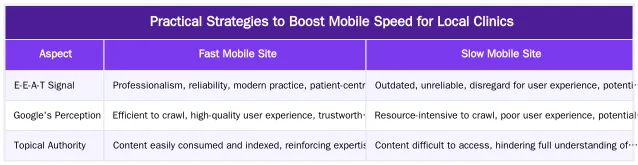
For medical practices in the YMYL (Your Money Your Life) category, demonstrating Expertise, Experience, Authoritativeness, and Trustworthiness (E-E-A-T) is paramount. A fast mobile site is a strong E-E-A-T signal. A technically sound, fast-loading website helps Google efficiently crawl, understand, and rank high-E-E-A-T medical content, reinforcing topical authority.
Reducing Google’s ‘Cost of Retrieval’ with Optimized Performance
Google’s algorithms evaluate crawling and indexing efficiency. A slow-loading site increases Google’s ‘Cost of Retrieval’—the resources (time, processing power) required to access and understand your content. By optimizing for mobile speed, you make it “cheaper” for Google to process your information. This efficiency can improve rankings, as Google prefers to serve content that is high-quality and accessible. Learn more about Reducing Cost of Retrieval: Technical SEO for Efficient Medical Website Performance.
Page Speed as an E-E-A-T Signal for Medical Practices
A fast-loading website signals expertise, authoritativeness, and trustworthiness to users and search engines. For YMYL content, such as medical advice or procedure details, Google prioritizes these signals. A slow site can convey a lack of attention to detail or an outdated practice, undermining your clinic’s perceived E-E-A-T. A performant site reinforces your credibility and commitment to patient experience. Google’s guidelines on E-E-A-T in Search Quality Rater Guidelines emphasize this.
Ready to Dominate Local Search? Optimize Your Clinic’s Mobile Speed
Mobile page speed local SEO is critical for your clinic’s visibility and patient acquisition. In London’s competitive private healthcare market, particularly for a comprehensive plastic surgery SEO blueprint, a fast mobile website is a requirement. Prioritizing Core Web Vitals and implementing optimizations ensures your practice is found by patients in ‘near me’ searches and provides the experience they expect.
Don’t let slow loading times hinder your clinic’s growth or diminish your Harley Street SEO efforts. Ensure your website is performing at its peak. Book a Semantic SEO Audit with Abdurrahman Şimşek to identify opportunities for improvement. You can also reach out directly via our Direct WhatsApp Strategy Line: +90 506 206 86 86.
Frequently Asked Questions
How does mobile page speed local seo directly influence my clinic’s rank in ‘near me’ searches?
It’s a direct and significant ranking factor. Google’s algorithm heavily favors fast-loading mobile websites, making strong mobile page speed local seo critical. A slow site can cause your clinic to be outranked by a competitor down the street, even if you’re physically closer, directly impacting your visibility and patient acquisition.
Can optimizing for mobile page speed local seo help my clinic get into the Google Local Pack?
Yes, absolutely. While proximity, relevance, and prominence are primary factors for the Local Pack, user experience signals like page speed are increasingly important. A faster, more usable site, achieved through effective mobile page speed local seo, can be the tie-breaker that pushes you into those top three map positions, attracting more local patients.
How does web hosting impact mobile page speed local seo for medical practices?
Your choice of web hosting significantly affects your site’s performance. A cheap, slow provider results in a high Time to First Byte (TTFB), meaning the server is slow to respond, which directly harms your mobile page speed local seo. Investing in premium, managed hosting is a foundational step for ensuring quick load times and strong local search performance.
Which Core Web Vital is most important for improving local search visibility?
Largest Contentful Paint (LCP) is arguably the most critical for local search. It measures how quickly the main content of a page loads, which is crucial for a potential patient on the go. A slow LCP creates a poor first impression and can lead them to immediately abandon your site for a competitor’s, impacting your local presence.
What are some quick wins for improving mobile website speed for a medical practice?
Two effective strategies include compressing and resizing all images to be no larger than necessary for mobile viewing. Additionally, implement a Content Delivery Network (CDN) to serve your website’s assets from servers closer to your patients, drastically reducing load times and enhancing user experience.
How can Abdurrahman Simsek help my clinic improve its mobile page speed local seo?
Abdurrahman Simsek, a Holistic SEO Strategist, specializes in optimizing technical SEO, including mobile page speed, for medical and plastic surgery clinics. He can conduct a comprehensive Semantic SEO Audit to identify specific bottlenecks and implement strategies to boost your local search visibility. You can book an audit or contact him directly via WhatsApp at +90 506 206 86 86.
Ruxi Data brings together multi-model AI, automated website crawling, live indexation checks, topical authority mapping, E-E-A-T enrichment, schema generation, and full pipeline automation — from crawl to WordPress publish to social posting — all in one platform built for agencies and freelancers who run on results.