
Medicalcondition Schema Guide: Elevating Medical Entity Recognition & E-e-a-t
This medicalcondition schema guide explains how to implement MedicalCondition, MedicalTherapy, and MedicalStudy schema markup using JSON-LD. Readers will learn to enhance Google’s understanding of their medical content, strengthen E-E-A-T signals, and secure prominent SERP features like Knowledge Graph panels. The guide details schema properties such as ‘associatedAnatomy’ and ‘possibleTreatment’ to optimize for precise medical entity recognition. Implementing this structured data is crucial for medical clinics aiming to improve search visibility and communicate their specialized expertise effectively to search engines and patients.
Abdurrahman Şimşek, a Semantic SEO Strategist with over 10 years of experience, specializes in building high-authority semantic content networks for medical clinics. His expertise in medical SEO and structured data ensures precise entity architecture and improved search performance.
To explore your options, contact us to schedule your consultation. You can also reach us via: Book a Semantic SEO Audit, Direct WhatsApp Strategy Line: +90 506 206 86 86
This medicalcondition schema guide explains using MedicalCondition, MedicalTherapy, and MedicalStudy schema markup with JSON-LD to improve Google’s understanding of your clinic’s expertise, strengthen E-E-A-T signals, and secure SERP features for your London medical practice. Implement this structured data to optimize for medical entity recognition and search visibility.
Understanding MedicalCondition Schema: The Foundation for Medical Entity Recognition
The MedicalCondition schema defines specific health issues and is foundational to medical entity recognition. Marking up conditions like “Gynecomastia” or “Sun Damage” provides search engines with explicit information about the ailments your clinic addresses. This helps Google accurately categorize your content and match it with relevant patient queries, improving search result precision.
This structured data ensures search engines understand the core medical entities on your pages. It helps medical clinics, especially those in plastic surgery or aesthetic medicine, communicate their scope of practice. Accurate entity recognition contributes to a website’s topical authority and relevance in medical search.
Key Properties of `MedicalCondition` Schema
Key properties in the schema define a medical condition with granular detail, allowing search engines to understand the entity.
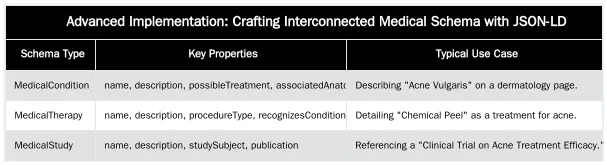
name: The official or common name of the medical condition (e.g., “Rhinoplasty”).alternateName: Other names or common terms for the condition (e.g., “Nose Job” for Rhinoplasty).description: A concise summary of the condition, its symptoms, or what it entails.possibleTreatment: Links to associated treatments or therapies, often using the MedicalTherapy schema.associatedAnatomy: Specifies the body part or anatomical structure related to the condition (e.g., “Nose” for Rhinoplasty). This property enhances precision and disambiguation for medical entities.
Populating these properties makes medical content semantically rich and interpretable by search engine algorithms. This structured approach is fundamental for medical websites seeking online visibility.
Connecting Treatments to Conditions: Implementing MedicalTherapy Schema
MedicalTherapy schema describes treatments, procedures, and interventions. It establishes a semantic link between a condition and its treatment. This connection helps search engines understand a clinic’s full scope of services, particularly for procedures in plastic surgery or dermatology.
Linking therapies to conditions creates a network of medical entities. This helps search engines present accurate information to users searching for health solutions. For instance, a page on “Breast Augmentation” can be marked up as a MedicalTherapy, linked to conditions like “Breast Hypoplasia” or “Breast Asymmetry,” providing context and demonstrating expertise.
Essential Properties for `MedicalTherapy`
MedicalTherapy schema uses specific properties to convey the nature and application of a treatment:
name: The name of the treatment or procedure (e.g., “Liposuction”).alternateName: Common or informal names (e.g., “Fat Removal Surgery”).description: A brief explanation of the therapy, its purpose, and how it’s performed.procedureType: Categorizes the type of procedure (e.g., “SurgicalProcedure,” “MedicalProcedure”).drug: If the therapy involves a specific medication, this property can link to a Drug schema.possibletreatment: This property, used within MedicalCondition, points to the MedicalTherapy entity, creating the crucial bidirectional link.
These properties allow detailed descriptions of medical interventions, making service pages more informative to patients and search engines. For London clinics, this precision helps attract patients searching for specific treatments.
Linking `MedicalTherapy` to `MedicalCondition` with JSON-LD
Linking a condition to its therapy is a cornerstone of semantic medical SEO. This is achieved by referencing the MedicalTherapy entity from within the MedicalCondition schema using the possibleTreatment property. A MedicalTherapy can also specify the conditions it treats.
Here is a simplified JSON-LD example demonstrating this linkage:
{
  "@context": "https://schema.org",
  "@graph": [
    {
      "@type": "MedicalCondition",
      "@id": "https://example.com/conditions/gynecomastia#condition",
      "name": "Gynecomastia",
      "description": "A condition causing enlarged male breasts.",
      "possibleTreatment": {
        "@type": "MedicalTherapy",
        "@id": "https://example.com/treatments/gynecomastia-surgery#therapy",
        "name": "Gynecomastia Surgery",
        "description": "Surgical removal of excess breast tissue in men.",
        "procedureType": "SurgicalProcedure"
      }
    },
    {
      "@type": "MedicalTherapy",
      "@id": "https://example.com/treatments/gynecomastia-surgery#therapy",
      "name": "Gynecomastia Surgery",
      "description": "Surgical removal of excess breast tissue in men.",
      "procedureType": "SurgicalProcedure",
      "recognizesCondition": {
        "@type": "MedicalCondition",
        "@id": "https://example.com/conditions/gynecomastia#condition"
      }
    }
  ]
}
This linking helps search engines understand the context of your medical services. For advanced implementations, consult an expert in implementing advanced medical schema to ensure accuracy and maximize impact.
Validating Expertise: Integrating MedicalStudy Schema for E-E-A-T
MedicalStudy schema establishes and reinforces E-E-A-T (Experience, Expertise, Authoritativeness, and Trustworthiness) signals for medical websites. In the YMYL (Your Money or Your Life) niche, credibility is paramount. Marking up clinical studies, research, and publications showcases a clinic’s scientific backing and practitioner expertise to search engines.
This data allows Google to connect your content with verifiable research, enhancing your practice’s perceived authority. For plastic surgeons and aesthetic clinics, referencing peer-reviewed articles or internal research validates treatment efficacy and practitioner knowledge, contributing to a stronger online reputation. This is a core component of an E-E-A-T for YMYL approach.
Core Elements of `MedicalStudy` Schema
Understanding the core properties of MedicalStudy schema is essential for its use:
name: The title of the study or research paper.description: A summary of the study’s objectives, methodology, and findings.studySubject: The medical condition, therapy, or population group being studied.outcomeMeasurement: The specific metrics or results measured during the study.sponsor: The organization or individual funding or overseeing the study.publication: Links to the published article or journal where the study appeared, often using the ScholarlyArticle or Periodical schema.
These properties provide a structured way to present scientific evidence, building trust with search engines and potential patients. Integrating this schema type signals a commitment to evidence-based practice.
Showcasing Research & Publications for E-E-A-T
Referencing peer-reviewed articles or internal studies using the publication property boosts E-E-A-T signals. Content backed by verifiable research demonstrates expertise and trustworthiness. For example, a plastic surgeon discussing a new technique can link to their published research on that technique, validating their authority.
This practice informs search engines and provides user transparency, reinforcing the clinic’s credibility. It aligns with Google’s emphasis on authoritative sources for medical information, making it a critical component of a semantic SEO for surgeons strategy. For details on schema properties, consult the official Schema.org documentation for MedicalStudy.
Advanced Implementation: Crafting Interconnected Medical Schema with JSON-LD
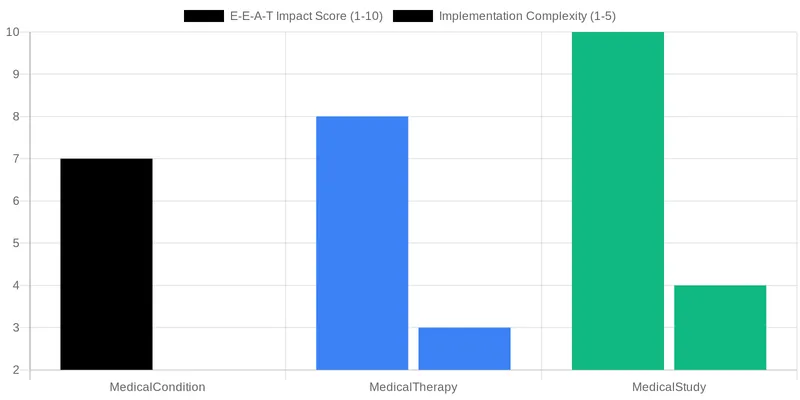
An effective semantic strategy links MedicalCondition, MedicalTherapy, and MedicalStudy schemas within a unified JSON-LD structure. This creates a semantic network that enhances medical entity recognition for search engines. This presents interconnected medical knowledge, mirroring relationships between conditions, treatments, and research, rather than isolated data points.
Leveraging these connections builds a digital representation of your clinic’s expertise. Defining these relationships gives search engines an unambiguous understanding of your services and their scientific basis. This reduces ambiguity and helps Google interpret complex medical content, which optimizes ‘Cost of Retrieval’.
A Unified JSON-LD Example for Condition, Therapy, and Study
The following JSON-LD code block interlinks all three schema types, creating an interconnected data model. This example shows how a condition, its treatment, and supporting research for an aesthetic procedure can be semantically linked.
{
  "@context": "https://schema.org",
  "@graph": [
    {
      "@type": "MedicalCondition",
      "@id": "https://example.com/conditions/sun-damage#condition",
      "name": "Sun Damage",
      "alternateName": "Photoaging",
      "description": "Skin damage caused by prolonged exposure to ultraviolet (UV) radiation, leading to wrinkles, age spots, and uneven texture.",
      "associatedAnatomy": {
        "@type": "AnatomicalStructure",
        "name": "Skin",
        "alternateName": "Integumentary System"
      },
      "possibleTreatment": [
        {
          "@type": "MedicalTherapy",
          "@id": "https://example.com/treatments/laser-resurfacing#therapy",
          "name": "Fractional Laser Resurfacing",
          "description": "A non-invasive procedure using laser technology to improve skin texture and tone by targeting sun-damaged cells.",
          "procedureType": "MedicalProcedure"
        }
      ]
    },
    {
      "@type": "MedicalTherapy",
      "@id": "https://example.com/treatments/laser-resurfacing#therapy",
      "name": "Fractional Laser Resurfacing",
      "alternateName": "Laser Skin Resurfacing",
      "description": "Fractional laser resurfacing uses microscopic laser columns to treat a fraction of the skin at a time, stimulating collagen production and improving sun damage.",
      "procedureType": "MedicalProcedure",
      "recognizesCondition": {
        "@type": "MedicalCondition",
        "@id": "https://example.com/conditions/sun-damage#condition"
      },
      "study": {
        "@type": "MedicalStudy",
        "@id": "https://example.com/research/laser-efficacy-study#study",
        "name": "Efficacy of Fractional Laser for Photoaging",
        "description": "A clinical study evaluating the effectiveness of fractional laser technology in treating signs of photoaging and sun damage.",
        "studySubject": {
          "@type": "MedicalCondition",
          "@id": "https://example.com/conditions/sun-damage#condition"
        },
        "outcomeMeasurement": "Improvement in skin texture, reduction in hyperpigmentation, patient satisfaction scores.",
        "sponsor": {
          "@type": "Organization",
          "name": "London Dermatology Institute"
        },
        "publication": {
          "@type": "ScholarlyArticle",
          "name": "Journal of Aesthetic Dermatology, Vol. 25, Issue 3",
          "url": "https://example.com/journal/laser-efficacy-study-publication"
        }
      }
    }
  ]
}
This example shows how one JSON-LD block can define multiple related entities, providing semantic context. Tools for AI-driven schema generation can assist in creating such complex structures.
Leveraging `associatedAnatomy` for Precision
The associatedAnatomy property within MedicalCondition schema specifies the body parts or anatomical structures related to a condition or procedure. For a plastic surgery clinic, this detail is valuable. For instance, marking “Rhinoplasty” with associatedAnatomy: "Nose" tells search engines the procedure relates to the nasal structure.
This precision helps disambiguate medical terms and matches your content with specific user queries. It contributes to an accurate understanding of your clinic’s specializations, which is critical for ranking in competitive markets like Harley Street. Defining anatomical relationships enhances the semantic clarity of your medical content.
The Strategic Impact: How Medical Schema Boosts SERP Features & Knowledge Graph
Medical schema offers search visibility benefits beyond basic rankings. Structured data increases the likelihood of content appearing in rich snippets and SERP features. This includes carousels for conditions, detailed descriptions in direct answers, and expanded knowledge panels for medical entities. For a London medical practice, this visibility can increase click-through rates and patient engagement.
Marked-up content feeds into Google’s Knowledge Graph, allowing your clinic to be recognized as an authoritative source for medical information. This medical entity recognition helps Google understand the relationships between your practitioners, treatments, and conditions, solidifying your clinic’s digital footprint. This aligns with the principles of advanced schema markup for entity representation.
Enhancing Rich Snippets and Knowledge Panels
Structured data gives Google explicit signals about page content. For medical queries, this can lead to rich snippets that display information directly in search results, such as recovery times for a procedure or success rates from a study. These results stand out and draw attention to your listings.
Structured medical data contributes to Knowledge Graph panels. These panels, often on the right side of search results, provide a concise summary of an entity. For a medical clinic, this could be a panel detailing a condition, linking to your content, and showcasing your practitioners. This direct exposure builds trust and authority with potential patients.
Reducing Google’s ‘Cost of Retrieval’ for Medical Entities
Abdurrahman Şimşek’s methodology optimizes Google’s ‘Cost of Retrieval’ (CoR). For medical content, this means making it easier for search engines to process, understand, and retrieve information. Structured data from interconnected medical schema contributes to this efficiency.
When medical entities are defined and linked, Google’s algorithms spend less computational effort inferring meaning from unstructured text. This can improve crawling, indexing, and ranking potential. Reducing CoR makes your medical website a more favorable source for Google, enhancing its visibility and authority in the healthcare sector. For more, see our page on Implementing Advanced Medical Schema for Entity Recognition.
Future-Proof Your Medical SEO: Partner with a Semantic Strategist
Implementing medical schema is a strategic imperative for SEO success in the healthcare market. The complexity of medical entities and the importance of E-E-A-T demand a sophisticated approach to structured data. Abdurrahman Şimşek, a London-based Semantic SEO Strategist, specializes in building Semantic Content Networks for medical clinics, skin clinics, and plastic surgeons.
Why Expert Semantic Engineering is Crucial
The nuances of medical schema, from linking conditions to therapies and validating expertise with studies, require specialized knowledge. Implementation errors can negate benefits or lead to penalties. A semantic engineering expert ensures your structured data is accurate, comprehensive, and aligned with your clinic’s goals. This precision is vital for local organic search in Harley Street and premium London postcodes.
Abdurrahman Şimşek has 10 years of experience in semantic engineering and medical SEO. This expertise helps your website rank and build resilient, algorithm-proof topical authority. To discuss your clinic’s semantic SEO strategy, Book a Semantic SEO Audit or connect directly via WhatsApp: +90 506 206 86 86.
Frequently Asked Questions
What is the primary purpose of using `MedicalCondition` schema, as explained in this medicalcondition schema guide?
The `MedicalCondition` schema defines specific health issues, such as ‘Gynecomastia’ or ‘Sun Damage’. This structured data helps search engines understand the conditions your clinic is qualified to treat. It is a foundational element of medical SEO for accurate entity recognition.
How does `MedicalTherapy` relate to `MedicalProcedure` within the context of this medicalcondition schema guide?
`MedicalTherapy` is a broader category that encompasses `MedicalProcedure`. You would use `MedicalTherapy` to describe a full treatment plan or approach, which might include one or more specific surgical procedures. This medicalcondition schema guide clarifies these distinctions for effective markup.
Can you provide a simple example of how `MedicalCondition` and `MedicalTherapy` connect, as detailed in this medicalcondition schema guide?
On a page about ‘Wrinkles’ (`MedicalCondition`), you can use the `possibleTreatment` property to point to your ‘Botox Injections’ page, which would be marked up with `MedicalTherapy`. This creates an explicit, semantic link that Google uses to understand your expertise and service offerings.
When is it appropriate to use the `MedicalStudy` schema for E-E-A-T?
Use `MedicalStudy` schema when you are referencing specific scientific research to support the efficacy or safety of a treatment you offer. This is a high-level E-E-A-T signal, as it grounds your marketing claims in verifiable, third-party scientific evidence, building immense trust, as this medicalcondition schema guide emphasizes.
Is this guide difficult for a non-developer to follow?
This guide is designed to be practical, providing clear examples and explanations of the properties. While a developer may need to implement the final JSON-LD code, this medicalcondition schema guide will empower marketing managers and content creators to devise the correct schema strategy for their medical content.
How can medical clinics get expert assistance with implementing advanced structured data?
For tailored implementation and strategic guidance, you can book a Semantic SEO Audit with Abdurrahman Şimşek or use the direct WhatsApp Strategy Line at +90 506 206 86 86. This ensures your medical content achieves optimal entity recognition and search visibility.
Ruxi Data brings together multi-model AI, automated website crawling, live indexation checks, topical authority mapping, E-E-A-T enrichment, schema generation, and full pipeline automation — from crawl to WordPress publish to social posting — all in one platform built for agencies and freelancers who run on results.