
Client Side Vs Server Side Rendering: Optimizing Performance & SEO
This article compares client side vs server side rendering to clarify their distinct impacts on web performance, SEO, and user experience. It details how each rendering approach, whether dynamic rendering in the browser (CSR) or server-pre-rendered content (SSR), influences critical metrics like Time to First Byte, First Contentful Paint, and Core Web Vitals. Understanding these differences is crucial for optimizing crawl budget and ensuring content visibility for search engines, especially for high-stakes YMYL sites. The analysis helps strategists choose the optimal rendering strategy for superior user experience and search engine perception.
Abdurrahman Şimşek, a Semantic SEO Strategist, provides expert insights into selecting the appropriate rendering strategy. This guidance helps businesses align their technical architecture with SEO best practices, enhancing online visibility and user trust through optimized performance and content delivery.
To explore your options, contact us to schedule your consultation. You can also reach us via: Book a Semantic SEO Audit, Direct WhatsApp Strategy Line: +90 506 206 86 86
Client side vs server side rendering compares two rendering approaches by performance, SEO implications, and user experience. The choice of architecture is important for businesses in competitive sectors like London’s private healthcare, where performance and crawl signals affect patient acquisition and online visibility. Each method influences key metrics and search engine perception.
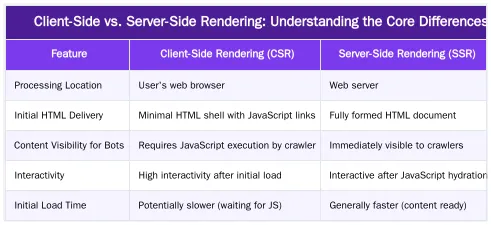
Client-Side vs. Server-Side Rendering: Understanding the Core Differences
The difference between client-side rendering (CSR) and server-side rendering (SSR) is where the initial HTML content is generated. CSR uses the user’s browser and JavaScript to build the page dynamically. SSR generates the complete HTML on the server before sending it to the browser.
This distinction impacts how quickly users see content and how search engine crawlers like Googlebot index the page. Each approach has technical workflows that dictate load times, interactivity, and resource use.
How Rendering Methods Impact Web Performance & SEO Metrics
The rendering method influences web performance metrics and SEO. Server-side rendering typically results in a faster Time To First Byte (TTFB) and First Contentful Paint (FCP) because the server delivers a complete HTML document. Client-side rendering often has a slower initial FCP as the browser must download, parse, and execute JavaScript before rendering content.
For search engines, the rendering process affects content discovery and indexing. While crawlers can execute JavaScript, SSR provides a more consistent content stream, which benefits the crawl budget and ensures all content is seen.
Core Web Vitals: A Deep Dive into LCP, FID, and CLS
Core Web Vitals (CWV) affect user experience and search rankings. Largest Contentful Paint (LCP) measures perceived load speed. SSR generally performs better for LCP by delivering content quickly, whereas CSR can be delayed by large JavaScript bundles. First Input Delay (FID) measures interactivity, which can be impacted by heavy JavaScript execution during CSR’s initial load. Cumulative Layout Shift (CLS) measures visual stability. Both methods can introduce CLS if content shifts after the initial render, but CSR is more prone to this if dynamic content loads asynchronously. For more on JavaScript’s impact on SEO, see JavaScript SEO for Healthcare: Rendering Strategies for Dynamic Content.
Crawl Budget & Indexing: Ensuring Googlebot Sees Your Content
A website’s rendering strategy affects its crawl budget and indexing efficiency. Server-side rendering presents fully hydrated HTML to Googlebot, requiring less processing power from the crawler and allowing more pages to be crawled within a given budget. Client-side rendering requires Googlebot to download and execute JavaScript, which consumes more resources and time. This can strain the crawl budget, especially for large sites. While Google has improved its JavaScript rendering, CSR can still introduce delays or missed content if JavaScript execution fails or is too slow. Dynamic rendering, serving a server-rendered version to bots and a CSR version to users, can mitigate these issues.
Choosing the Right Rendering Strategy for Your Website
The optimal rendering strategy depends on a website’s requirements, balancing performance, user experience, and SEO. Frameworks like React, Angular, and Vue.js primarily support client-side rendering, but tools like Next.js (for React) and Nuxt.js (for Vue.js) offer built-in server-side rendering and static site generation capabilities.
An interactive web application might prioritize CSR for its dynamic capabilities, while a content-heavy blog or e-commerce site would benefit from SSR’s faster initial load times and improved crawlability.

When to Leverage Client-Side Rendering (CSR)
Client-side rendering is suitable for applications where interactivity is more important than initial load time. Examples include user dashboards, online editors, or social media feeds where content updates without full page reloads. In these cases, the initial JavaScript download is a one-time cost for a responsive experience. For applications where SEO is not the primary concern, such as internal tools or authenticated user areas, CSR can be an efficient choice.
The Benefits of Server-Side Rendering (SSR) and Hybrid Approaches
Server-side rendering improves initial page load speed and search engine optimization. By delivering fully formed HTML, SSR makes content immediately available to users and crawlers, leading to a faster First Contentful Paint and improved crawlability. Hybrid models, offered by frameworks like Next.js, combine the strengths of SSR, CSR, and Static Site Generation (SSG). These approaches allow developers to pre-render parts of a site for performance and SEO while enabling client-side interactivity where needed. Hydration, where client-side JavaScript takes over a server-rendered page, is a component of many hybrid strategies, transitioning from static content to an interactive application.
Optimizing Rendering for YMYL Sites: An SEO Strategist’s View
For YMYL (Your Money Your Life) websites in the medical and plastic surgery sectors, rendering choices affect trust, authority, and patient acquisition. Abdurrahman Şimşek, a Semantic SEO Strategist for London’s private healthcare market, notes that rendering strategy directly impacts how search engines assess a site’s E-E-A-T (Experience, Expertise, Authoritativeness, Trustworthiness) signals. A site that loads slowly or presents inconsistent content can erode user trust and signal poor quality to search algorithms, hindering its ability to rank.
Delivering medical information, surgeon profiles, and procedure details quickly and consistently to users and crawlers is essential. This often favors server-side rendering or hybrid approaches to maintain content integrity and performance.
Reducing Cost of Retrieval with Efficient Rendering
Efficient rendering strategies contribute to a lower ‘Cost of Retrieval’ for search engines. This concept refers to the resources (time, processing power, bandwidth) Googlebot uses to crawl, render, and index a website. For complex medical sites, inefficient rendering can increase this cost, leading to reduced crawl efficiency and slower indexing. By delivering pre-rendered HTML via SSR or SSG, websites reduce the computational burden on Googlebot, allowing it to process more pages. This helps maintain topical authority and comprehensive coverage of medical entities. Learn more in Reducing Cost of Retrieval: Technical SEO for Efficient Medical Website Performance.
E-E-A-T and User Trust: The Role of Performance in Healthcare SEO
In the YMYL space, E-E-A-T is part of search engine evaluation. Fast page loads, influenced by rendering choices, contribute to a positive user experience. A patient seeking medical information expects immediate access to content. Delays or visual instability can lead to frustration, increased bounce rates, and a perception of unreliability. These negative user signals can indirectly impact E-E-A-T, as Google interprets poor user experience as a sign of lower quality. A site that loads quickly reinforces trust and professionalism, signaling to users and search engines that the medical practice is authoritative. This is important for London’s medical websites, where patient expectations for digital experiences are high. See Google’s Core Web Vitals documentation.
Measuring the Impact: Core Web Vitals and User Experience
After implementing a rendering strategy, monitoring its impact on user experience and SEO is necessary. For medical practices, performance metrics correlate with patient acquisition and consultation bookings. An optimized site ranks higher and converts more effectively because it provides a better experience for potential patients.
How rendering choices affect interactivity and accessibility is also important, especially for diverse patient demographics. Tools and regular audits identify areas for improvement.
Tools and Metrics for Performance Monitoring
Google PageSpeed Insights provides an overview of a page’s performance, including Core Web Vitals scores and recommendations. Lighthouse, in Chrome DevTools, offers similar auditing capabilities. Google Search Console’s Core Web Vitals report highlights pages with performance issues across a site. Real user monitoring (RUM) tools provide insights into actual user experiences, capturing data on load times, interactivity, and visual stability from various devices and network conditions. For more on these tools, see the web.dev Measure documentation.
User Experience Beyond Speed: Interactivity and Accessibility
Interactivity and accessibility are as important as speed for medical websites. First Input Delay (FID) measures the time from a user’s first interaction to the browser’s response. Heavy client-side JavaScript can negatively impact FID. Accessibility allows all users, including those with disabilities, to navigate the website. A clear semantic HTML structure, often more straightforward with SSR, and management of dynamic content are important for screen readers and other assistive technologies. A fast, interactive, and accessible website reinforces trust and encourages engagement.
Future-Proof Your Website: Partner with a Semantic SEO Expert
Rendering choices, performance, and their influence on SEO and E-E-A-T require specialized knowledge. For medical clinics and plastic surgeons in London, this is important for organic growth. Abdurrahman Şimşek, a Semantic SEO Strategist and Web Developer, specializes in building high-authority Semantic Content Networks for the private healthcare sector. He uses technical SEO and semantic engineering to build websites that are fast, user-friendly, and structured for search engine ranking.
Partnering with an expert who understands rendering, Core Web Vitals, and YMYL sites can improve your digital presence.
Conclusion
The choice between client-side, server-side, or a hybrid rendering approach affects web performance, SEO, and user experience. While CSR offers interactivity, SSR often provides better initial load times and crawlability, which benefits content-heavy and YMYL websites. These methods impact Core Web Vitals, crawl budget, and E-E-A-T signals, which are important for organic visibility in 2026.
For London’s private healthcare sector, strategic rendering decisions are necessary. Book a Semantic SEO Audit to discuss a strategy for your clinic. You can also reach out via our Direct WhatsApp Strategy Line: +90 506 206 86 86.
Frequently Asked Questions
What is the primary performance difference between client side vs server side rendering?
The primary difference lies in where the HTML is rendered. With Server-Side Rendering (SSR), the server sends a fully rendered HTML page, resulting in a faster Time To First Byte (TTFB) and First Contentful Paint (FCP). Client-Side Rendering (CSR) sends a minimal HTML shell and JavaScript, which then renders the page in the browser, often leading to a slower initial load. This distinction is key when comparing client side vs server side rendering performance.
How does the choice between client side vs server side rendering impact SEO for medical websites?
Server-Side Rendering (SSR) is unequivocally superior for medical websites. It ensures that critical YMYL content and E-E-A-T signals are immediately available to search engine crawlers without requiring JavaScript execution. This reliability is paramount for achieving high rankings in the healthcare sector, making the client side vs server side rendering decision crucial for such sites.
Does the decision between client side vs server side rendering significantly impact mobile user experience?
Yes, significantly. SSR typically provides a better mobile experience on slower networks or less powerful devices because the “heavy lifting” is done on the server. CSR can feel sluggish on mobile as the device’s processor must execute JavaScript to display content, potentially leading to higher bounce rates. Understanding the implications of client side vs server side rendering is vital for mobile optimization.
Can I switch from Client-Side Rendering (CSR) to Server-Side Rendering (SSR) without a full website rebuild?
It depends on your existing framework. Frameworks like Next.js (for React) or Nuxt.js (for Vue) are specifically designed to facilitate SSR and can be adopted into existing applications. However, for a site built purely with client-side React, the transition can be complex and may require significant architectural changes and development effort.
Is dynamic rendering a good compromise between Client-Side and Server-Side Rendering?
Dynamic rendering can be an excellent compromise, especially for SEO. It involves serving a server-rendered version of the page to search engine bots while serving a client-side rendered version to human users. This ensures perfect indexability without sacrificing the interactive benefits of a CSR application for users.
How can Abdurrahman Şimşek help optimize my website’s rendering strategy for SEO?
Abdurrahman Şimşek, a Holistic SEO Strategist, specializes in evaluating and optimizing rendering strategies for maximum search engine visibility, particularly for YMYL sites. You can book a Semantic SEO Audit to assess your current setup and receive tailored recommendations. For direct strategy discussions, reach out via WhatsApp at +90 506 206 86 86.
Ruxi Data brings together multi-model AI, automated website crawling, live indexation checks, topical authority mapping, E-E-A-T enrichment, schema generation, and full pipeline automation — from crawl to WordPress publish to social posting — all in one platform built for agencies and freelancers who run on results.