
Advanced Medical Schema: Elevating Entity Recognition and E-e-a-t
Implementing advanced medical schema moves beyond basic structured data to establish profound entity recognition and topical authority for medical websites. This approach leverages specific schema types like MedicalCondition, MedicalTherapy, MedicalStudy, and MedicalGuideline to precisely define medical services and expertise. By mastering schema nesting and JSON-LD context, clinics enhance E-E-A-T signals, feed the knowledge graph, and optimize for generative AI in search results. This strategic implementation improves site visibility and prepares content for future search paradigms.
Abdurrahman Şimşek, a Semantic SEO Strategist, specializes in building high-authority semantic content networks for medical clinics. His expertise in advanced structured data and E-E-A-T principles helps medical sites achieve deeper entity recognition and topical authority within the YMYL search landscape.
To explore your options, contact us to schedule your consultation. You can also reach us via: Book a Semantic SEO Audit, Direct WhatsApp Strategy Line: +90 506 206 86 86
Implementing advanced medical schema goes beyond basic structured data to achieve deeper entity recognition and establish topical authority for medical websites. This approach defines who a medical practice is, where it operates, what conditions it treats, and how. Using specific schema types like MedicalCondition and MedicalTherapy, medical clinics can enhance site visibility, strengthen E-E-A-T signals, and prepare for generative AI in search results.
What is Advanced Medical Schema & Why Go Beyond the Basics?
Advanced medical structured data uses granular schema.org types to describe medical conditions, treatments, studies, and guidelines, moving beyond basic identity and location. This markup gives search engines a machine-readable understanding of a medical practice’s expertise and services. For Your Money or Your Life (YMYL) websites, this semantic detail is crucial for establishing authority and trustworthiness.
The Limitations of Basic Physician & MedicalBusiness Schema
Schema types like Physician and MedicalBusiness identify a practitioner or clinic and their contact details. They only cover the “who” and “where,” not the specific medical conditions treated, procedures offered, or the scientific backing for those treatments. Relying on only these types fails to communicate a clinic’s core medical expertise to search engines.
Why Advanced Schema is Critical for YMYL & E-E-A-T
For YMYL topics, Google emphasizes E-E-A-T (Experience, Expertise, Authoritativeness, and Trustworthiness). Detailed medical structured data directly signals these qualities. Explicitly marking up conditions, therapies, and research demonstrates a website’s understanding of medical subjects. This information helps search engines validate content accuracy and credibility, which is paramount for medical advice and services. It also supports a Knowledge Graph entry for the medical entity, solidifying its online presence.
Unlocking Deeper Entity Recognition: Key Advanced Medical Schema Types
Medical websites should use specific schema types to articulate their core services and knowledge. These types provide detail for search engines to understand relationships between medical entities.
Defining ‘What’ You Treat: MedicalCondition Schema
The MedicalCondition schema type describes specific illnesses, diseases, symptoms, or diagnoses. Properties include name, alternateName, description, possibleComplication, associatedAnatomy, and differentialDiagnosis. It can link to related treatments using possibleTreatment, pointing to MedicalTherapy or MedicalProcedure entities. This connection helps search engines understand a clinic’s services relative to patient needs.
Detailing ‘How’ You Treat: MedicalTherapy & MedicalProcedure Schema
MedicalTherapy describes treatments or interventions, including drug therapies and rehabilitation. MedicalProcedure details surgical or non-surgical methods. Both convey the “how” of medical care. Properties include procedureType, bodyLocation, preparation, recoveryTime, and outcome. This detail enhances search engine understanding and can contribute to rich results.

Establishing Authority: MedicalStudy & MedicalGuideline Schema
To bolster E-E-A-T, medical websites should use MedicalStudy and MedicalGuideline schema. MedicalStudy marks up clinical trials, research papers, and observational studies, with properties like studyDesign, population, and outcomeMeasure. MedicalGuideline is for official recommendations or protocols from authoritative bodies. Citing research and guidelines with structured data provides machine-readable evidence of a clinic’s adherence to best practices, enhancing its authority. Referencing peer-reviewed studies and official guidelines is a strong E-E-A-T signal.
Implementing Complex Medical Schema: Nesting & JSON-LD Best Practices
Implementing advanced medical structured data requires attention to nesting, JSON-LD syntax, and validation. These ensure search engines accurately interpret relationships between medical entities.
Mastering Schema Nesting for Interconnected Medical Entities
Nesting schema embeds one schema type within another to represent real-world relationships. For medical entities, this connects a Physician to a MedicalClinic, which offers MedicalProcedures addressing specific MedicalConditions. For instance, a Physician entity could have an alumniOf property pointing to a MedicalOrganization (university), and a worksFor property pointing to a MedicalClinic. The clinic lists MedicalProcedures that are possibleTreatments for MedicalConditions. This structure provides an interconnected view of the medical practice. For detailed guidance on combining these foundational types, refer to our article on How to Use Physician, MedicalClinic, and Procedure Schema Together.
JSON-LD Context & Vocabulary: Ensuring Semantic Accuracy
JSON-LD (JavaScript Object Notation for Linked Data) is the recommended format for structured data. The @context property specifies the vocabulary, typically schema.org. Using the correct @context and schema.org vocabulary is paramount for semantic accuracy. Misusing properties or types leads to misinterpretation by search engines, negating implementation benefits. Following official schema.org documentation ensures the data is universally understood.
Structured Data Validation: Tools and Troubleshooting Common Errors
Validation after implementation is critical. Google’s Rich Results Test and the Schema.org Validator are tools for checking syntax, identifying errors, and previewing potential rich results. Common errors include incorrect nesting, missing required properties, typos in property names, and invalid data types. Regular validation ensures structured data remains accurate. Promptly addressing errors maintains the markup’s integrity and positive impact on search visibility.
How Advanced Schema Builds E-E-A-T and Future-Proofs Your Medical Site
Using advanced structured data is strategic for medical websites, impacting E-E-A-T, Knowledge Graph integration, and preparing for Generative Engine Optimization (GEO). Abdurrahman Şimşek, a semantic SEO strategist, emphasizes this markup is a foundational element of a digital strategy for medical clinics.
Feeding the Knowledge Graph: From Entities to Topical Authority
Advanced structured data gives search engines explicit signals about a medical practice’s specializations and the relationships between its practitioners, services, and conditions. This information feeds Google’s Knowledge Graph, helping build an authoritative entry for the medical entity. When Google understands these connections, the website’s topical authority for specific medical areas strengthens. This is a core component of building an “algorithm-proof” online presence, as detailed in our cornerstone article, Semantic SEO for Surgeons: Building Algorithm-Proof Topical Authority with Automation.
Optimizing for Generative AI: Schema’s Role in AI Overviews
In 2026, with the increasing prominence of Generative AI in search, well-structured, entity-rich schema makes content more accessible and understandable for AI models. When search engines generate AI Overviews or provide direct answers, they rely on defined entities and relationships to synthesize information. Websites with comprehensive medical structured data are more likely to be identified as authoritative sources and featured in these generative results. This semantic engineering approach is crucial for future-proofing content strategy.
Reducing Cost of Retrieval: Efficiency for Googlebot and Better Rankings
Clear structured data reduces the effort for search engines to understand and process content. This concept, “Cost of Retrieval” (CoR), is the computational resources Googlebot expends to crawl, parse, and interpret a webpage. When medical information is marked up with schema, Googlebot extracts entities and attributes more efficiently, improving crawl efficiency and potentially strengthening ranking signals. This is beneficial for complex medical websites with extensive content. For example, a well-structured site might see improved indexing rates and faster recognition of new content.
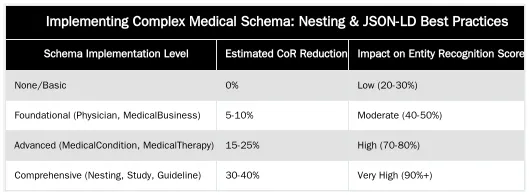
Identifying and Capitalizing on Advanced Schema Opportunities for Medical Clinics
Beyond core medical types, clinics can use advanced structured data for competitive advantage. These areas can enhance visibility and trustworthiness, particularly in the competitive London private healthcare market.
Schema for Patient Testimonials & Before/After Galleries
Patient testimonials and before/after galleries are trust signals for medical clinics. Implementing Review and AggregateRating schema makes patient feedback eligible for rich snippets, increasing click-through rates. ImageObject schema can be used within galleries, with descriptions that include medical context (e.g., the description property detailing the procedure and outcome). This enhances visibility and gives search engines a deeper understanding of the visual content’s relevance to medical procedures.
Defining Relationships: Surgeons, Clinics, and Affiliated Hospitals
An entity network defines the relationships between surgeons, their clinics, and affiliated hospitals. Using properties like memberOf, worksFor, and affiliation within Physician and MedicalClinic schema creates a web of interconnected entities. For example, a surgeon’s profile could link to their clinic, which links to a hospital where procedures are performed. This strengthens the entity graph, giving search engines a comprehensive understanding of the practice’s medical ecosystem.
Automating Schema Generation with Semantic Engineering
Manually creating complex, nested structured data for every medical condition, procedure, and practitioner is time-consuming and prone to error. Semantic engineering offers a solution. Tools like Ruxi Data can automate generating accurate schema at scale. This automation ensures consistency, reduces manual effort, and allows clinics to deploy advanced structured data across their website, a differentiator for achieving topical authority. To learn more about this approach, explore our article on AI-Driven Schema Generation in 2026: How to Automate JSON-LD for Rich Results.
Conclusion
Using advanced medical structured data beyond basic Physician and MedicalBusiness schema is necessary for medical websites to establish authority and visibility. Defining medical conditions, therapies, studies, and their interrelationships enhances E-E-A-T signals, strengthens Knowledge Graph presence, and optimizes for generative AI in search. This implementation is a differentiator, ensuring search engines understand a practice’s expertise. For London medical clinics, this semantic precision helps attract patients and secure an online presence. To explore how this can benefit your digital strategy, contact us. You can also Book a Semantic SEO Audit or reach out directly via WhatsApp: +90 506 206 86 86.
Frequently Asked Questions
Why is advanced medical schema crucial for medical websites?
Basic schema like `Physician` and `MedicalBusiness` identifies who you are and where you operate. Advanced medical schema goes further, defining *what* conditions you treat and *how* you treat them, establishing your website as a comprehensive medical authority. This deeper understanding helps search engines accurately categorize your expertise and services.
How does implementing advanced medical schema enhance E-E-A-T signals?
By structuring data around specific
Ruxi Data brings together multi-model AI, automated website crawling, live indexation checks, topical authority mapping, E-E-A-T enrichment, schema generation, and full pipeline automation — from crawl to WordPress publish to social posting — all in one platform built for agencies and freelancers who run on results.