
Ai-driven Schema Generation: Automating Json-ld for Rich Results
AI-driven schema generation automates JSON-LD markup, crucial for securing rich results and enhancing visibility in Google AI Overviews by 2026. This article details how AI leverages NLP and machine learning to create dynamic, context-aware structured data, moving beyond manual methods. Readers will understand the strategic importance of ai-driven schema generation for establishing robust topical authority and optimizing for generative search engines. It explores specific Schema.org vocabulary applications, including entity schema, to improve search engine understanding and content representation.
Abdurrahman Şimşek, a Semantic SEO Strategist, provides expert insights into leveraging advanced structured data for digital presence optimization. This content emphasizes practical strategies for implementing and validating automated schema markup to achieve maximum impact in evolving search landscapes.
To explore your options, contact us to schedule your consultation. You can also reach us via: Book a Semantic SEO Audit, Direct WhatsApp Strategy Line: +90 506 206 86 86, Hire as Semantic SEO Architect
In 2026, the landscape of search engine optimization is increasingly shaped by artificial intelligence, making ai-driven schema generation a critical strategy for securing rich results and dominant visibility in Google AI Overviews. This article explores how AI automates JSON-LD, its profound impact on structured data, and how it can elevate your digital presence. Understanding this evolution is essential for any entity aiming to establish robust topical authority and enhance search engine understanding of its content.
What is AI-Driven Schema Generation & Why it Matters in 2026?
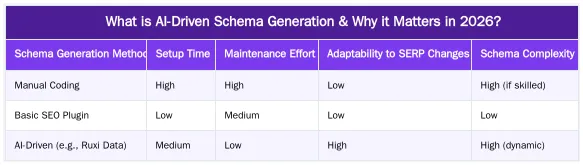
AI-driven schema generation refers to the automated creation and deployment of structured data markup, primarily JSON-LD, using artificial intelligence algorithms. This process moves beyond manual coding or basic plugin functionalities, enabling dynamic, context-aware schema that accurately reflects a page’s content and its underlying entities. In 2026, this automation is crucial for securing rich results, enhancing visibility in Google AI Overviews, and optimizing for search engine ‘Cost of Retrieval’ (CoR).
The Evolution of Structured Data: Manual to Automated
Historically, implementing structured data involved manual coding or relying on basic SEO plugins. These methods often produced generic or incomplete markup. The advent of AI has transformed this, allowing for sophisticated, nested entity schema that adapts to content changes and evolving SERP demands. This shift is particularly impactful for complex domains, where precise entity relationships are paramount for search engine understanding and establishing topical authority.
The ability to automatically generate and update structured data ensures that search engines consistently receive the most accurate and comprehensive information about your content. This reduces the effort required to maintain schema, allowing for greater focus on strategic content development and entity modeling. For more on advanced schema, explore advanced schema markup in 2026.
How AI Automates JSON-LD for Enhanced Search Visibility
AI automates JSON-LD by analyzing content, identifying key entities, attributes, and relationships, then translating this understanding into Schema.org vocabulary. This process leverages Natural Language Processing (NLP) and machine learning to interpret text, images, and other page elements. The AI can then construct detailed, nested structured data that goes far beyond simple page type declarations.
The primary benefit is the dynamic creation of highly specific schema, such as Article schema, Product schema, or even complex MedicalProcedure schema, tailored to the exact context of the page. This precision helps search engines like Google better understand the content’s relevance, leading to improved rich result eligibility and enhanced search visibility. Automated JSON-LD ensures consistency across large websites, a challenge for manual implementation.
Dynamic Schema Generation with Ruxi Data
Platforms like Ruxi Data exemplify advanced dynamic schema generation. Ruxi Data utilizes live SERP analysis to inform its schema creation, ensuring the generated markup is optimized for current search intent and competitive landscapes. This infrastructure goes beyond static templates, creating context-aware schema that adapts to content updates and algorithmic shifts. By leveraging AI for automated SEO with Ruxi Data, businesses can significantly reduce the manual effort associated with structured data management. This approach is particularly effective for complex content networks, where maintaining accurate and comprehensive schema is critical for search engine understanding. Learn more about dynamic schema generation.
Optimizing for Google AI Overviews & Generative Engine Optimization (GEO)
Google AI Overviews, powered by large language models, rely heavily on understanding entities and their relationships. Robust entity schema, precisely generated by AI, provides the foundational data for these generative search experiences. By clearly defining entities like “plastic surgeon,” “rhinoplasty procedure,” or “Harley Street clinic” and their attributes, AI-driven schema generation directly contributes to Generative Engine Optimization (GEO).
This deep semantic understanding allows AI Overviews to synthesize accurate, comprehensive answers, often drawing directly from well-structured data. For medical and YMYL (Your Money Your Life) sectors, this is paramount. Establishing medical E-E-A-T infrastructure for surgeons through detailed schema ensures that authoritative information is prioritized. To apply semantic architecture to medical SEO, consider how a strong semantic SEO framework for plastic surgeons can enhance visibility.
Entity Schema and the Cost of Retrieval (CoR)
Entity schema plays a pivotal role in optimizing the search engine’s Cost of Retrieval (CoR). When content is clearly marked up with entities and their properties, search engines expend less computational effort to understand, index, and retrieve relevant information. This efficiency can lead to better crawl rates, faster indexing, and ultimately, improved rankings. A well-designed semantic architecture inherently contributes to a lower CoR. To reduce Cost of Retrieval with Ruxi Data, businesses can leverage its automation capabilities to streamline content processing and schema deployment. Explore crawl budget optimization workflows for more details.
The precision of automated JSON-LD, especially for complex entity-attribute-value (EAV) modeling for surgical procedures, ensures that search engines accurately interpret the nuances of specialized content. This is a critical component of building topical authority for aesthetic practices and achieving dominance in competitive markets like London aesthetic clinics.
Strategic Schema Types for Maximum Impact in 2026
While basic schema types are widely used, AI-driven approaches enable the strategic deployment of more complex and nested schema for maximum impact. Beyond common types like FAQPage schema and LocalBusiness schema, the power lies in combining and extending these. For instance, a LocalBusiness schema can be nested within a MedicalBusiness, which then contains Physician entities, each with their own MedicalSpecialty and MedicalProcedure details.
This granular approach provides search engines with a rich, interconnected web of information, significantly boosting the content’s semantic depth. It helps search engines understand not just what a page is about, but who is providing the information, their qualifications, and the specific services offered. This is particularly vital for establishing E-E-A-T in sensitive sectors.
Tailoring Schema for YMYL Sectors: Medical & Aesthetic Clinics
For YMYL sectors, such as medical clinics and plastic surgeons, the accuracy and comprehensiveness of structured data are non-negotiable. AI-driven schema generation excels here by automating the creation of highly specific schema types like MedicalBusiness, Physician, and MedicalProcedure. This ensures that critical E-E-A-T signals—Expertise, Experience, Authoritativeness, and Trustworthiness—are explicitly communicated to search engines.
For example, a plastic surgeon’s profile can be marked up with their credentials, specializations, affiliations, and even specific surgical procedures they perform, all linked semantically. This level of detail is crucial for building E-E-A-T for London aesthetic clinics and achieving dominance in a highly competitive market. Implementing advanced schema for entity modeling is key to this strategy. For specialized schema, refer to medical schema for surgeons.
Implementing & Validating Your Automated Schema Markup
Successful implementation of automated structured data requires careful planning and continuous validation. The process typically involves integrating an AI-powered schema tool with your content management system (CMS) or website infrastructure. This allows for dynamic injection of JSON-LD based on content analysis. Best practices include defining clear entity mapping rules, ensuring consistency across your site, and regularly auditing the generated schema.
Schema validation tools, such as Google’s Rich Results Test and Schema.org’s Schema Markup Validator, are indispensable. These tools verify the syntax and adherence to Schema.org standards, helping identify errors that could prevent rich results. Continuous monitoring is essential, as search engine guidelines and Schema.org vocabulary evolve. As a Semantic SEO Strategist with 10 years of experience, Abdurrahman Şimşek emphasizes the importance of robust validation for medical content configuration.
Beyond Basic Plugins: Advanced Schema Validation
While many SEO plugins offer basic schema generation, their validation capabilities are often limited. Advanced schema validation goes beyond syntax checks to ensure semantic accuracy and alignment with search intent. This involves verifying that the generated schema accurately reflects the content’s entities and their relationships, and that it supports the desired rich result types. For example, validating a Physician schema means checking not just its structure, but also that the listed medical specialties and procedures are genuinely present and authoritative on the page.
This level of scrutiny is particularly important for YMYL domains, where misinformation or inaccurate structured data can have significant negative impacts on E-E-A-T. Automated schema validation, integrated into a continuous deployment pipeline, ensures that your structured data remains optimized and error-free, contributing to a lower Cost of Retrieval. For more insights, refer to automated schema markup guides.
Elevate Your Digital Presence with Advanced Schema Strategies
In 2026, leveraging AI for structured data is no longer an option but a necessity for competitive visibility. Automated JSON-LD enhances rich result eligibility, optimizes for Google AI Overviews, and reduces the Cost of Retrieval for search engines. By embracing advanced schema strategies, businesses can establish unparalleled topical authority and E-E-A-T, particularly vital for YMYL sectors.
As a London-based Semantic SEO Strategist specializing in medical and aesthetic surgery, Abdurrahman Şimşek provides the expertise and infrastructure to implement these cutting-edge solutions. Transform your digital presence and achieve dominant search visibility. Contact us today to discuss how AI-driven schema can revolutionize your SEO strategy. You can also Book a Semantic SEO Audit, reach out via Direct WhatsApp Strategy Line: +90 506 206 86 86, or Hire as Semantic SEO Architect.
Frequently Asked Questions
How is ai-driven schema generation different from standard SEO plugins?
Unlike basic plugins that use static templates, this advanced approach uses live SERP analysis to create context-aware, dynamic JSON-LD. This method of ai-driven schema generation identifies the exact schema used by top competitors, automating highly detailed markup to win rich results and placement in AI Overviews.
How does ai-driven schema generation handle content updates?
Advanced systems constantly monitor your content for changes. When a page is updated, our process for ai-driven schema generation automatically regenerates and validates the associated markup. This ensures your structured data always reflects the current on-page information, maintaining accuracy for search engines.
Is the JSON-LD from automated schema generation validated?
Yes, all markup created through this process is automatically checked against Google’s Rich Result Test and the Schema.org Validator. This pre-validation ensures the code is error-free and eligible for rich results before it is deployed, saving significant technical resources.
How does ai-driven schema generation improve E-E-A-T for YMYL sites?
For high-stakes YMYL (Your Money or Your Life) topics, ai-driven schema generation explicitly defines expertise by automating detailed Author, Review, and Organization schema. It builds a machine-readable layer of trust by citing authoritative sources, which search engines use to evaluate Experience, Expertise, Authoritativeness, and Trustworthiness.
Can automated systems create custom schema types?
Yes, sophisticated platforms support the full Schema.org vocabulary and allow for the creation of custom schema templates. This is essential for niche industries or businesses that need to define specific entities and properties not covered by standard types, ensuring complete semantic accuracy.
How can I implement advanced schema automation for my business?
The first step is a comprehensive analysis of your current digital assets and competitive landscape. You can book a Semantic SEO Audit with Abdurrahman Şimşek to identify opportunities and develop a custom strategy. This audit provides a clear roadmap for implementing a data-driven approach to win rich results.
Ruxi Data brings together multi-model AI, automated website crawling, live indexation checks, topical authority mapping, E-E-A-T enrichment, schema generation, and full pipeline automation — from crawl to WordPress publish to social posting — all in one platform built for agencies and freelancers who run on results.