Programmatic Internal Links: Reinforcing Topical Hubs for Medical SEO
Programmatic internal links automate the creation of contextual hyperlinks within a website, significantly enhancing site structure and search engine understanding. This method scales internal linking for large content repositories, such as medical websites, ensuring consistent reinforcement of topical hubs and E-E-A-T signals. By leveraging automated internal linking, medical clinics can build robust content networks that guide users and crawlers, improving information retrieval and establishing strong topical authority. This strategic approach minimizes manual effort while maximizing semantic connections across diverse content.
Abdurrahman Şimşek, a Semantic SEO Strategist, specializes in leveraging semantic automation and Ruxi Data to build high-authority content networks. His approach focuses on optimizing E-E-A-T and topical relevance for competitive YMYL niches like plastic surgery and aesthetic clinics.
To explore your options, contact us to schedule your consultation.
Programmatic internal links help plastic surgeons and aesthetic clinics build topical hubs, enhance E-E-A-T, and drive patient acquisition in competitive markets like London. Automating internal linking creates an algorithm-proof content network.
What Are Programmatic Internal Links and Why Do They Matter for Medical SEO?
Programmatic internal links are hyperlinks automatically generated and placed within a website’s content based on predefined rules or algorithms. This automation scales the internal linking process, ensuring relevant content is interconnected without manual intervention. For medical websites with extensive content on procedures, conditions, and surgeon profiles, this approach maintains a coherent site structure and signals expertise to search engines.
For medical SEO, it consistently reinforces topical hubs and E-E-A-T (Experience, Expertise, Authoritativeness, Trustworthiness) signals. Manual internal linking becomes impractical as a medical site grows, leading to missed semantic connections. Automated internal linking ensures every piece of content contributes to an interconnected network, guiding users and search engine crawlers.
The Core Concept: Automation for Scale and Precision
Programmatic linking shifts from individual, human-placed links to a system-driven approach. Instead of manually identifying anchor text and target URLs, a set of rules or an algorithm performs this task. This creates thousands of contextual links across a large content repository, such as a medical clinic’s website with surgical procedures, patient guides, and research articles. Precision comes from defining specific criteria for link placement, ensuring relevance.
This method benefits medical sites requiring high accuracy and consistency in their information architecture. It ensures that related medical entities, like a specific procedure and the surgeon who performs it, are always linked, strengthening the site’s semantic understanding for search engines.
How Automated Internal Linking Systems Build Topical Authority
Automated internal linking systems understand content relationships to build topical authority. By connecting related pages, these systems help search engines understand a medical website’s expertise. This reinforcement of topical hubs improves the “Cost of Retrieval” for Googlebot, making it more efficient for search engines to crawl, understand, and index the site’s content.
When a system consistently links a core procedure page to supporting articles about recovery, risks, and patient testimonials, it signals comprehensive coverage. This structured linking shows search engines the website is a definitive resource on a topic, contributing to higher rankings and E-E-A-T.
Leveraging NLP and Entity Recognition for Contextual Links
Natural Language Processing (NLP) and entity recognition are foundational to automated internal linking. NLP algorithms analyze text to understand its semantic meaning, identifying key entities such as medical conditions, procedures, anatomical terms, and surgeon names. Once these entities are recognized, the system determines the most relevant pages to link to.
For instance, if an article discusses “rhinoplasty recovery,” NLP can identify “rhinoplasty” as a core entity and suggest linking to the main rhinoplasty procedure page or a recovery guide. This semantic understanding ensures generated links are contextual and valuable to users and search engines, unlike simple keyword matching. This process creates a semantic content network.
Rules-Based vs. AI-Driven Approaches for Medical Content
Automated linking can be implemented through various methodologies, each with implications for medical content accuracy and scalability.
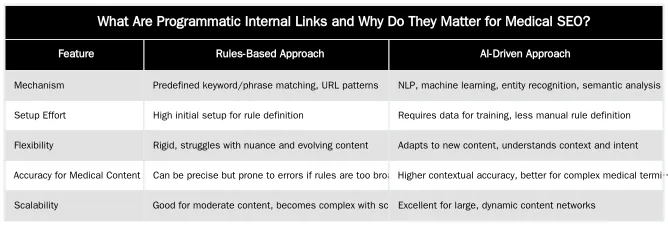
Rules-based systems are simpler to implement initially but require extensive manual rule definition and maintenance. AI-driven systems, while more complex to set up, offer better contextual understanding and adaptability, making them ideal for evolving medical information. These systems can discern subtle semantic relationships, ensuring links are medically appropriate and enhance user understanding.
Implementing Programmatic Internal Links: A Strategic Blueprint for Medical Sites
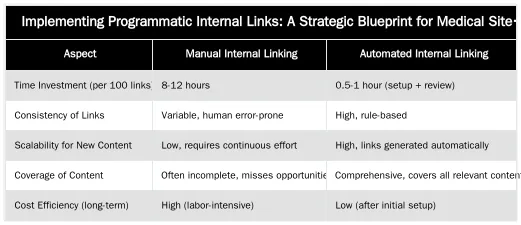
Implementing programmatic internal links requires planning to be effective and avoid pitfalls. The goal is to create a linking structure that supports user navigation and search engine understanding. This involves defining rules, generating appropriate anchor text, and integrating the solution with your content management system.
An automated internal linking strategy reduces manual SEO effort, allowing medical teams to focus on content creation and patient care. It also ensures the website’s internal link equity is distributed optimally, boosting the visibility of service pages and practitioner profiles.
Defining Smart Rules and Anchor Text Generation
Effective automated internal linking begins with defining rules that dictate when and where links should be placed. For a medical site, rules might include: automatically linking mentions of a procedure (e.g., “breast augmentation”) to its service page; linking surgeon names to their bio pages; or connecting symptoms to condition pages. The key is to establish a hierarchy and relevance score for potential links.
Anchor text generation is equally critical. Dynamic, contextually relevant anchor text is preferred over generic phrases. Systems can be configured to use the exact phrase, a synonym, or a longer descriptive phrase, ensuring variety and naturalness. This approach supports an E-E-A-T-driven internal linking architecture, guiding search engines to understand the precise topic of the linked page.
Integrating with Your CMS and Monitoring Performance
Integrating an automated internal linking solution with your Content Management System (CMS) is a practical step. Many CMS platforms, like WordPress, offer plugins, while custom-built sites may require Python scripts or API integrations. The integration should allow for rule management and the ability to preview or approve suggested links before publication, ensuring a balance between automation and human oversight.
Ongoing monitoring is essential. Regularly review link performance, click-through rates, and crawl statistics. Tools can track the number of internal links generated, their distribution, and their impact on page authority. Adjust rules as content evolves or new topical hubs emerge. This iterative process prevents over-optimization and ensures the linking strategy remains aligned with SEO goals.
The Abdurrahman Şimşek Approach: Semantic Automation for E-E-A-T
Abdurrahman Şimşek, with over a decade in semantic SEO, emphasizes that automated internal linking is a strategic imperative for medical websites. His approach integrates semantic engineering principles so every automated link contributes to a site’s E-E-A-T and topical authority, particularly for competitive London markets like Harley Street.
This methodology creates an interconnected content network that mirrors how search engines understand information. Using tools and custom scripts, it builds an algorithm-proof structure that signals expertise and trustworthiness, critical for YMYL (Your Money Your Life) industries like healthcare. This application of automated internal linking helps medical practices improve local organic search performance.
Optimizing ‘Cost of Retrieval’ with Intelligent Linking
The “Cost of Retrieval” refers to the resources Googlebot expends to crawl, process, and understand a website. For large medical sites, an inefficient internal linking structure can increase this cost, potentially leading to slower indexing or missed content. Semantic linking addresses this challenge.
By ensuring every relevant page is linked contextually, automated systems guide Googlebot efficiently through the site. This reduces the effort required to discover and understand content relationships, leading to faster indexing and better allocation of crawl budget. Abdurrahman Şimşek’s expertise ensures medical websites are discoverable and optimally understood by search engines, a critical factor for ranking in competitive healthcare niches.
Ruxi Data and Python: Scaling Semantic Relationships
Integrating Ruxi Data with custom Python scripts scales semantic relationships and automates internal linking. Ruxi Data identifies semantic gaps within a content network and maps complex entity relationships. This data informs Python scripts which automatically generate relevant internal links.
Python for SEO creates bespoke link building scripts that analyze content at scale, identify optimal anchor text, and insert links into a CMS or staging environment. This process ensures every automated link reinforces topical hubs and strengthens E-E-A-T signals across a medical content network. This approach is detailed further in resources on internal linking automation with Ruxi Data and how to automate internal linking effectively.
Beyond Automation: Ensuring Quality and Avoiding Pitfalls
Automated internal linking is not a set-it-and-forget-it solution. Without oversight, it can lead to over-optimization, irrelevant links, or unnatural anchor text, which can negatively impact SEO and user experience. Combining automation with human oversight is crucial for medical content.
Successful implementation requires quality control to ensure the system serves E-E-A-T and user value. This requires regular audits and adjustments to prevent counterproductive links.
Maintaining Naturalness and User Experience
The primary purpose of any internal link is to provide value to the user. Programmatic links must feel natural and guide users to related, helpful information. Links that appear forced, repetitive, or irrelevant can detract from the user experience, increasing bounce rates and signaling low quality to search engines.
To maintain naturalness, systems should be configured with parameters that limit the number of links per page, vary anchor text, and prioritize links to highly relevant content. This enhances the user’s journey, so they can explore related medical topics or services, rather than just serving search engine algorithms.
Auditing and Pruning: The Human Element in Automated Linking
Even with automation, regular human audits are indispensable. An audit involves reviewing the links generated by the system to identify any that are irrelevant, redundant, or potentially harmful. This process helps prune ineffective or outdated links and refine the rules governing link generation. For medical websites, this human review is critical to uphold the highest standards of E-E-A-T and content accuracy.
Auditors should check for:
- Contextual relevance: Does the link truly add value to the user’s understanding?
- Anchor text quality: Is it natural and descriptive?
- Over-optimization: Are there too many links on a single page or repetitive anchor text?
- Broken links: Are all linked pages still active and accessible?
This feedback ensures the automated system improves, maintaining an effective internal link profile.
The Impact of Programmatic Internal Links on Medical SEO Performance
Programmatic internal linking benefits medical websites by improving SEO performance and patient acquisition. By creating an organized, semantically rich content network, clinics can improve metrics from search rankings to user engagement.
This approach ensures the website’s architecture is scalable, supporting growing content while maintaining authority. The resulting improvements in visibility and user experience translate into a stronger online presence and a more effective patient acquisition funnel.
Enhanced Topical Authority and E-E-A-T Signals
A programmatic internal linking strategy signals a medical website’s expertise and authority across its content hubs. When a system consistently connects a core topic (e.g., “facelift surgery”) to all related sub-topics (e.g., “types of facelifts,” “facelift recovery,” “surgeon qualifications for facelifts”), it creates a strong topical cluster. This comprehensive coverage, reinforced by links, boosts E-E-A-T signals.
Search engines recognize these interconnected networks as indicators of a site’s comprehensive understanding of a subject. For YMYL content, this is critical. It helps establish the medical practice as a trusted source of information, helping it rank for competitive medical queries. This also aligns with principles discussed in automated internal linking in 2026.
Improved Crawlability, Indexing, and User Journey
A strong internal link structure improves crawlability and indexing. Programmatic internal linking ensures search engine crawlers can discover and access all relevant pages on a medical website, even those deep within the site architecture. This leads to more comprehensive indexing, making more content visible in search results.
Beyond search engines, a well-linked site improves the user journey. Patients can navigate between related articles, gaining a deeper understanding of procedures, conditions, and treatment options. This enhanced user experience, characterized by longer dwell times and lower bounce rates, signals content quality and relevance to search engines, contributing to better rankings and higher conversion rates for patient inquiries.
Future-Proof Your Medical Practice with Semantic SEO Automation
Programmatic internal linking is an advanced SEO strategy for medical clinics and plastic surgeons. It offers a scalable, precise method to build topical authority, enhance E-E-A-T, and optimize for search engine efficiency. Using semantic automation, medical practices can create a resilient content network that withstands algorithm updates and attracts patients in competitive markets like London.
To learn how internal linking and semantic SEO can improve your medical practice’s online presence, consider a consultation. Visit abdurrahmansimsek.com to learn more about building an algorithm-proof content strategy.
Frequently Asked Questions
What exactly are programmatic internal links?
Programmatic internal links are hyperlinks automatically generated and placed within a website’s content based on predefined rules or algorithms. Unlike manual linking, this method scales the internal linking process by using keyword or entity matching to contextually connect relevant pages. For medical sites, this ensures consistent linking from mentions of a procedure to its dedicated pillar page.
How do programmatic internal links reinforce topical hubs for medical sites?
By setting up intelligent rules, programmatic internal links ensure that every mention of a specific medical procedure or condition across your site automatically links back to its main pillar page. This systematic approach funnels link equity and relevance to your core content hubs, significantly strengthening their authority and E-E-A-T. It creates a robust network that signals to search engines the depth of your expertise on specific medical topics.
Is it risky to automate internal linking, and could it appear as spam?
Automation carries a risk if not implemented with precision. The key to avoiding spam is to develop sophisticated rules that prioritize genuine relevance, natural anchor text variation, and user experience. High-quality automated linking systems, like those leveraging Ruxi Data, employ semantic analysis to ensure links are genuinely helpful and contextually appropriate, not just keyword-stuffed.
What kind of technology is used for advanced internal link automation?
Advanced internal link automation systems utilize Natural Language Processing (NLP) and entity recognition to understand content context beyond simple keyword matching. These technologies can identify mentions of specific medical procedures, surgeon names, or conditions, and then intelligently create the most appropriate and semantically relevant links. This ensures a highly precise and effective internal linking strategy.
What is the primary advantage of using programmatic internal links for large medical websites?
The main advantage is unparalleled scalability and consistency. For extensive medical websites with hundreds or thousands of pages, manually creating and maintaining an optimal internal link structure is practically impossible. Using programmatic internal links ensures that every piece of content, new and old, is perfectly integrated into your topical hubs, consistently reinforcing your site’s E-E-A-T and overall authority.
How can medical practices begin implementing semantic internal linking strategies?
Medical practices can start by mapping their core topical hubs and identifying key entities within their content. Consulting with a semantic SEO strategist, like Abdurrahman Şimşek, can help design a tailored strategy and implement advanced systems like Ruxi Data. This approach ensures your internal linking is optimized for both search engines and patient navigation, driving better organic growth.
Ruxi Data brings together multi-model AI, automated website crawling, live indexation checks, topical authority mapping, E-E-A-T enrichment, schema generation, and full pipeline automation — from crawl to WordPress publish to social posting — all in one platform built for agencies and freelancers who run on results.