
YMYL Ranking Pitfalls: Navigating Aesthetic Clinic SEO
This article details common ymyl ranking pitfalls that new aesthetic clinics encounter when seeking online visibility. It addresses critical factors such as thin content, inadequate E-E-A-T signals, and technical SEO oversights that impact patient safety and search engine performance. Understanding these challenges is essential for clinics aiming to comply with Google’s stringent quality guidelines and establish a strong digital presence in the competitive medical sector.
Abdurrahman Şimşek, a Semantic SEO Strategist, provides insights into overcoming these hurdles. The content focuses on actionable strategies to build trust and authority, crucial for YMYL-compliant websites.
To explore your options, contact us to schedule your consultation. You can also reach us via: Book a Semantic SEO Audit, Direct WhatsApp Strategy Line: +90 506 206 86 86
New aesthetic clinics face challenges establishing online visibility within the Your Money Your Life (YMYL) sector. This article identifies common ymyl ranking pitfalls that hinder new clinics and provides strategies to navigate Google’s quality guidelines for long-term organic success in the London market.
What Are the Most Common YMYL Ranking Pitfalls for New Aesthetic Clinics?
The most common ymyl ranking pitfalls for new aesthetic clinics include thin or superficial content, insufficient E-E-A-T (Experience, Expertise, Authoritativeness, Trustworthiness), and neglected technical SEO. Google’s algorithms rigorously scrutinize YMYL content for patient safety. Without a deliberate strategy, new clinics struggle to meet these standards, leading to poor search visibility.
The Critical Role of YMYL in Aesthetic Medicine SEO
YMYL (“Your Money Your Life”) topics can impact a person’s health, financial stability, or safety. Aesthetic medicine is a YMYL category. Google applies heightened quality standards to YMYL content, prioritizing sources with clear E-E-A-T. For new clinics, all content, from procedure descriptions to blog posts, must be accurate, comprehensive, and attributed to qualified medical professionals. Failure to meet these guidelines can result in low rankings or exclusion from search results, impacting patient acquisition.
Why Do New Aesthetic Clinics Struggle with YMYL Compliance?
New aesthetic clinics struggle with YMYL compliance because of the challenge of establishing E-E-A-T from scratch, limited resources for content creation, and misunderstanding Google’s Quality Rater Guidelines. Unlike established practices, new clinics must build their digital reputation. The competitive London private healthcare market exacerbates these challenges, as established clinics have strong authority signals.
For a comprehensive overview, refer to YMYL SEO Compliance: A Practical Checklist for Medical Websites.
The E-E-A-T Hurdle: Building Trust Without a Track Record
Establishing E-E-A-T is a hurdle for new aesthetic clinics. Google’s algorithms and human quality raters look for signals of real-world experience, verifiable expertise, authoritativeness, and trustworthiness. New clinics lack the historical data, patient reviews, and online presence of established practices. To overcome this, new clinics must showcase the qualifications and experience of their medical professionals, publish original research or case studies, and seek patient testimonials. The nuances of E-E-A-T are detailed in E-E-A-T for YMYL 2026.
Identifying and Overcoming Key YMYL Content Pitfalls
Content issues are significant ymyl ranking pitfalls for new aesthetic clinics, often stemming from a misunderstanding of the depth and accuracy required for medical topics. Overcoming these pitfalls requires creating patient-centric content that meets medical standards and demonstrates expertise.
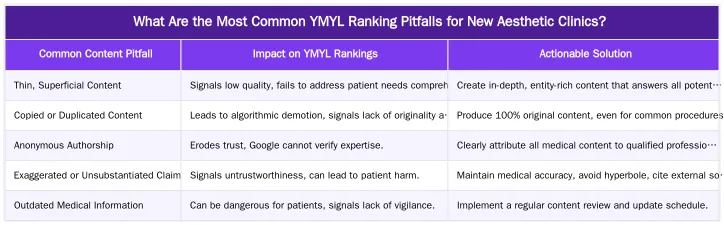
Thin, Superficial, or Copied Content: The E-E-A-T Killer
Thin medical content offers minimal value, lacks depth, or provides generic information. This includes brief procedure descriptions without details on risks, recovery, or alternatives. Copied content signals a lack of originality and expertise. Google’s algorithms identify and de-rank such content in YMYL sectors. To avoid this, clinics must create comprehensive, original, and medically accurate content that addresses patient queries. Google’s “How Search Works” emphasizes quality and relevance.
Anonymous Authorship & Exaggerated Claims: Eroding Trust
Content without clear author attribution diminishes trust signals. For YMYL topics, Google expects content written or reviewed by qualified medical professionals. Anonymous content suggests a lack of accountability and expertise. Unsubstantiated medical claims or hyperbole can damage a clinic’s credibility. Clinics should display the credentials of their medical team, including qualifications, experience, and professional memberships. All claims must be factual, evidence-based, and avoid misleading language. The National Library of Medicine highlights the importance of accurate health information.
Technical & User Experience Pitfalls That Harm YMYL Rankings
Technical and user experience (UX) issues can impact a new aesthetic clinic’s YMYL rankings. Google uses these factors to assess a site’s quality and trustworthiness. Missing contact information, poor site structure, or outdated SEO tactics like keyword stuffing erode trust and hinder Google’s evaluation of a site’s authority.
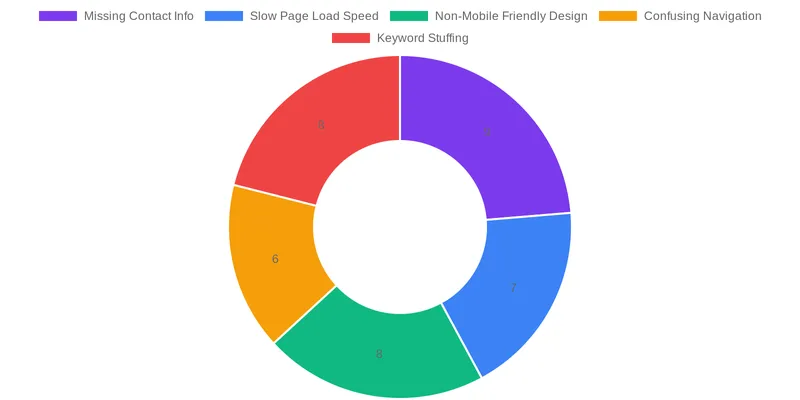
Missing Contact Information & Poor User Experience
For YMYL websites, accessible and accurate contact information is a fundamental trust signal. Patients need to find phone numbers, addresses, and booking options easily. A lack of this information deters patients and signals a lack of transparency to Google. A poor user experience—slow loading times, confusing navigation, or a non-mobile-friendly design—negatively impacts patient perception and SEO. Google prioritizes websites that provide a good user journey, especially on mobile. Fast load times and intuitive site architecture affect patient satisfaction and search visibility. Google’s Core Web Vitals directly measure user experience.
Keyword Stuffing & Over-Optimization: A Relic of the Past
Outdated SEO tactics like keyword stuffing, excessively repeating keywords to manipulate rankings, now lead to penalties and diminish content quality for medical topics. Google’s algorithms understand natural language and semantic relevance. Instead of stuffing keywords, clinics should create content that naturally incorporates related terms and entities to answer patient questions. Over-optimization signals an attempt to trick search engines, which is detrimental to YMYL site performance.
Building a YMYL-Compliant Foundation with Semantic SEO
Addressing YMYL challenges requires moving beyond keyword-centric SEO to a semantic framework. Abdurrahman Şimşek, a London-based Semantic SEO Strategist with over 10 years of experience, builds high-authority Semantic Content Networks for medical clinics. This methodology focuses on how Google understands entities and their relationships, reducing the “Cost of Retrieval” for search engines and establishing topical authority for medical sites.
From Keywords to Entities: Future-Proofing Your Clinic’s Content
The future of YMYL SEO is understanding entities, not just keywords. An entity is a concept, such as a medical procedure (“Rhinoplasty”), a condition (“Acne”), or a physician. Structuring content around entities and their attributes helps Google build a clearer, more trustworthy knowledge graph. This involves Entity-Attribute-Value (EAV) modeling, where each entity is described by its attributes (e.g., Rhinoplasty: recovery time, anesthesia type, ideal candidate). This approach makes content comprehensive, contextually rich, and easier for search engines to process, preventing many YMYL ranking pitfalls. For details, see Entity-Based Content Audit.
The Role of a Semantic SEO Strategist in Preventing Pitfalls
A specialist like Abdurrahman Şimşek, with expertise in medical content and tools like Ruxi Data, can build an algorithm-proof semantic content network for London clinics. This involves mapping topical authority to ensure all content contributes to a cohesive understanding of the clinic’s expertise. By focusing on semantic relationships and entity modeling, a strategist can identify and mitigate YMYL issues before they impact rankings. This foresight is valuable for new clinics establishing an online presence in a competitive market.
Your Action Plan: Ensuring YMYL Compliance for Long-Term Growth
YMYL compliance is an ongoing process. New aesthetic clinics need a systematic approach to content, technical optimization, and E-E-A-T demonstration. Regular audits and continuous improvement are essential.
Conduct a content audit to identify thin, superficial, or copied pages. Create comprehensive, medically accurate content attributed to a qualified professional. Implement structured data (Schema markup) to define medical entities and services. Regularly review and update content for accuracy. Foster a positive online reputation by soliciting and responding to patient reviews. Ensure your website’s technical foundation is sound, with fast loading times, mobile responsiveness, and clear contact information.
A Practical Checklist for YMYL SEO Compliance
For a detailed guide, see YMYL SEO Compliance: A Practical Checklist for Medical Websites. This resource provides a framework for auditing and improving adherence to Google’s YMYL guidelines.
Secure Your Clinic’s Future: Partner with a YMYL SEO Expert
Navigating YMYL compliance and avoiding ranking pitfalls requires specialized expertise. For new aesthetic clinics in London, partnering with a semantic SEO strategist is an investment in long-term organic success. Abdurrahman Şimşek offers strategies to build high-authority content networks that comply with Google’s guidelines and improve local organic search.
Conclusion
New aesthetic clinics face YMYL challenges where Google’s guidelines demand high E-E-A-T and technical quality. Overcoming ranking pitfalls like thin content, anonymous authorship, and poor user experience is crucial for online visibility and trust. A semantic SEO strategy focusing on entity-based content and medical accuracy builds a foundation for organic growth. Partnering with an SEO consultant for the London private healthcare market provides the expertise to navigate these complexities. Book a Semantic SEO Audit today, or reach out directly via WhatsApp Strategy Line: +90 506 206 86 86.
Frequently Asked Questions
What is the most common YMYL ranking pitfall for a new clinic?
The most common YMYL ranking pitfall is publishing “thin” or superficial content that lacks medical depth and authoritativeness. New clinics often fail to provide comprehensive answers to patient questions, which Google’s systems identify as low-quality and untrustworthy for Your Money Your Life topics. This directly hinders their ability to establish credibility and rank effectively.
How do unsubstantiated claims contribute to YMYL ranking pitfalls?
Exaggerated or unproven claims (e.g., “scar-free results guaranteed”) directly contradict Google’s E-E-A-T requirements for trustworthiness. This is a major red flag that can lead to suppressed rankings, as the content is deemed potentially harmful or misleading. Such practices severely undermine a clinic’s credibility within the sensitive medical sector.
What are the YMYL ranking pitfalls associated with anonymous content?
Publishing medical advice without a clearly identified, qualified author is one of the biggest challenges for YMYL sites. Google needs to verify who is providing the information to trust it, making anonymous or corporate-authored blogs lack the necessary ‘Expertise’ and ‘Authoritativeness’ signals. This significantly impacts a site’s ability to rank for competitive medical terms.
How does a weak ‘About Us’ page become a significant challenge for YMYL sites?
A poor ‘About Us’ page is a significant ymyl ranking pitfall because Google’s guidelines emphasize the importance of transparency and accountability. A lack of detailed information about the clinic or the medical professionals responsible for the site erodes trust. This deficiency signals low quality and can negatively impact your ability to rank for competitive medical terms.
What technical issues can lead to poor performance in YMYL categories?
Technical issues like slow page loading speeds, poor mobile responsiveness, and insecure connections (lack of HTTPS) can severely impact user experience and trust. For YMYL sites, these technical deficiencies signal a lack of professionalism and care, which Google’s algorithms penalize. Ensuring a robust technical foundation is crucial for establishing authority.
How can Abdurrahman Şimşek help my clinic avoid these challenges?
Abdurrahman Şimşek, a Semantic SEO Strategist, specializes in building YMYL-compliant foundations for medical and plastic surgery clinics. He offers a Semantic SEO Audit to identify and rectify these common ranking obstacles, ensuring your content meets Google’s stringent E-E-A-T requirements. You can book an audit at abdurrahmansimsek.com/contact/ or reach out via WhatsApp at +90 506 206 86 86 for direct strategy.
Ruxi Data brings together multi-model AI, automated website crawling, live indexation checks, topical authority mapping, E-E-A-T enrichment, schema generation, and full pipeline automation — from crawl to WordPress publish to social posting — all in one platform built for agencies and freelancers who run on results.