
E-e-a-t Internal Linking: Elevating Medical Website Authority
An e-e-a-t internal linking architecture is fundamental for YMYL medical websites to demonstrate expertise, experience, authority, and trustworthiness to search engines. This strategy involves creating a logical, interconnected content network that builds topical authority and guides both users and crawlers. By leveraging semantic linking and structured content silos, medical practices can reinforce their credibility, enhance link equity distribution, and improve organic search visibility. This approach ensures valuable information, such as surgeon qualifications and procedure guides, receives appropriate prominence, aligning with Google’s Quality Rater Guidelines.
Abdurrahman Şimşek, a Semantic SEO Strategist with over 10 years of experience, specializes in developing high-authority Semantic Content Networks for medical clinics. His expertise focuses on holistic SEO strategy and YMYL optimization, particularly for the London private healthcare market.
To explore your options, contact us to schedule your consultation.
An e-e-a-t internal linking architecture is a fundamental strategy for medical websites in the YMYL (Your Money or Your Life) landscape. A structured internal linking strategy signals expertise, experience, authority, and trustworthiness to search engines. This guide provides actionable steps for medical practices to enhance online presence and patient acquisition. This architecture is crucial for medical professionals aiming for strong organic search visibility in 2026.
What is E-E-A-T-Driven Internal Linking for Medical Sites?
E-E-A-T-driven internal linking is structuring a website’s internal links to demonstrate expertise, experience, authority, and trustworthiness to search engines. For medical websites, this means creating a logical, interconnected content network that guides users and crawlers through a site’s knowledge. This aligns with Google’s Quality Rater Guidelines, which emphasize E-E-A-T as a critical ranking factor for YMYL (Your Money or Your Life) topics like health information.
Strategically connecting related medical procedures, conditions, and expert profiles signals a site’s comprehensive understanding of a subject. This goes beyond keyword matching, focusing on semantic relationships between entities. An effective internal linking strategy ensures valuable information, such as a surgeon’s qualifications or procedure guides, receives link equity and visibility, reinforcing the site’s credibility.
The Core Principles of Semantic Internal Linking
Semantic linking focuses on the meaning and relationships between content pieces, not just keyword-based connections. Instead of linking “breast augmentation” to another page mentioning the same term, semantic internal linking connects the entity “breast augmentation” to related entities like “implant types,” “recovery protocols,” “surgeon qualifications,” and “patient testimonials.” This builds a topical map, allowing search engines to understand the full scope of a medical practice’s expertise.
This method ensures every link contributes to a cohesive narrative, demonstrating an organized understanding of a medical specialty. It helps search engines recognize the site as a comprehensive resource, enhancing its authority and trustworthiness.
Why is E-E-A-T Internal Linking Critical for YMYL Medical Websites?
E-E-A-T is critical for YMYL medical websites, where inaccurate information can harm a user’s health or finances. Search engines apply rigorous standards to these sites, prioritizing those demonstrating high levels of expertise, experience, authority, and trustworthiness. An internal linking strategy directly impacts these trust signals, reinforcing topical authority and improving search visibility for sensitive health topics.
For plastic surgeons and aesthetic clinics, this means interconnecting all content, from procedure pages to surgeon biographies, to highlight the practice’s credentials and knowledge. This structured approach helps search engines recommend the site as a reliable source of medical information, which is paramount for patient acquisition and online reputation in competitive markets like London.
Reinforcing Topical Authority and Content Silos
Content silos and topic clusters demonstrate comprehensive coverage of medical specialties. Grouping related articles and procedure pages into internally linked categories signals expertise in those areas. For instance, a plastic surgery clinic might create a silo for “Facial Procedures,” linking all related content—rhinoplasty, facelift, blepharoplasty—to a central cornerstone page. This structured approach, detailed in a guide to content silo architecture, reinforces topical authority.
Internal links within these silos ensure effective link equity flow, strengthening key page authority. This organized structure benefits search engines by making the site’s topical depth clear and provides a logical navigation path for prospective patients.
Enhancing User Experience and Reducing ‘Cost of Retrieval’
Intuitive internal navigation improves the user journey on a medical website. When patients can easily find related information, such as pre-operative instructions linked from a procedure page, their experience is enhanced. This positive user engagement, characterized by longer time on site and lower bounce rates, sends favorable signals to search engines.
A well-organized internal linking structure helps search engines efficiently crawl and understand the site’s architecture. This reduces the ‘Cost of Retrieval’ for search engine bots, meaning they can discover and index more content with less effort. For complex medical websites, optimizing this cost is crucial for ensuring all relevant pages are considered for ranking.
Building Your E-E-A-T Internal Linking Architecture: Practical Strategies
An E-E-A-T-focused internal linking strategy requires careful planning for medical websites. The goal is to create a network that highlights expertise and guides users and search engines to the most authoritative content. This involves identifying cornerstone content, placing contextual links, and optimizing anchor text for medical procedure pages and surgeon bios.
For a plastic surgeon’s website, this means ensuring a comprehensive guide to “Rhinoplasty” (cornerstone content) is linked from every blog post on nasal aesthetics, and that the surgeon’s bio page is linked from all relevant procedure pages. This approach builds a foundation for organic visibility.
Strategic Placement: Cornerstone Content and Contextual Links
Cornerstone content is the most important, comprehensive content on your site, such as guides on medical procedures or health topics. These pages should receive the most internal links. Identify these key pages (e.g., “Complete Guide to Breast Augmentation”) and link to them from supporting articles (e.g., “Choosing Implant Size,” “Breast Augmentation Recovery Tips”).
Contextual links, embedded in the body copy of articles, are powerful. They provide semantic relevance and guide users to more information. For example, in an article on “Facelift Techniques,” a phrase like “learn more about our advanced technical SEO framework” could link to a page detailing surgical approaches, reinforcing topical authority and user experience.
Optimizing Anchor Text for Clarity and Semantic Relevance
Anchor text is the visible, clickable text of a hyperlink. For E-E-A-T, anchor text must be descriptive and semantically rich, accurately reflecting the linked page’s content. Avoid generic phrases like “click here” or “read more.” Instead, use specific medical terms, procedure names, or conditions that provide clear context.
For a link to a page about “Liposuction,” appropriate anchor text could be “advanced liposuction techniques” or “liposuction recovery guide.” This precision helps search engines understand the destination page’s topic and reinforces the site’s expertise in specific medical entities. Avoid over-optimizing with exact match keywords; focus on natural language variations that enhance clarity for users and algorithms.
Leveraging Semantic Engineering for Advanced Internal Linking
Abdurrahman Şimşek, a Semantic SEO Strategist, applies Semantic Engineering principles to build high-authority content networks for medical clinics. This includes creating E-E-A-T-driven internal linking structures that surpass conventional SEO approaches. By integrating tools like Ruxi Data and automated systems, medical websites can achieve semantic coherence and link equity distribution that competitors overlook.
This methodology ensures every internal link serves a purpose, connecting related entities and concepts to maximize topical authority and minimize the ‘Cost of Retrieval’ for search engines. For London’s private healthcare market, this provides a strategic advantage in demonstrating expertise and trustworthiness.
Automating Internal Link Placement with Semantic Intelligence
Programmatic or AI-driven internal linking, informed by semantic analysis, can reinforce topical hubs and distribute link equity across extensive medical websites. This approach uses algorithms to identify the most relevant connections between content pieces based on their semantic relationships. For instance, an automated system could analyze a new blog post about “post-operative care for breast augmentation” and automatically link it to the main “Breast Augmentation” procedure page, the surgeon’s bio, and related articles on recovery tips.
This method ensures consistent and comprehensive internal linking, especially for large sites with many medical articles. Abdurrahman Şimşek’s work, including insights on automating internal linking to reinforce semantic relationships and leveraging Ruxi Data for internal linking automation, demonstrates how semantic intelligence can scale E-E-A-T signals effectively.
EAV Modeling and Its Role in Link Architecture
Entity-Attribute-Value (EAV) modeling provides a structured framework for organizing information, which can inform internal linking strategies. In a medical context, an entity might be a “Rhinoplasty procedure.” Its attributes could include “anesthesia type,” “recovery time,” “cost range,” and “surgeon qualifications.” The values would be the specific details for each attribute.
By mapping content using EAV, internal links can connect specific attributes to their respective entities. For example, a page detailing “General Anesthesia for Cosmetic Surgery” could link to all procedure pages where general anesthesia is an attribute. This creates an interconnected knowledge graph within the website, helping search engines understand relationships between medical concepts and enhancing the site’s semantic richness.
Measuring the Impact: How E-E-A-T Linking Boosts Medical SEO
Tracking the success of an E-E-A-T internal linking strategy involves monitoring key metrics that reflect improved site structure, search engine understanding, and user engagement. For medical websites, these indicators translate into better organic performance and increased patient inquiries.
A well-implemented strategy should lead to measurable improvements in how search engines crawl and index content, user interaction, and the visibility of medical information. Regular analysis of these metrics allows for continuous refinement of the linking architecture.
Key Performance Indicators for Internal Link Success
Monitoring specific KPIs helps evaluate the effectiveness of an internal linking strategy:
- Improved Crawl Depth: Search engines reach more pages, indicating better content discoverability.
- Increased Page Authority: Key pages (e.g., procedure guides, surgeon bios) accumulate more internal link equity, boosting their authority.
- Enhanced Organic Visibility: Higher rankings and increased organic traffic for target medical keywords.
- Better User Engagement: Metrics like reduced bounce rate, increased time on site, and more pages per session indicate users are finding relevant information.
- Conversion Rate: An increase in consultation requests or appointment bookings from improved organic traffic.
A clinic might observe these improvements after implementing a structured internal linking strategy:
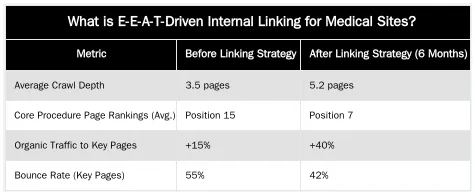
Internal Linking Strategies: E-E-A-T Impact Comparison
Different internal linking approaches yield varying E-E-A-T benefits and challenges for medical sites:
| Strategy | Description | E-E-A-T Benefits | Challenges for Medical Sites |
|---|---|---|---|
| Flat Architecture | All pages linked equally from homepage/main nav. | Limited. Weak topical signals. | Poor link equity distribution, difficult for crawlers to discern importance. |
| Deep Silos/Topic Clusters | Content grouped by topic, links within silos. | Strong topical authority, clear expertise signals. | Requires careful planning, can isolate some content if not balanced. |
| Contextual Linking | Links embedded within body text to related content. | High semantic relevance, enhances user experience. | Can be time-consuming to implement manually at scale. |
| Cornerstone Content Focus | Most links point to key pillar pages. | Boosts authority of critical pages, clear hierarchy. | Risk of neglecting supporting content if not balanced. |
| Automated Semantic Linking | AI/programmatic links based on entity relationships. | Scalable E-E-A-T signals, optimal link equity flow. | Requires advanced semantic engineering expertise and tools. |
Partner with an Expert for Your Medical Website’s Semantic SEO
For plastic surgeons, aesthetic clinic owners, and medical directors in London, navigating E-E-A-T and internal linking requires specialized expertise. Abdurrahman Şimşek offers bespoke Semantic SEO strategies, including advanced internal linking architecture, tailored for the private healthcare market. Leverage over a decade of experience building high-authority semantic content networks. Discover how an E-E-A-T-driven site structure can transform your online presence and attract high-value patients.
Conclusion
An effective e-e-a-t internal linking architecture is a strategic imperative for medical websites in the YMYL space. By structuring internal links, medical practices can signal their expertise, experience, authority, and trustworthiness to search engines and patients. Implementing content silos, optimizing anchor text, and leveraging semantic engineering techniques are crucial steps in building an algorithm-proof online presence. This work improves search rankings, enhances user experience, reduces the ‘Cost of Retrieval’ for search engines, and drives patient acquisition. For an advanced technical SEO framework tailored to London’s medical practices, explore consulting services at abdurrahmansimsek.com.
Frequently Asked Questions
How does a strong e-e-a-t internal linking architecture signal Expertise for E-E-A-T?
A logical, siloed structure demonstrates a deep and organized understanding of a topic. When you link from a specific procedure page back to a comprehensive cornerstone guide about that medical specialty, you are creating a semantic map that signals your website’s expertise to both users and search engines. This is a core principle of e-e-a-t internal linking.
What is the role of anchor text in an E-E-A-T internal linking strategy?
Anchor text provides crucial context about the linked page’s content. Using descriptive, keyword-relevant anchor text (e.g., ‘learn about our rhinoplasty techniques’ instead of ‘click here’) helps Google understand the relationship between pages and reinforces the topical relevance of your content clusters. This improves user experience and search engine understanding.
How can internal links highlight Authoritativeness for medical websites?
Consistently link from blog posts and informational articles to your main service pages, your ‘About the Surgeon’ page, and any published research or credentials. This flow of link equity from informational content to core entity pages reinforces the authority of the surgeon and the clinic, crucial for YMYL topics.
What are content silos and how do they support E-E-A-T for medical practices?
Content silos are a way of structuring your site where related content is grouped together and interlinked, often with a main ‘pillar’ page at the top. For a surgeon, you might have a silo for ‘Facial Procedures’ and another for ‘Body Procedures.’ This organized structure makes your expertise clear and easy for Google to crawl and understand, boosting your topical authority.
Should every page link back to the homepage in an e-e-a-t internal linking plan?
While your logo will typically link to the homepage, it’s more powerful to create contextual links between deeply related articles and pillar pages. An effective e-e-a-t internal linking strategy prioritizes building deep, topical link structures over simply linking everything back to the homepage, enhancing semantic relevance.
How can I begin optimizing my medical website’s e-e-a-t internal linking?
Starting with a comprehensive audit of your current site structure and content is key. An expert semantic SEO strategist can then help you map out content clusters and implement a robust e-e-a-t internal linking architecture. You can partner with Abdurrahman Şimşek for a tailored strategy to enhance your medical website’s search visibility.
Ruxi Data brings together multi-model AI, automated website crawling, live indexation checks, topical authority mapping, E-E-A-T enrichment, schema generation, and full pipeline automation — from crawl to WordPress publish to social posting — all in one platform built for agencies and freelancers who run on results.