
Core Web Vitals for Surgeons: Enhancing Patient Trust and Search Visibility
Understanding core web vitals for surgeons is crucial for optimizing medical website performance and patient acquisition. This guide details how Largest Contentful Paint (LCP), Cumulative Layout Shift (CLS), and Interaction to Next Paint (INP) directly impact procedure and gallery pages. Strong core web vitals for medical websites signal professionalism, build patient trust, and improve E-E-A-T signals. Optimizing these metrics ensures a fast, stable, and responsive user experience, which is vital for credibility in the YMYL medical sector and for securing higher search engine rankings.
Abdurrahman Şimşek, a Semantic SEO Strategist, specializes in optimizing medical websites for performance and E-E-A-T. His expertise ensures clinics achieve high search visibility and patient confidence through technical SEO and semantic content architecture.
To explore your options, contact us to schedule your consultation.
For plastic surgeons and aesthetic clinics, a fast, stable, and responsive website is a cornerstone of patient trust and online visibility. This guide covers core web vitals for surgeons, how these metrics impact procedure and gallery pages, and your clinic’s E-E-A-T and patient acquisition. On medical websites, user experience directly correlates with perceived professionalism and credibility. A technically sound site allows potential patients to access information, building confidence in your practice.
What Are Core Web Vitals and Why Do They Matter for Surgeons?
Core Web Vitals are metrics Google uses to measure user experience for page loading, interactivity, and visual stability. For medical websites, these metrics influence patient perception, trust, and search engine rankings. A website that performs well signals professionalism and reliability, which is critical in the Your Money Your Life (YMYL) medical sector where accuracy and trustworthiness are scrutinized.
Sites with poor Core Web Vitals scores may see reduced visibility in search results, meaning fewer potential patients discover their services. A slow or unstable website can frustrate visitors, causing them to leave. This impacts conversion rates and patient acquisition. Optimal performance is part of an advanced technical SEO framework for medical sites.
Understanding LCP, CLS, and INP for Medical Websites
The three Core Web Vitals are Largest Contentful Paint (LCP), Cumulative Layout Shift (CLS), and Interaction to Next Paint (INP). LCP measures the load time of the largest content element, often a hero image or video. A slow LCP makes a site feel sluggish. CLS quantifies unexpected layout shifts. For example, a “Book Consultation” button moves as an image loads above it, creating a frustrating experience. INP assesses page responsiveness to user interactions like clicks and taps. A high INP indicates a laggy interface, which is detrimental on interactive forms or patient portals.
For medical websites, these metrics impact perceived quality and professionalism. A fast, stable, and responsive site reinforces a clinic’s credibility and contributes to its E-E-A-T (Experience, Expertise, Authoritativeness, Trustworthiness) signals.
Optimizing Largest Contentful Paint (LCP) on High-Impact Procedure Pages
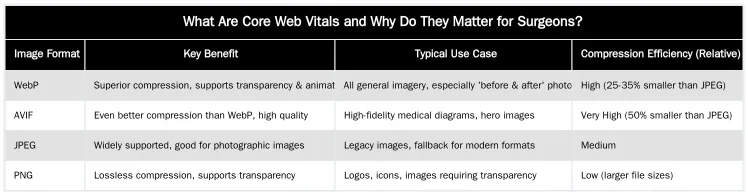
Procedure and gallery pages on a surgeon’s website contain high-resolution images and videos, which showcase results and educate patients. These media elements are frequently the largest contentful paint, impacting LCP. Optimizing LCP requires balancing visual quality with performance. Techniques include image compression, serving responsive images, and using modern image formats with better compression.
For ‘before and after’ galleries, visual detail is critical. Avoid aggressive compression that degrades image quality. Serve images at appropriate dimensions for the viewport, use lazy loading for images below the fold, and preload critical above-the-fold images. Embedded video content must be managed. Load videos efficiently without autoplay, using a placeholder image until the user initiates playback. A Content Delivery Network (CDN) can reduce LCP by serving assets from servers closer to the user.
Strategies for Image & Video Optimization in Surgical Galleries
Convert images to next-gen formats like WebP, which can reduce file sizes by 25-35% compared to JPEG or PNG without noticeable quality loss. Implement responsive images using the `srcset` attribute to serve different sizes based on screen resolution, preventing mobile users from downloading large desktop images. Use lazy loading for images and videos below the fold to defer their loading until they enter the viewport, improving initial page load times.
Preload critical ‘before and after’ images above the fold using “. Ensure all images have explicit width and height attributes to prevent layout shifts. A CDN speeds up global asset delivery. For video, use lightweight embed codes. YouTube or Vimeo embeds are often sufficient with optimization, but consider self-hosting smaller videos if bandwidth allows. Regularly audit image compression for sustained performance.
Minimizing Cumulative Layout Shift (CLS) in Before & After Galleries
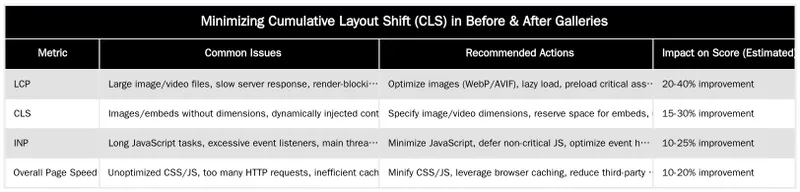
Cumulative Layout Shift (CLS) is problematic on medical websites, especially in dynamic ‘before and after’ galleries, embedded testimonials, or booking widgets. These elements often load asynchronously or have undefined dimensions, causing content to shift as they render. This movement disrupts the user experience, creates frustration, and makes a website seem unprofessional. On a surgeon’s site, this visual instability undermines patient trust.
Addressing CLS requires reserving space for dynamic content. For images and videos, specify `width` and `height` attributes in HTML or CSS so the browser can allocate space before the media loads, preventing shifts. For embedded content like testimonials or booking widgets, define container dimensions or use CSS aspect ratio boxes to reserve space. Font loading can also trigger CLS; use `font-display: swap` or preload critical fonts to mitigate this. Avoid injecting content above existing content. An audit of image compression and gallery structure can reveal CLS culprits.
Ensuring Visual Stability: Common CLS Triggers and Fixes
Common CLS triggers on medical websites include images and videos without explicit dimensions, dynamically injected content, web fonts causing text reflow, and unoptimized third-party embeds. To fix these, include `width` and `height` attributes for all image and video tags. For responsive images, use CSS to manage sizing while maintaining the aspect ratio. For dynamic content like pop-ups or booking forms, load them off-screen or reserve space in their containers. If content must be injected, ensure it does not push existing content down.
Font loading strategies are vital. Use `font-display: optional` or `font-display: swap` to prevent invisible text (FOIT) or unstyled text (FOUT). Preload critical web fonts using “. For advertisements or third-party widgets, allocate space using CSS `min-height` or `aspect-ratio` properties. Regularly test pages with Google PageSpeed Insights or Lighthouse to identify CLS issues. Maintaining visual stability reinforces the clinic’s reliability.
Beyond Metrics: Core Web Vitals, E-E-A-T, and Patient Trust
Core Web Vitals’ impact extends beyond page speed. For medical practices, strong performance contributes to a clinic’s E-E-A-T signals—Experience, Expertise, Authoritativeness, and Trustworthiness. A fast, stable, and responsive website reflects professionalism. This signals to Google and potential patients that the clinic operates with precision and care. Abdurrahman Şimşek, with over a decade of experience in semantic SEO for medical clinics, emphasizes that a technically sound website is foundational to digital credibility.
Google’s algorithms reward websites with good user experiences, especially in YMYL categories like health. A site with poor Core Web Vitals can signal a lack of investment or care. A high-performing site reinforces the clinic’s authority and trustworthiness. This alignment between technical performance and perceived quality is crucial for attracting patients in competitive markets like London’s Harley Street. It builds a digital reputation that mirrors the quality of in-person care.
The Role of Page Speed in Signalling Professionalism and Credibility
A slow or unstable website impacts a patient’s perception of a clinic’s quality. A website is a virtual front desk; if it is slow or clunky, it creates an impression of disorganization. This erodes trust and deters potential patients. A fast, responsive experience conveys efficiency and modernity, aligning with patient expectations for a surgical practice.
For Google, optimizing Core Web Vitals reduces the “Cost of Retrieval” (CoR), the resources it expends to crawl, index, and rank a website. Slow or poorly structured websites require more effort for Googlebot to process, increasing their CoR. Optimizing page speed and stability makes it easier for Google to evaluate content, which can positively influence rankings. This concept is central to technical SEO for efficient medical website performance.
For further understanding, refer to Google’s Core Web Vitals documentation and the Search Quality Rater Guidelines.
Improving Interaction to Next Paint (INP)
Interaction to Next Paint (INP) measures a page’s responsiveness to user input. For surgeon websites, INP is important on interactive elements like booking forms, patient portals, or gallery filters. A high INP score indicates slow response to user actions, creating a frustrating experience. When patients fill out sensitive information or navigate treatment options, immediate interface feedback is essential for building confidence.
Strategies to improve INP involve optimizing JavaScript execution, reducing main thread work, and preventing long tasks from blocking user interactions. This includes deferring non-critical JavaScript, breaking up long tasks, and optimizing event listeners. For instance, when a patient clicks to expand FAQs, the response should be instantaneous. Delays can lead to repeated clicks, confusion, or abandonment. Prioritizing responsiveness is a key differentiator for medical websites.
Technical Audit Checklist for Core Web Vitals on Medical Sites
A regular technical audit is essential for maintaining Core Web Vitals performance. This checklist helps identify and address common issues across LCP, CLS, and INP. These actions improve user experience and strengthen E-E-A-T signals. For a more comprehensive approach, consider an advanced technical SEO framework for medical websites.
Partner with an Expert
Optimizing Core Web Vitals for surgeons is a complex process requiring specialized technical expertise. A high-performing website is a strategic asset that builds patient trust, reinforces E-E-A-T, and drives patient acquisition. For clinics in competitive markets like London, partnering with an SEO strategist who understands the healthcare sector is valuable. Abdurrahman Şimşek specializes in building high-authority semantic content networks and optimizing web performance for medical clinics, skin clinics, and plastic surgeons.
Conclusion
Core Web Vitals are indicators of a surgeon’s online professionalism and help build patient trust. By optimizing Largest Contentful Paint (LCP), Cumulative Layout Shift (CLS), and Interaction to Next Paint (INP) on procedure and gallery pages, medical practices can enhance user experience and strengthen E-E-A-T signals. A fast, stable, and responsive website improves search visibility and instills confidence in potential patients. For guidance on web performance, explore SEO and web development services at abdurrahmansimsek.com.
Frequently Asked Questions
Why are core web vitals for surgeons particularly important for a surgeon’s website?
For surgeons, patient trust (a key component of E-E-A-T) begins with the user experience. A fast, stable website signals professionalism and credibility. Poor core web vitals for surgeons, especially on critical procedure and gallery pages, can lead to user frustration and a perception of a low-quality practice, impacting both rankings and patient conversions.
What is the biggest Core Web Vitals challenge for ‘before and after’ galleries for medical professionals?
The biggest challenge is optimizing Largest Contentful Paint (LCP). These galleries often rely on high-resolution images, which are large files and can severely slow down page load times. Without proper compression, modern image formats (like WebP), and a smart loading strategy, these images can result in a poor LCP score.
How does Cumulative Layout Shift (CLS) affect patient experience on procedure pages?
High CLS, often caused by ads, videos, or images loading without defined dimensions, creates a jarring user experience. A patient trying to read about a procedure or click a call-to-action could have the layout shift unexpectedly, causing frustration and mistrust. Minimizing CLS is crucial for a stable, professional-looking page and a positive patient journey.
What is a realistic LCP target for a page with high-resolution
Ruxi Data brings together multi-model AI, automated website crawling, live indexation checks, topical authority mapping, E-E-A-T enrichment, schema generation, and full pipeline automation — from crawl to WordPress publish to social posting — all in one platform built for agencies and freelancers who run on results.