
Medical Qualifications for SEO: Boosting E-e-a-t and Organic Rankings
Showcasing medical qualifications for SEO is crucial for enhancing E-E-A-T signals and achieving higher organic rankings in the private healthcare sector. This article details how effectively presenting physician credentials on-page and through structured data, like schema markup, builds authoritativeness and trust signals for search engines and patients. It covers integrating GMC registration and professional body memberships to strengthen entity SEO and improve knowledge panel visibility, directly impacting a clinic’s ability to attract high-value patients.
Abdurrahman Şimşek, a Semantic SEO Strategist specializing in medical clinics, provides expert guidance on leveraging these credentials. His approach focuses on semantic content architecture and topical authority to optimize YMYL websites for Google’s stringent E-E-A-T requirements.
To explore your options, contact us to schedule your consultation.
For London’s private healthcare sector, showcasing medical qualifications for SEO is a critical strategy to enhance a clinic’s E-E-A-T signals and achieve higher organic rankings in 2026. Presenting physician credentials effectively on-page and through structured data directly influences search engine perception and patient confidence. This guide provides actionable insights for medical practices to attract high-value patients.
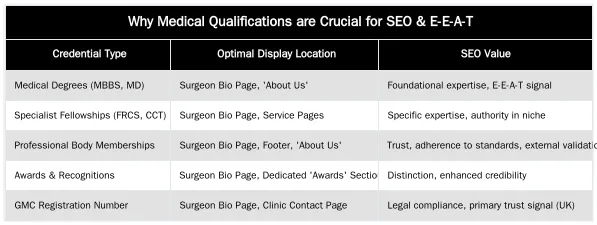
Why Medical Qualifications are Crucial for SEO & E-E-A-T
Medical qualifications establish Expertise, Experience, Authoritativeness, and Trust (E-E-A-T) on Your Money Your Life (YMYL) websites. Google’s algorithms and human quality raters scrutinize medical content to ensure it originates from credible sources. Displaying physician credentials signals to search engines and patients that the information and services are reliable and backed by verifiable expertise. This directly impacts a clinic’s ability to rank for competitive medical queries.
The YMYL Imperative: Google’s Focus on Trust
Medical content is in Google’s YMYL category because it can impact a user’s health, financial stability, or safety. This classification triggers heightened scrutiny from Google’s quality algorithms. For medical websites, verifiable expertise is a prerequisite for ranking. Professional qualifications demonstrate that content authors and service providers have the necessary training and accreditation. This focus on trust is paramount for any private healthcare provider seeking visibility in search results. Learn more about establishing E-E-A-T for surgeons and the E-E-A-T for YMYL in 2026.
Google’s Quality Rater Guidelines state that pages with low E-E-A-T for YMYL topics, especially medical advice, should be rated low quality. This makes transparently presenting professional qualifications non-negotiable for medical SEO. Google’s guidance on helpful content reinforces the need for demonstrable expertise.
How to Effectively Showcase Physician Credentials on Your Website
Showcase physician credentials with strategic placement and clear presentation across your clinic’s website so patients and search engines can identify practitioner expertise. Primary locations include dedicated surgeon bio pages, ‘About Us’ sections, and ‘Qualifications’ pages.
On-Page Best Practices for Surgeon Bio Pages
A high-ranking surgeon bio page lists degrees, certifications, specializations, and awards. Present each qualification with its awarding institution and year, for example, “MBBS, University College London (2005)” or “FRCS (Plast), Royal College of Surgeons of England (2015)”. Use bullet points or a structured format for readability. Ensure the page is accessible from the main navigation. Link to external verification sources like university alumni pages or professional body registers where appropriate. For more guidance, refer to articles on writing surgeon bio pages that build trust and rank.
Leveraging Professional Body Memberships & Affiliations
Listing memberships in organizations like the Royal College of Surgeons, the British Association of Plastic, Reconstructive and Aesthetic Surgeons (BAPRAS), or the British Association of Aesthetic Plastic Surgeons (BAAPS) sends strong trust signals. These affiliations indicate adherence to professional standards and commitment to medical excellence. Link directly to the surgeon’s profile on these bodies’ official websites. This provides third-party verification, bolstering E-E-A-T. Displaying these memberships prominently, often with their official logos, enhances visual credibility.
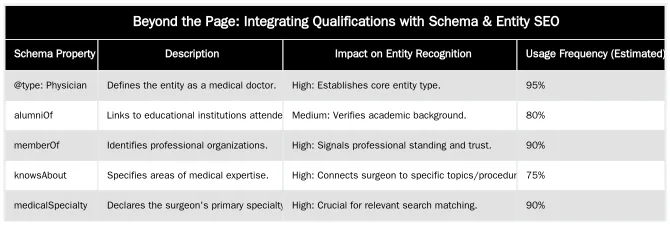
Beyond the Page: Integrating Qualifications with Schema & Entity SEO
Communicating medical qualifications to search engines extends beyond visible text. Use structured data (Schema.org markup) to define a physician’s credentials and affiliations. This helps Google understand the entities involved, contributing to a more robust Knowledge Graph entry and potential Knowledge Panel inclusion for the surgeon.
Structured Data for Expertise: Physician, knowsAbout, & alumniOf Schema
Implementing `Physician` schema is crucial. Within this schema, properties like `alumniOf` specify universities and medical schools attended, while `memberOf` identifies professional bodies. The `knowsAbout` property links their expertise to specific medical conditions or procedures. This granular data helps Google build a comprehensive understanding of the surgeon’s professional profile. For detailed implementation, refer to our guide on implementing advanced medical schema.
Influencing the Knowledge Panel and Entity Recognition
Consistent, structured presentation of qualifications across your site and the web helps Google build a robust entity for the surgeon. This increases the likelihood of a Knowledge Panel appearing in search results, displaying key information like specialties, affiliations, and contact details. Providing clear, machine-readable data through schema reinforces the surgeon’s entity, improving their entity SEO. This approach aligns with the EAV model for surgical procedures, where attributes like qualifications are linked to the surgeon entity.
GMC Registration & UK Professional Bodies: Building Trust in London
For London’s private healthcare practitioners, UK-based medical registrations and professional body memberships are indispensable. These credentials resonate with local patients and are critical signals for Google’s understanding of regional authority and trust.
The Significance of GMC Registration for UK Surgeons
General Medical Council (GMC) registration is a foundational trust signal for any medical practitioner in the UK, signifying that a doctor meets the professional standards required to practice medicine. Displaying the GMC registration number on surgeon bio pages and clinic contact pages is essential. Linking directly to the official GMC register provides immediate, verifiable proof of a surgeon’s standing. This transparency builds patient confidence and demonstrates compliance with UK medical regulations.
Other Key UK Medical Associations and Their SEO Value
Membership in other UK professional bodies also signals expertise and commitment to high standards. Examples include the Royal College of Surgeons of England, the British Association of Aesthetic Plastic Surgeons (BAAPS), or the British Association of Plastic, Reconstructive and Aesthetic Surgeons (BAPRAS). These memberships indicate specialized training and adherence to ethical guidelines within specific fields. Integrating these affiliations on your website with official logos and links to the organization’s site enhances E-E-A-T. Google interprets these signals as indicators of a practitioner’s authority and trustworthiness, which is valuable in competitive markets like Harley Street.
What Impact Do Strong Credentials Have on Your Clinic’s SEO?
Showcasing professional qualifications benefits a clinic’s SEO performance and patient acquisition. Benefits include improved search visibility, enhanced patient trust, and higher conversion rates for private practices in London.
Enhanced Search Visibility and Trust Signals
Strong E-E-A-T signals from clearly presented medical qualifications can lead to higher rankings, better visibility in local packs, and increased organic traffic. Google prioritizes authoritative sources for YMYL queries, and verifiable credentials contribute to this perception. Patients are more likely to click on results that demonstrate a practitioner’s expertise. This increased trust translates into higher click-through rates and greater engagement.
Patient Conversion and Reputation Management
Displaying physician credentials influences patient decision-making. Verifiable qualifications reduce patient anxiety and build confidence in the practitioner’s ability, which encourages bookings and inquiries. A strong foundation of professional qualifications contributes to a positive online reputation, providing a basis for patient reviews and testimonials that reinforce the clinic’s authority. This approach supports a strong online presence and drives patient conversion.
Partner with a Specialist for Unlocking Your Medical E-E-A-T
Optimizing E-E-A-T for medical websites is a complex process requiring specialized knowledge. Abdurrahman Şimşek is a Semantic SEO Strategist specializing in building high-authority Semantic Content Networks for medical clinics, skin clinics, and plastic surgeons. Partnering with an expert in medical SEO ensures your clinic maximizes its online authority and patient acquisition potential.
Conclusion
Showcasing medical qualifications and professional memberships is a cornerstone of effective SEO for private medical practices in 2026. It addresses Google’s E-E-A-T requirements for YMYL content, builds patient trust, and enhances search visibility. By presenting physician credentials on-page and leveraging schema markup, clinics can improve their organic rankings and attract more high-value patients. Visit abdurrahmansimsek.com to learn more about building a semantic SEO strategy for your medical practice.
Frequently Asked Questions
Why are medical qualifications for SEO crucial for healthcare websites?
For medical (YMYL) websites, Google’s algorithms and human raters actively look for signals of expertise and authoritativeness. Clearly showcasing medical qualifications for SEO is a direct way to provide these E-E-A-T signals, which is essential for ranking in competitive healthcare markets like London. This helps build patient trust and improves search visibility.
Where should I prominently display physician credentials on my website?
Physician credentials should be listed in multiple key places. These include prominently on the surgeon’s individual bio page, summarized on the ‘About Us’ page, and where relevant, on specific procedure pages. The goal is to make expertise clear and easily accessible to both patients and search engines.
Should I link to external professional body profiles to enhance my medical qualifications for SEO?
Absolutely. Linking to your official profile on sites like the General Medical Council (GMC), BAAPS, or BAPRAS is a powerful external validation of your credentials. This provides a strong, verifiable trust signal that Google can easily follow, reinforcing your authority and expertise.
How does Schema Markup help showcase medical qualifications for SEO?
Using ‘Physician’ schema markup allows you to programmatically tell search engines about a surgeon’s specialty, qualifications (‘alumniOf’), and publications. This structured data helps Google accurately build its Knowledge Graph entity for the surgeon, boosting their authority and helping them understand your medical qualifications for SEO.
Does quantifying professional experience contribute to E-E-A-T signals?
Yes, it significantly contributes to the ‘Experience’ part of E-E-A-T. Quantifying experience in years, or by the number of procedures performed, provides a concrete and easily understood signal of expertise for both patients and search engines. This helps establish credibility and trust.
How can Abdurrahman Şimşek help my clinic improve its E-E-A-T and showcase its medical qualifications for SEO?
Abdurrahman Şimşek specializes in building high-authority Semantic Content Networks for medical clinics, focusing on YMYL and E-E-A-T optimization. By leveraging semantic engineering and strategic content configuration, he helps London-based practices effectively present their medical qualifications for SEO, attracting high-value patients. You can learn more about his services at abdurrahmansimsek.com.
Ruxi Data brings together multi-model AI, automated website crawling, live indexation checks, topical authority mapping, E-E-A-T enrichment, schema generation, and full pipeline automation — from crawl to WordPress publish to social posting — all in one platform built for agencies and freelancers who run on results.