
CRO for Plastic Surgeons: Convert More Website Visitors
CRO for plastic surgeons is essential for transforming website visitors into booked patient consultations. This blueprint outlines strategies to optimize your online presence, focusing on high-converting landing pages, clear calls to action, and streamlined consultation forms. Enhancing user experience and leveraging trust signals like testimonials are critical for patient conversion in the medical aesthetics sector. Implementing data-driven A/B testing ensures continuous improvement, maximizing your return on investment and driving practice growth. Effective cro for plastic surgeons directly impacts lead generation and patient acquisition.
Abdurrahman Şimşek, a London-based Semantic SEO Strategist, specializes in building high-authority semantic content networks for medical clinics and plastic surgeons. His expertise ensures websites are optimized for both search engines and patient conversion, delivering tangible results in competitive markets like Harley Street.
To explore your options, contact us to schedule your consultation.
For plastic surgeons, digital success is measured by converting website visitors into patients. This cro for plastic surgeons blueprint provides strategies to optimize your online presence to increase booked consultations and grow your practice. Transforming visitors into leads is fundamental for growth in the medical aesthetics sector.
What is Conversion Rate Optimization (CRO) for Plastic Surgeons?
Conversion Rate Optimization (CRO) is the process of increasing the percentage of website visitors who complete a desired action, like filling out a consultation form or booking an appointment. For plastic surgeons, CRO transforms website traffic into patient leads and booked consultations.
In medicine, a “conversion” is a high-value action reflecting significant patient commitment, unlike smaller e-commerce purchases. For a plastic surgery practice, optimizing conversion rates requires understanding patient psychology, streamlining user experience, and building trust. A clear, frictionless path from interest to inquiry directly impacts practice growth and revenue.
Why CRO is Non-Negotiable for Your London Practice
In a competitive market like London’s Harley Street, attracting website visitors is not enough. Patient acquisition costs are substantial, making it imperative to maximize the value of every visitor. CRO ensures marketing spend yields the highest return by converting more existing traffic into patient leads.
A conversion strategy directly impacts profitability. Instead of investing in more traffic, CRO improves the efficiency of current digital assets. This is vital for plastic surgeons, as patient decisions involve significant trust and financial commitment.
Maximizing ROI in a Competitive Market
London’s private healthcare market is saturated. While SEO and paid ads drive traffic, the investment is wasted without effective conversion pathways. CRO guides acquired traffic toward booking consultations, yielding more patients from the same number of visitors and a higher marketing ROI.
If a practice doubles its website traffic with no increase in consultations, it has a conversion problem. Optimizing the website experience can grow patient inquiries without increasing traffic volume, making every marketing pound work harder.
The E-E-A-T Advantage in Patient Conversion
For medical YMYL (Your Money Your Life) websites, Google’s E-E-A-T guidelines (Experience, Expertise, Authoritativeness, Trustworthiness) are critical for both search rankings and patient conversion. A website demonstrating a surgeon’s E-E-A-T is more likely to convert visitors. Abdurrahman Şimşek integrates E-E-A-T principles into web design and content architecture to influence patient decision-making.
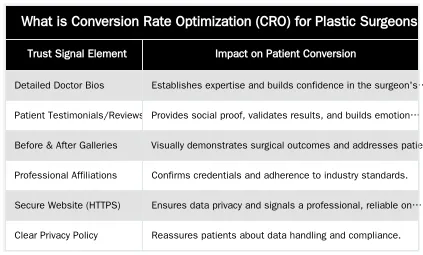
Patients seeking plastic surgery are making life-altering decisions and require evidence of a practitioner’s credentials and patient satisfaction. Websites communicating trust through detailed doctor bios, patient testimonials, and transparent information achieve higher conversion rates. For more on building authority, refer to resources on expertise and authority.
Essential CRO Strategies for Boosting Patient Consultations
Optimizing Your Landing Pages and Calls-to-Action (CTAs)
Landing pages are the first point of contact for patients interested in a specific procedure. They must be focused and clear, with compelling headlines, concise procedure information, and strong visuals. The most critical component is the Call-to-Action (CTA).
CTAs must be prominent, clear, and action-oriented, such as “Book Your Private Consultation” or “Request a Virtual Consultation.” CTAs should be visible above the fold and repeated on the page. The wording should convey value and urgency without being aggressive. For strategies on how SEO and web design underpin CRO, explore plastic surgery SEO in London.
Designing High-Converting Consultation Forms
Consultation forms are a primary conversion point, and their design directly impacts submission rates. Keep forms brief, asking only for essential information (e.g., name, email, phone). Longer forms deter patients; use multi-step forms if more information is necessary, breaking the process into smaller steps.
Forms must be mobile-friendly with large input fields and clear labels. Provide explicit privacy assurances for sensitive medical information. A clear, visually distinct “Submit” button is vital. Research on form design best practices highlights brevity and clarity.
Enhancing User Experience (UX) and Building Trust Online
The Impact of Page Speed and Mobile Responsiveness
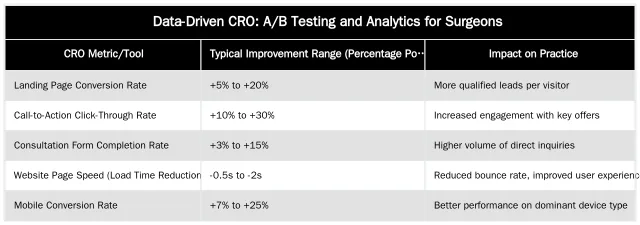
Slow loading times deter visitors, many of whom use mobile devices. A slow or non-mobile-optimized site leads to high bounce rates and lost opportunities. Google’s Core Web Vitals are ranking factors that correlate with user satisfaction and conversion. Improve performance by optimizing images, leveraging browser caching, and using efficient hosting. Users expect pages to load in 2-3 seconds; longer times increase abandonment. For more on web performance, consult Google’s Web Vitals.
Leveraging Trust Signals: Testimonials, Doctor Bios, and Security
Detailed doctor biographies highlighting qualifications, specializations, and experience establish expertise. Patient testimonials and before-and-after galleries provide social proof and demonstrate successful outcomes. Professional affiliations, like GMC registration or surgical association memberships, lend credibility. A secure website (HTTPS) is a fundamental trust signal that protects visitor data. Transparent pricing information can also build confidence.
Data-Driven CRO: A/B Testing and Analytics for Surgeons
Abdurrahman Şimşek’s expertise in semantic engineering and data science helps interpret user data to create CRO strategies. This involves understanding user behavior and intent to align website elements accordingly.
Implementing A/B Testing for Continuous Improvement
A/B testing (split testing) compares two versions of a webpage or element to determine which performs better. For a plastic surgery website, this can include testing CTA button colors, headlines, form arrangements, or landing page layouts. Showing different versions to audience segments scientifically determines which elements yield higher conversion rates.
For example, a practice could A/B test a “Book Consultation” button with “Schedule Your Private Consultation” versus “Get a Free Assessment.” The version generating more clicks or submissions wins. This iterative process refines and optimizes the patient journey.
Utilizing Analytics and Heatmaps to Uncover Insights
Tools like Google Analytics provide data on traffic, demographics, behavior flow, and conversion funnels. Analyzing this data helps identify pages with high bounce rates, common exit points, and where users drop off before converting. This quantitative data reveals “what” is happening.
Heatmaps and session recordings provide qualitative insights into “why” users behave certain ways. Heatmaps show where users click, scroll, and spend time, highlighting interest or confusion. Session recordings of anonymized user journeys reveal friction points and usability issues. Combining these tools provides a comprehensive understanding of user behavior to inform CRO strategies.
Achieving Tangible Results: What to Expect from CRO
Increased Consultation Bookings and Patient Acquisition
Effective CRO directly increases consultation bookings. Streamlining the patient journey means more visitors schedule appointments, which translates into more qualified leads and new patients. A higher conversion rate makes marketing more efficient, acquiring more patients without increasing the advertising budget.
Improved Marketing ROI and Business Growth
When a website converts a higher percentage of visitors, every marketing dollar becomes more effective, improving ROI. Practices can acquire more patients by leveraging existing traffic efficiently instead of increasing ad spend. This efficiency fuels business growth, allowing for strategic resource allocation, technology investment, or service expansion.
Partner with a Specialist for Your CRO Success
Optimizing for patient conversions requires technical expertise, marketing insight, and an understanding of the medical aesthetics industry. For London plastic surgeons, navigating digital marketing and CRO is challenging. A specialist can integrate CRO with semantic SEO and web development.
Abdurrahman Şimşek provides expertise in building high-converting websites and semantic content networks for medical clinics and plastic surgeons. Leverage a decade of experience to turn your online presence into a patient acquisition engine.
Conclusion
For plastic surgeons, a conversion rate optimization strategy is necessary to thrive online. Focusing on clear CTAs, streamlined forms, user experience, and E-E-A-T principles increases patient consultations. A data-driven approach using A/B testing and analytics ensures continuous improvement and measurable results. Discover how specialized semantic SEO and web development can transform your digital presence by visiting abdurrahmansimsek.com.
Frequently Asked Questions
What is the most critical initial step in cro for plastic surgeons to improve patient conversions?
For cro for plastic surgeons, start by optimizing your calls-to-action (CTAs) and contact forms. Ensure CTAs are clear and compelling, like ‘Book Your Private Consultation,’ and forms are simple, mobile-friendly, and only ask for essential information to reduce friction. This foundational step is crucial for turning visitors into leads.
How significantly does website page speed impact conversion rates for plastic surgery practices?
Page speed dramatically affects conversion rates, a key aspect of effective conversion rate optimization. Slow-loading websites are major conversion killers, as potential patients are often impatient and will quickly leave for a competitor’s faster site if procedure pages or galleries take too long to load. Optimizing speed is a vital component of successful CRO.
What types of social proof are most effective for improving patient conversions in plastic surgery?
Video testimonials and detailed case studies are the most powerful forms of social proof for plastic surgeons. They build immense trust by allowing potential patients to see real results and hear authentic experiences, which is far more persuasive than simple star ratings. Integrating these elements is a core strategy in cro for plastic surgeons.
Should plastic surgery procedure pages include pricing details for better conversion?
While exact pricing can be complex, providing a clear price range or a detailed explanation of cost-influencing factors can significantly improve conversions. This transparency builds trust and pre-qualifies leads, ensuring inquiries come from patients who understand the investment involved. It’s a strategic move in conversion rate optimization.
How can plastic surgeons identify effective areas for A/B testing in their conversion rate optimization efforts?
To identify what to test for better conversion, use tools like heatmaps (e.g., Hotjar) to observe user behavior, clicks, and areas of friction. This data helps form hypotheses, such as “changing the CTA button color will increase clicks,” which can then be validated through A/B testing to improve performance. This data-driven approach is fundamental for effective CRO.
How can cro for plastic surgeons be effectively implemented to boost patient consultations?
To effectively implement cro for plastic surgeons, begin with a comprehensive audit of your website’s current performance and user journey. Partnering with a specialist in medical SEO and CRO, like Abdurrahman Şimşek, can provide a tailored blueprint and expert guidance to optimize for higher patient conversions and practice growth. This ensures a strategic and data-driven approach.
What exactly is cro for plastic surgeons and why is it crucial for practice growth?
CRO for plastic surgeons involves systematically optimizing your website and digital assets to increase the percentage of visitors who complete a desired action, such as booking a consultation or filling out a contact form. It’s crucial because it maximizes the return on your existing marketing spend by converting more interested visitors into actual patients, driving sustainable practice growth.
Ruxi Data brings together multi-model AI, automated website crawling, live indexation checks, topical authority mapping, E-E-A-T enrichment, schema generation, and full pipeline automation — from crawl to WordPress publish to social posting — all in one platform built for agencies and freelancers who run on results.