
Establishing E-e-a-t for Surgeons: Building Digital Trust and Visibility
For surgeons, establishing e-e-a-t for surgeons is fundamental for digital success and patient acquisition. This guide details how to build online credibility, crucial for YMYL content and high search rankings. It covers foundational content like physician credentials and optimized bio pages, alongside external trust signals such as patient reviews. Implementing semantic SEO strategies helps surgeons demonstrate expertise and authority, satisfying Google Quality Rater Guidelines and securing prominent visibility in competitive medical markets. Effectively establishing E-E-A-T for surgeons ensures patient trust and sustained practice growth.
As a Semantic SEO Strategist, Abdurrahman Şimşek provides actionable insights for medical professionals. This content offers a strategic framework for surgeons to enhance their online presence and build robust digital authority, aligning with search engine requirements for medical content.
To explore your options, contact us to schedule your consultation. You can also reach us via: Book a Semantic SEO Audit, Direct WhatsApp Strategy Line: +90 506 206 86 86
For surgeons in the London private healthcare market, establishing e-e-a-t for surgeons is a foundational requirement for digital success. E-E-A-T (Experience, Expertise, Authoritativeness, Trust) is critical for medical SEO, attracting high-value patients and securing search visibility for medical practices in 2026.
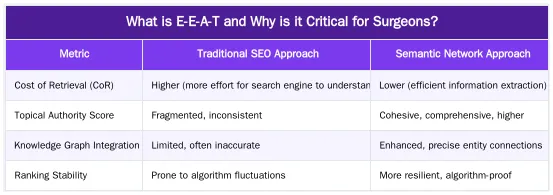
What is E-E-A-T and Why is it Critical for Surgeons?
E-E-A-T (Experience, Expertise, Authoritativeness, and Trust) is Google’s framework for evaluating content quality, especially for “Your Money or Your Life” (YMYL) topics like health and finance. For surgeons, E-E-A-T directly influences search rankings and patient perception. Google’s Quality Rater Guidelines state that YMYL content must come from highly credible sources. Without strong E-E-A-T signals, a surgeon’s website may struggle to rank, impacting patient trust and visibility.
Surgical practices are a YMYL category. Patients seek reliable information from qualified professionals before making health decisions. Search engines prioritize content from sources showing credentials and positive patient outcomes. An E-E-A-T strategy is non-negotiable for surgeons seeking digital prominence and patient acquisition in 2026.
Understanding E-E-A-T is fundamental to the definitive guide to SEO for private healthcare clinics in London. Neglecting these signals leads to lower rankings and reduced patient engagement, affecting a practice’s growth.
Building Foundational E-E-A-T: Content & Credentials
Demonstrating experience and expertise begins with website content. Craft pages highlighting professional background, specializations, and patient-centric information. Structured content helps search engines and patients verify a surgeon’s qualifications.
Optimizing Surgeon Bio Pages & Professional Profiles
A surgeon’s bio page is key for online credibility. It should feature professional headshots, a detailed career overview, and a personal statement conveying empathy and dedication. Articulate specializations, years of experience, and patient care philosophy. Include information on specific procedures and patient outcomes. This detail builds trust and helps pages rank.
Maintaining updated profiles on professional platforms and directories reinforces online presence. These external profiles should mirror the surgeon’s site for consistency and visibility. Consistency across platforms strengthens the surgeon’s entity recognition by search engines.
Showcasing Medical Qualifications, Memberships & Awards
Display medical degrees, board certifications, and professional association memberships. List relevant qualifications, like GMC registration in the UK, and memberships with bodies like BAAPS (British Association of Aesthetic Plastic Surgeons) or the Royal College of Surgeons. Link to the official websites of these organizations. This provides verifiable proof of credentials, boosting trust signals.
Awards, publications, and research contributions enhance expertise and authority. Present these achievements clearly in a dedicated section or within the bio. This informs patients and signals to search engines that the surgeon is a leader in their field. For more on this, see Medical SEO Services for Surgeons: A Data-Driven E-E-A-T Framework.
Cultivating Trust: Patient Reviews & External Validation
Trust is a critical E-E-A-T component in medicine. Patient reviews and external validation endorse a surgeon’s competence and ethical practice. These signals show positive patient experiences, influencing prospective patients and search engine algorithms.
Leveraging Patient Testimonials and Online Reviews
Solicit and manage patient testimonials and online reviews. Encourage patients to leave reviews on platforms like Google Business Profile and Doctify. Display testimonials on the website with patient consent and attribution. Schema markup for reviews can enable rich snippets in search results, enhancing credibility.
Responding professionally to all reviews, positive and negative, shows commitment to patient care. This transparency builds trust. Consistent positive reviews across multiple platforms create a strong digital reputation.
The Role of Digital PR and Authoritative Mentions
Mentions, features, and backlinks from reputable medical journals, news outlets, and health publications boost a surgeon’s authoritativeness and trust signals. Digital PR positions the surgeon as an expert source. References from respected external entities act as a vote of confidence for search engines.
Media engagement, expert commentary, or published research can lead to high-quality backlinks. These links from authoritative domains transfer SEO value, reinforcing E-E-A-T. External validation is a key differentiator in competitive markets like London.
Beyond Basics: Semantic E-E-A-T for Surgical Authority
Advanced semantic SEO strategies provide an algorithm-proof foundation for surgical authority. This includes structuring content for entity recognition, contributing to the Knowledge Graph, and optimizing for “Cost of Retrieval” (CoR), which signals understanding and relevance to search engines.
Structuring Content for Entity Recognition (EAV Modeling)
Entity-Attribute-Value (EAV) modeling helps search engines understand medical procedures and surgeon expertise. By defining entities (e.g., “Rhinoplasty”), their attributes (e.g., “recovery time,” “anesthesia type”), and their values, content becomes structured and machine-readable. This data feeds Google’s Knowledge Graph, reinforcing E-E-A-T by associating the surgeon with specific medical knowledge.
EAV modeling maps the semantic landscape of a surgical practice, not just keywords. This includes the surgeon, procedures, treated conditions, and associated concepts. This approach helps search engines connect a surgeon to their areas of expertise, enhancing authority.
The Impact of Semantic Networks on E-E-A-T & CoR
A semantic content network is interconnected content covering a topic cluster to demonstrate knowledge. This network, supported by tools like Ruxi Data, reduces Google’s ‘Cost of Retrieval’ (CoR). When a search engine can efficiently extract accurate information from a site, it signals higher authority, improving rankings and visibility.
Ruxi Data automates identifying topical gaps and structuring content to build these networks, creating a cohesive, authoritative digital presence. This approach to topical authority is a key differentiator in competitive markets. Understanding this relationship is vital for Knowledge Graph and E-E-A-T SEO.
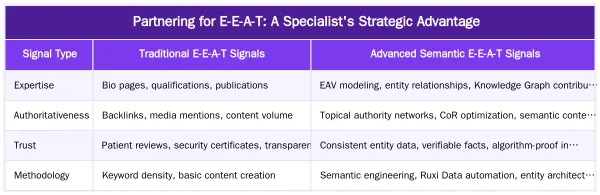
Partnering for E-E-A-T: A Specialist’s Strategic Advantage
For surgeons in YMYL niches, partnering with a specialist semantic SEO strategist is crucial. Generic SEO approaches often fail in the regulated medical field. A specialist understands healthcare digital marketing, patient privacy, and ethical content creation for YMYL SEO compliance.
Why Niche Expertise Matters for YMYL Domains
Generalist SEO agencies often lack the understanding for medical content. Risks include misinterpreting terminology, failing to follow regulatory guidelines (like GDPR and HIPAA), or creating content that lacks depth for E-E-A-T. A specialist has the domain knowledge to accurately represent surgical procedures and patient care, ensuring content is medically sound and SEO-optimized. This insight is critical for avoiding YMYL ranking pitfalls and building authority.
London’s private healthcare market demands an SEO strategy beyond basic keyword optimization. It requires understanding patient search intent, medical advertising ethics, and the technical intricacies of medical websites. This niche expertise ensures SEO efforts contribute to a surgeon’s E-E-A-T and digital success.
Abdurrahman Şimşek’s Approach to E-E-A-T Infrastructure
Abdurrahman Şimşek, a London-based Semantic SEO Strategist, specializes in building Semantic Content Networks for medical clinics and plastic surgeons. His methodology integrates semantic engineering, Entity-Attribute-Value (EAV) modeling, and Ruxi Data infrastructure to create algorithm-proof topical authority. This approach optimizes for search engine ‘Cost of Retrieval’ (CoR), making a surgeon’s website a source of expertise.
Using Ruxi Data, Abdurrahman Şimşek automates topical map creation and content structuring, creating a cohesive, authoritative digital presence. This framework attracts high-value patient cases in markets like Harley Street by establishing E-E-A-T that is resilient to algorithm updates. This is part of a comprehensive plastic surgery SEO blueprint.
Elevate Your Practice: Secure Your E-E-A-T Foundation
An E-E-A-T strategy is fundamental for surgeons. It ensures visibility, builds patient trust, and positions a practice as an authority. Every element, from foundational content to semantic engineering, contributes to an online presence. An E-E-A-T foundation is an investment in long-term success and patient acquisition.
Conclusion
For surgeons, a strong E-E-A-T profile is a prerequisite for attracting and converting high-value patients. By showcasing E-E-A-T through optimized content, reviews, and semantic strategies, medical practices build a digital foundation. This approach helps search engines recognize medical authority, leading to organic growth. To develop your E-E-A-T infrastructure, contact us. You can also Book a Semantic SEO Audit or reach out via Direct WhatsApp Strategy Line: +90 506 206 86 86.
Frequently Asked Questions
Why is establishing e-e-a-t for surgeons essential for digital success?
E-E-A-T (Experience, Expertise, Authoritativeness, Trust) is Google’s framework for evaluating Your Money or Your Life (YMYL) content, which includes all medical information. For surgeons, establishing e-e-a-t for surgeons is non-negotiable as it directly impacts rankings, patient trust, and the ability to attract high-value cases. Without strong E-E-A-T, a surgeon’s website may struggle to rank, impacting patient trust and visibility.
What are the key foundational signals for establishing e-e-a-t for surgeons?
Key signals for building this trust include detailed author bios with verifiable credentials, genuine patient reviews and testimonials, and comprehensive ‘About Us’ pages detailing the clinic’s philosophy. Showcasing memberships in professional bodies and publishing peer-reviewed articles or studies also significantly contribute to establishing e-e-a-t for surgeons. These elements collectively build a strong profile of trustworthiness and expertise.
How does semantic SEO help in establishing e-e-a-t for surgeons?
Semantic SEO structures your website’s data so search engines can easily understand your credentials, specialties, and authority. Using advanced schema like ‘Physician’ and ‘MedicalProcedure’ explicitly communicates your expertise, which is a core component of establishing e-e-a-t for surgeons. This precise data organization helps search engines confidently recommend your practice to relevant patients.
How can a new surgical practice accelerate establishing e-e-a-t for surgeons?
While true authority takes time, a new clinic can accelerate the process by focusing on foundational content from day one. This includes comprehensive surgeon bios, transparent pricing and procedure pages, and actively soliciting patient reviews. A technically sound website that is fast and secure also provides an immediate trust signal, aiding in establishing e-e-a-t for surgeons.
Beyond content, what other factors contribute to establishing e-e-a-t for surgeons?
E-E-A-T is holistic and extends beyond just on-page content. Signals also include your off-page reputation, such as mentions in reputable medical journals or professional directories, and positive patient reviews on third-party sites. The technical performance, security, and user experience of your website also play a crucial role in establishing e-e-a-t for surgeons.
How can I get expert help with my clinic’s E-E-A-T strategy?
For a tailored approach to enhancing your online presence and authority, consider booking a Semantic SEO Audit with Abdurrahman Şimşek. As a specialist in medical and plastic surgery SEO, he can provide strategic guidance on building a robust E-E-A-T foundation. You can also reach out directly via the contact page or WhatsApp for immediate strategy discussions.
Ruxi Data brings together multi-model AI, automated website crawling, live indexation checks, topical authority mapping, E-E-A-T enrichment, schema generation, and full pipeline automation — from crawl to WordPress publish to social posting — all in one platform built for agencies and freelancers who run on results.