
Measure SEO Impact: Quantifying Semantic Network Performance
To measure seo impact of a semantic content network, medical clinics require a precise framework to quantify digital performance. This article outlines key performance indicators (KPIs) and tools, including Google Search Console, to assess organic traffic, keyword rankings, and user engagement. Understanding how to measure SEO impact validates topical authority, demonstrates content ROI, and informs strategic content expansion for sustained patient acquisition.
Abdurrahman Şimşek, a Semantic SEO Strategist with 10+ years of experience, specializes in building high-authority Semantic Content Networks for medical and aesthetic clinics. His expertise focuses on quantifying topical authority and connecting SCN performance directly to patient acquisition and clinic revenue.
To explore your options, contact us to schedule your consultation. You can also reach us via: Book a Semantic SEO Audit, Direct WhatsApp Strategy Line: +90 506 206 86 86
To measure seo impact of a semantic content network, plastic surgeons and aesthetic clinic owners require a precise framework. This article outlines the metrics and tools to quantify digital performance, demonstrate return on investment, and inform content strategy. Understanding these elements is vital for medical practices aiming for online growth and patient acquisition in 2026.
Why Measuring Your Semantic Content Network’s Impact is Crucial for Clinic Growth
Measuring a semantic content network’s (SCN) impact helps medical clinics validate their investment and refine digital strategy. An SCN organizes information around entities and their relationships to build topical authority. Measurement ensures these efforts translate into business outcomes.
- Demonstrates ROI: Quantifies the financial return on content investment, justifying resources.
- Informs Strategy: Provides data-driven insights to optimize existing content and plan future topics.
- Validates Topical Authority: Confirms the network’s effectiveness in establishing expertise and trust.
- Identifies Growth Opportunities: Pinpoints areas for network expansion or improvement for greater visibility.
- Secures Competitive Advantage: Allows clinics to adapt to algorithm changes and maintain market leadership.
Understanding the Value of a Semantic Content Network
Semantic content networks comprehensively cover a topic, establishing a clinic as an authoritative source. This approach improves search visibility for complex medical topics by aligning content with how search engines understand information, not just keywords. Building a Semantic Content Network (SCN) for topical authority in aesthetics ensures each piece of content reinforces the practice’s expertise.
Key Performance Indicators for Semantic SEO Success
Evaluating a semantic content network requires SEO KPIs beyond basic traffic. These metrics show how search engines understand your content and how prospective patients engage with it. Tracking these indicators assesses the value of your semantic strategy.
Tracking Organic Traffic & Keyword Performance
Monitor organic traffic growth, especially increases in organic sessions to pages within your semantic cluster. Analyze keyword rankings for head terms and long-tail, entity-based queries. A healthy SCN increases impression share across a broad range of relevant search terms, indicating Google’s confidence in your topical coverage. Track performance for the entire topic cluster, not just individual pages, to observe how related content supports visibility. This approach aligns with a strategy to quantify topic cluster impact.
Assessing Topical Authority Score & User Engagement
Topical authority score growth is a key indicator of SCN success. This is inferred from increased visibility for related entities, higher rankings for competitive terms, and appearance in SERP features like featured snippets or “People Also Ask” boxes. User engagement metrics are also vital. A low bounce rate, extended time on page, and more pages per session signal that users find your content relevant. These metrics confirm your content ranks, addresses user intent, fosters trust, and guides the patient journey.
Leveraging Google Search Console & Analytics for SCN Performance Insights
SEO reporting for a semantic content network relies on data from Google Search Console (GSC) and Google Analytics (GA4). These tools provide the data to understand search performance and user interaction. Integrating these insights via platforms like Looker Studio enables comprehensive analysis.
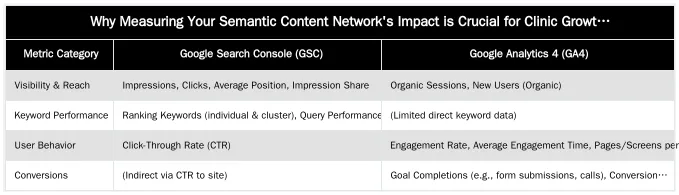
Google Search Console: Uncovering Impression Share & Entity Visibility
GSC is indispensable for measuring SCN search performance. The Performance report lets you filter data by pages or queries in your topic clusters to monitor impressions, clicks, and average position for core entities and supporting content. Tracking new ranking keywords identifies how your semantic network is expanding its SERP footprint. Impression share growth for the entire network indicates increasing topical authority and visibility. GSC data can also inform competitor SEO analysis.
Google Analytics: Measuring User Behavior & Conversion Paths
Google Analytics 4 (GA4) complements GSC with insights into on-site user behavior. Analyze organic traffic sources, user engagement, and conversion rates related to your SCN. Custom GA4 reports can track the patient journey from initial entry to conversion events like booking a consultation. This data shows which parts of your network are most effective at nurturing leads. Looker Studio can pull data from both GSC and GA4 for advanced visualization and comprehensive dashboards.
Connecting SCN Performance to Patient Acquisition & Clinic Revenue
An SEO strategy’s goal is to attract patients and increase revenue. Connecting SCN performance to business outcomes is critical for demonstrating ROI. This requires tracking organic conversion rates and the patient journey from search to consultation.
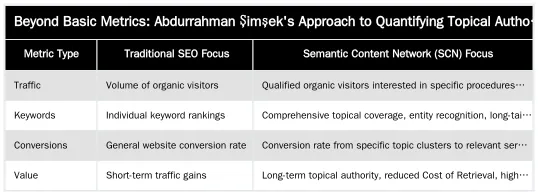
Calculating Content ROI for Surgical Practices
Calculating content ROI requires understanding patient lifetime value. Tracking the conversion rate from organic leads to consultations and procedures assigns a monetary value to SEO efforts. For example, if a topic cluster on “Rhinoplasty” generates leads that convert into high-value patients, you can attribute a portion of clinic revenue to that content. This demonstrates how organic conversion rates impact revenue, justifying investment in semantic SEO. Understanding how to measure topic cluster ROI is key for surgical practices.
From Organic Traffic to Booked Consultations
The SCN guides prospective patients through their decision-making process. By providing comprehensive information at each stage of the patient journey, from initial research to comparing procedures, the SCN nurtures leads. Tracking this journey involves monitoring how users interact with different content pieces before converting. For instance, a patient might read a guide on “facial rejuvenation,” then an article on “non-surgical rhinoplasty,” and finally land on a service page to book a consultation. This progression, facilitated by structured semantic content, drives conversions and contributes to booked consultations. Understanding the patient acquisition content blueprint is crucial for London’s private surgeons.
Ready to Quantify Your Semantic SEO Advantage?
Measuring a semantic content network’s SEO impact is paramount for a medical practice’s online growth. Focusing on correct KPIs, using advanced tools, and a strategic approach to topical authority allows clinics to track progress and link SEO efforts to patient acquisition and revenue. Partner with Abdurrahman Şimşek to quantify and amplify your semantic SEO advantage. Book a Semantic SEO Audit or reach out directly via WhatsApp Strategy Line: +90 506 206 86 86.
Conclusion
Measuring a semantic content network’s SEO impact allows clinics to track progress and link SEO efforts to patient acquisition and revenue. For a strategy tailored to your clinic, contact us, Book a Semantic SEO Audit, or connect via WhatsApp Strategy Line: +90 506 206 86 86.
Frequently Asked Questions
What are the primary metrics to measure SEO impact of a Semantic Content Network?
Key metrics include growth in organic traffic to the entire cluster, an increase in the number of ranking keywords for the topic, and improved rankings for the main pillar page keyword. These indicators help quantify the network’s effectiveness in attracting relevant users and improving overall search visibility.
How can Google Search Console help assess the performance of an SCN?
Google Search Console is crucial for evaluating SCN performance. By filtering reports by URL path (e.g., `/face-surgery/`), you can observe combined clicks, impressions, and average position for the entire content hub, providing direct insights into its search visibility.
Beyond traffic, what other indicators should I look for to measure SEO impact?
Look for improvements in user engagement metrics like time on page and lower bounce rates, which signal content quality and user satisfaction. Additionally, tracking goal completions (e.g., consultation form fills) originating from pages within the SCN helps measure SEO impact on critical business objectives.
How do you quantify topical authority itself within a semantic content network?
Topical authority is assessed by its effects: achieving high, stable rankings for competitive head terms and ranking for a broad spectrum of long-tail keywords within the topic. This demonstrates Google’s recognition of your site as a comprehensive and trusted resource, reducing reliance on sheer backlink volume.
Ruxi Data brings together multi-model AI, automated website crawling, live indexation checks, topical authority mapping, E-E-A-T enrichment, schema generation, and full pipeline automation — from crawl to WordPress publish to social posting — all in one platform built for agencies and freelancers who run on results.