
Semantic Content Network: Building Topical Authority in Aesthetics
Designing a semantic content network (SCN) is crucial for aesthetic clinics to establish robust topical authority and attract high-value patients. This article details how an SCN moves beyond keyword-centric strategies, organizing content around entities and their relationships to mirror search engine understanding. Readers will learn to architect their content using pillar pages, topic clusters, and the EAV model, leveraging tools like Ruxi Data for automated development. This entity-based approach is vital for YMYL industries, signaling expertise and trustworthiness to search engines and prospective patients.
Abdurrahman Şimşek, a Semantic SEO Strategist with 10+ years of experience, specializes in building high-authority semantic content networks for medical clinics. His expertise in semantic engineering and information retrieval ensures content architecture that meets stringent E-E-A-T requirements for YMYL niches.
To explore your options, contact us to schedule your consultation. You can also reach us via: Book a Semantic SEO Audit, Direct WhatsApp Strategy Line: +90 506 206 86 86
Ranking for keywords is no longer enough in aesthetic medicine. Designing a semantic content network (SCN) establishes topical authority and attracts high-value patients. This guide covers the architecture, benefits, and implementation of SCNs for plastic surgeons and aesthetic clinics. An SCN is crucial for medical practices seeking sustained organic growth and patient trust.
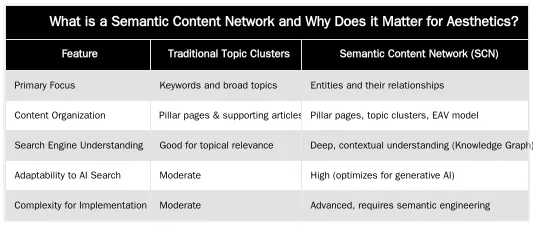
What is a Semantic Content Network and Why Does it Matter for Aesthetics?
A Semantic Content Network (SCN) is an SEO architecture that organizes website content around entities and their relationships, moving beyond keyword-centric strategies. It creates a structured, interconnected web of information that mirrors how search engines understand the world. For aesthetic clinics and plastic surgeons, an SCN is critical because it builds topical authority and trust signals, essential for Google’s ranking algorithms in Your Money Your Life (YMYL) industries.
Beyond Keywords: Understanding Entity-Based SEO for Medical Practices
Google’s algorithms no longer match keywords; they understand entities—real-world concepts like “Rhinoplasty,” “Breast Augmentation,” or “Harley Street Clinic.” This entity-based approach allows search engines to grasp the nuances of medical procedures, conditions, and treatments. A structured content architecture communicates your website’s expertise in a machine-readable format, establishing your clinic as a definitive source of information.
The Imperative of Topical Authority in YMYL Niches
Topical authority is non-negotiable in YMYL sectors like aesthetic medicine. Google’s Quality Rater Guidelines emphasize Expertise, Experience, Authoritativeness, and Trustworthiness (E-E-A-T). A comprehensive content structure demonstrates knowledge across an entire subject area, not just isolated keywords. This signals to search engines that your clinic is a reliable, authoritative source, which is crucial for building patient trust and achieving high rankings for sensitive medical queries. For more on foundational content architecture, see Semantic Architecture for Plastic Surgeons.
Architecting Your Semantic Content Network: Pillars, Clusters, and EAV
Structuring an SCN involves pillar pages and topic clusters, augmented by semantic modeling. This approach ensures comprehensive coverage and precise definition of medical concepts, making content intelligible to search engines and patients.
Pillar Pages and Topic Clusters: The Foundational Structure
An SCN begins with pillar pages: comprehensive guides on broad topics (e.g., “Breast Augmentation”). These pages are central hubs, internally linking to supporting topic clusters. Topic clusters are specific articles on sub-topics related to the pillar (e.g., “Recovery Timeline for Breast Augmentation,” “Types of Breast Implants,” “Choosing a Surgeon for Breast Augmentation”). This interlinking strategy reinforces topical relevance and authority. For more on this structure, refer to Pillar Page SEO Strategy.
Implementing the Entity-Attribute-Value (EAV) Model for Medical Content
The Entity-Attribute-Value (EAV) model is a core component of an SCN for medical content. It defines medical entities (e.g., ‘Rhinoplasty’) and their attributes (e.g., ‘Procedure Duration’, ‘Anesthesia Type’, ‘Ideal Candidate’, ‘Potential Risks’). This structured data approach creates precise and informative content. Applying the EAV model creates a machine-readable dataset that enhances search engine understanding and improves the potential for rich snippets and AI-generated answers. Learn more about this model in Entity-Attribute-Value (EAV) SEO: A Practical Guide for Medical Practices.
Leveraging Ruxi Data for Automated Semantic Content Network Development
Abdurrahman Şimşek, a London-based Semantic SEO Strategist with over 10 years of experience, specializes in building high-authority SCNs for medical clinics. His methodology uses Ruxi Data, a semantic engine, to automate and optimize the development of these content structures. This approach ensures all content contributes to the clinic’s topical authority and E-E-A-T signals.
From Data to Drafts: Automating Content Briefs for Medical Writers
Ruxi Data analyzes search engine results pages (SERPs) and knowledge graphs to identify topical gaps and entity relationships. This automates the generation of detailed content briefs. These briefs guide medical writers, ensuring each article is semantically optimized, covers all necessary entity attributes, and contributes to the SCN. This streamlines content production while maintaining accuracy and relevance. For more on this, see Scaling Medical SEO: Automating Topical Maps with Ruxi Data for London Clinics.
Scaling Content Production Without Sacrificing Quality or E-E-A-T
Automation guided by semantic engineering principles allows medical clinics to expand their content footprint efficiently. Ruxi Data’s ability to generate precise content requirements means quality and E-E-A-T standards remain high even with increased production. This is crucial for YMYL industries where accuracy and authority are paramount. Abdurrahman Şimşek’s expertise ensures this automation produces strategic, high-quality content for search engines and prospective patients.
The Impact of an SCN: Achieving Unrivaled Topical Authority and Patient Acquisition
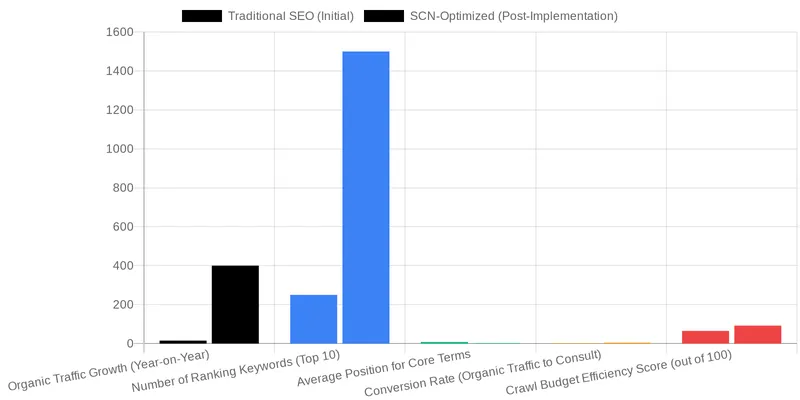
Implementing an SCN yields benefits for aesthetic clinics, including improved search visibility, patient trust, and higher conversion rates. This positions your clinic as an authority, attracting qualified patient leads.
Dominating Search Visibility for Niche Cosmetic Procedures
Topical authority from an SCN leads to higher rankings for a wider array of high-value search queries. Instead of ranking for a few broad terms, your clinic’s website will appear for numerous long-tail and niche cosmetic procedure searches, attracting qualified patient leads seeking specific treatments. This comprehensive visibility helps your clinic capture a larger share of the aesthetic market, particularly in competitive areas like London. Page structure is discussed in Pillar Page SEO Strategy.
Future-Proofing Your Clinic’s SEO Against Algorithm Updates and Generative AI
An entity-first approach makes your content more resilient to Google’s algorithm updates. By focusing on semantic understanding rather than keyword density, your content aligns with how search engines evaluate information. A structured SCN positions your content for inclusion in AI Overviews and other generative search features, which rely on well-defined entities and relationships to synthesize answers. This strategy supports long-term organic success.
Ready to Transform Your Clinic’s Online Presence?
Implementing a semantic content network requires expertise in semantic engineering and medical SEO. For plastic surgery practices or aesthetic clinics in London seeking topical authority and high-value patients, Abdurrahman Şimşek offers strategic guidance and technical implementation. Leverage over a decade of experience in crafting algorithm-proof content architectures.
Conclusion
Implementing a semantic content network is necessary for aesthetic clinics to dominate search results and build patient trust. By shifting from keyword-centric tactics to an entity-based approach, using tools like Ruxi Data, and structuring content with models like EAV, medical practices can establish topical authority. This strategy improves search visibility and patient acquisition and future-proofs an online presence against evolving search algorithms and generative AI. To learn how an SCN can elevate your clinic’s digital strategy, Book a Semantic SEO Audit or reach out via the WhatsApp Strategy Line: +90 506 206 86 86.
Frequently Asked Questions
What is a semantic content network (SCN)?
A semantic content network is an advanced SEO architecture that organizes website content around entities and their relationships, rather than just keywords. It uses pillar pages and topic clusters to create a machine-readable map of your expertise, establishing deep topical authority. This structured approach helps search engines understand the full scope of your knowledge on a subject.
How is an SCN different from a standard blog structure?
A standard blog is often chronological or loosely categorized, focusing on individual posts. In contrast, an SCN is a deliberate, interconnected web of content designed to comprehensively cover a topic, proving expertise to search engines. This strategic organization guides users through their journey, providing a complete information experience.
Why is a semantic content network crucial for aesthetics clinics?
For Your Money Your Life (YMYL) topics like aesthetics, demonstrating E-E-A-T (Experience, Expertise, Authoritativeness, Trustworthiness) is non-negotiable. A well-designed semantic content network proves your comprehensive knowledge on procedures, conditions, and outcomes. This robust demonstration of expertise is a powerful signal of authority to Google, building patient trust and driving organic growth.
What are the first steps to designing a comprehensive content architecture?
Begin by identifying your core entities, such as specific aesthetic procedures like ‘rhinoplasty’ or ‘dermal fillers’. Next, map out all related sub-topics, common patient questions, and procedural details to form your topic clusters. This meticulous process creates the foundational blueprint for your entire content structure.
Can specialized tools like Ruxi Data help build this type of content infrastructure?
Yes, specialized semantic infrastructure like Ruxi Data can significantly automate and streamline the development process. It assists in modeling entities and their attributes (EAV), mapping intricate topical relationships, and generating the optimal structure for a robust content network. This saves considerable time and ensures a highly effective setup.
How can I get started with designing a semantic content network for my clinic?
Abdurrahman Şimşek specializes in building high-authority semantic content networks for medical clinics and plastic surgeons. You can book a Semantic SEO Audit directly through his website to assess your current strategy and outline a tailored SCN plan. Alternatively, reach out via the direct WhatsApp Strategy Line: +90 506 206 86 86 for immediate consultation.
Ruxi Data brings together multi-model AI, automated website crawling, live indexation checks, topical authority mapping, E-E-A-T enrichment, schema generation, and full pipeline automation — from crawl to WordPress publish to social posting — all in one platform built for agencies and freelancers who run on results.