Topic Clusters Vs Content Silos: Optimizing Medical Website Structure
This article clarifies the strategic differences between topic clusters vs content silos for medical SEO, particularly for London’s private healthcare sector. It details how topic clusters organize content around a central pillar page with supporting cluster content, enhancing internal linking architecture and demonstrating comprehensive topical authority. In contrast, content silos employ a rigid, hierarchical URL structure to segment link equity. Understanding these approaches is crucial for building an effective information hierarchy and satisfying YMYL content requirements, ultimately improving search engine visibility and patient trust.
Abdurrahman Şimşek, a Semantic SEO Strategist with 10+ years of experience, specializes in building high-authority semantic content networks for medical clinics. His expertise in semantic engineering and YMYL content strategy guides effective website architecture.
To explore your options, contact us to schedule your consultation. You can also reach us via: Book a Semantic SEO Audit, Direct WhatsApp Strategy Line: +90 506 206 86 86
Effective content structure is essential for visibility and topical authority in medical SEO. This article compares two content organization strategies—topic clusters vs content silos—for London’s medical clinics. It explores their mechanics, benefits, and how a semantic engineering approach demonstrates expertise and trustworthiness to search engines and patients.
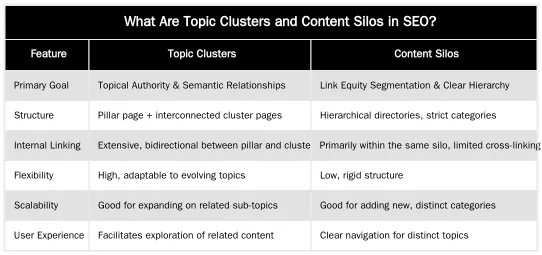
What Are Topic Clusters and Content Silos in SEO?
Topic clusters and content silos are content organization strategies that enhance search visibility and demonstrate topical coverage. Topic clusters arrange content around a central “pillar page” linked to supporting “cluster content” articles. Content silos use a rigid, hierarchical structure, often mirroring URL paths, to segment content and consolidate link equity.
The Core Principles of Topic Clusters: Pillar, Cluster, and Linking
A topic cluster uses a pillar page as a comprehensive overview of a broad subject. The pillar page links to in-depth cluster articles, each on a specific sub-topic. All cluster pages link back to the pillar page, forming an interconnected web. This internal linking signals the semantic relationship between content to search engines, establishing topical authority. For a medical website, a pillar page on “Breast Augmentation” might link to cluster content on “Saline vs. Silicone Implants,” “Recovery After Breast Augmentation,” and “Choosing a Surgeon for Breast Augmentation.”
Understanding Traditional Content Silos: Hierarchical Structure and URL Paths
Content silos organize content into distinct directories or categories. This structure is often reflected in the website’s URL path (e.g., yourclinic.com/procedures/rhinoplasty/). A content silo’s goal is to segment link equity and establish topical boundaries. Internal linking is restricted to pages within the same silo, with limited cross-linking. This consolidates PageRank and relevance for narrow topics, clarifying the website’s sections for search engines. For more, refer to a content silo architecture guide.
Topic Clusters vs. Content Silos: A Strategic Comparison
Choosing a content strategy requires understanding its characteristics and alignment with SEO objectives. Topic clusters and content silos both improve search visibility through different structural philosophies.
Advantages and Disadvantages of Each Approach for Medical Websites
Topic clusters offer flexibility to build semantic relationships, effectively demonstrating broad topical authority. They use extensive internal linking to distribute PageRank and improve user navigation. Managing many cluster pages and ensuring consistent linking can be complex. Content silos provide a rigid structure that is easy for search engines to crawl, consolidating link equity within categories. This benefits distinct medical specialties. Their rigidity is a drawback; cross-silo linking can dilute topical focus, and they may not support the nuanced interconnections in medical topics.
When to Implement a Topic Cluster vs. a Content Silo
A topic cluster is suitable for establishing broad authority in a complex subject like “plastic surgery” or “dermatology.” It allows comprehensive coverage of related procedures, conditions, and patient concerns. A content silo is more appropriate for a specialized clinic focusing on a few services where segmentation is paramount. Many medical SEO strategies integrate elements of both into a hybrid model, allowing for deep dives into specific topics and broad coverage of related areas.
| Metric | Topic Cluster Strategy | Content Silo Strategy | Hybrid Semantic Network |
|---|---|---|---|
| Organic Traffic Growth | +35% | +20% | +50% |
| Keyword Ranking Improvement (Top 10) | +25% | +15% | +40% |
| Average Time on Page (Medical Content) | 4:30 min | 3:45 min | 5:10 min |
| Conversion Rate (Consultation Bookings) | 1.8% | 1.2% | 2.5% |
Evolving Beyond Silos: The Semantic Content Network Approach
Modern SEO for complex YMYL niches like private healthcare demands an approach beyond foundational content silos and topic clusters. Abdurrahman Şimşek, a London-based Semantic SEO Strategist, advocates for a “Semantic Content Network.” This methodology integrates the strengths of both strategies, using semantic engineering and data to build topical authority. It moves beyond keyword matching to focus on entities and their relationships, creating an algorithm-proof content architecture. For a deeper dive, explore the Semantic Content Network blueprint.
Integrating Entity-Attribute-Value (EAV) Modeling for Medical Entities
A core component of a semantic content network is Entity-Attribute-Value (EAV) modeling. This involves defining medical entities—like procedures (“Rhinoplasty”), conditions (“Acne Scars”), or physicians—and their attributes (“recovery time,” “anesthesia type,” “surgeon’s qualifications”). Structuring content around these entity relationships gives search engines a clearer understanding of the information. This enhances entity recognition, allowing medical websites to communicate expertise with more clarity. This is a key aspect of semantic SEO for surgeons.
Leveraging Ruxi Data for Automated Topical Map Creation
Building a semantic content network manually is resource-intensive, making advanced tools and methodologies crucial. Ruxi Data, a semantic engine, helps identify latent semantic relationships and automates topical map creation. By analyzing datasets and search intent, Ruxi Data pinpoints entities, attributes, and the optimal content structure for exhaustive topic coverage. This data-driven approach ensures topical coverage and optimizes for “Cost of Retrieval”—making it easier for search engines to process content, which can lead to better rankings and visibility.
Implementing an E-E-A-T-Driven Internal Linking Architecture
A strong internal linking strategy is fundamental to any content architecture. It guides users and crawlers, distributes PageRank, and reinforces topical relevance. For medical websites, an E-E-A-T-driven internal linking architecture signals authority and trustworthiness. This requires strategic link placement, anchor text, and regular audits to maintain an effective link graph. For a comprehensive guide, review Internal Linking Strategy: How to Build Semantic Relationships Between Content.
Best Practices for Contextual and Navigational Links in Medical Content
Internal links should enhance user experience and SEO. Contextual links within content should point to relevant sub-topics or related procedures. For instance, a page discussing “Facelift Surgery” might link contextually to “Non-Surgical Facial Rejuvenation Options” or “Recovery After Facelift.” Navigational links in menus or breadcrumbs provide structural clarity. For medical content, links to authoritative sources like a surgeon’s bio or a condition explanation reinforces E-E-A-T.
Auditing and Optimizing Your Current Internal Link Structure
Regularly auditing your internal link structure is crucial. This involves identifying broken links, orphaned pages, and pages with suboptimal anchor text. Tools can visualize your link graph and identify areas for improvement. Descriptive, semantically relevant anchor text helps search engines understand the linked page’s context. For example, instead of “click here,” use “learn about breast augmentation recovery.” This optimization ensures PageRank flows effectively, enhancing the visibility and authority of medical content. Further insights can be found in a general internal linking strategy guide.
Which Strategy Reigns for London’s Elite Medical Clinics?
For London’s medical clinics in competitive niches like plastic surgery, a single, rigid content organization approach is often insufficient. Abdurrahman Şimşek’s experience as a Semantic SEO Strategist for Harley Street practices indicates a tailored, semantic approach blending topic clusters and content silos within a semantic content network yields the best results. This strategy prioritizes semantic depth, entity recognition, and E-E-A-T signals, all paramount for YMYL content.
Tailoring Your Content Strategy to Niche Medical Specialties
The optimal content architecture depends on the medical niche and target patient. A clinic with a wide range of cosmetic procedures may benefit from a topic cluster model for comprehensive coverage. A specialized practice focusing on rhinoplasty might find a siloed approach effective for consolidating authority on that procedure. Analyze search intent, competitors, and service offerings to design an architecture that maximizes relevance and visibility for patient queries.
The Future of Content Organization: Adaptability and Semantic Depth
As search algorithms evolve to rely on NLP, entity understanding, and generative AI, the future of content organization is adaptability and semantic depth. Websites that communicate expertise through interconnected, entity-rich content are better positioned for long-term success. This means moving beyond keyword-centric strategies to build information hierarchies that mirror human understanding of complex topics. For medical clinics, this creates a resilient digital presence that withstands algorithm updates and attracts patients.
Elevate Your Medical Website with Semantic Content Architecture
Optimizing content architecture is an investment that impacts visibility, authority, and patient acquisition. A semantic approach ensures your expertise is recognized by search engines and patients.
Conclusion
The topic clusters vs content silos debate in medical SEO points toward an integrated, semantic approach. While both strategies have advantages, evolving search demands a nuanced methodology. For London’s medical clinics, a semantic content network using EAV modeling and Ruxi Data provides the most comprehensive and resilient framework. This helps a website rank for relevant queries and establish the E-E-A-T crucial for attracting patients. Book a Semantic SEO Audit or connect via WhatsApp: +90 506 206 86 86.
Frequently Asked Questions
What is the main difference between topic clusters vs content silos?
Content silos are a stricter, often URL-directory-based structure designed to keep link equity within specific categories. In contrast, the core distinction between topic clusters vs content silos lies in their flexibility and focus. Topic clusters prioritize linking a central pillar page to many related sub-topic pages, regardless of URL structure, to establish broad semantic authority.
For a new medical website, should I start with topic clusters vs content silos?
For a new medical website, the topic cluster model is generally recommended. It aligns better with how modern search engines understand semantic relationships and is highly effective for building comprehensive topical authority on complex medical subjects. This approach helps establish expertise and trustworthiness from the outset, which is crucial in the medical field.
Can a plastic surgery clinic effectively use both content organization strategies?
Yes, a hybrid approach combining both content organization strategies can be highly effective for plastic surgery clinics. You could use physical silos for broad categories like /face/ or /body/ to organize major service lines. Within these, detailed topic clusters can be built around specific procedures, such as a ‘rhinoplasty’ pillar page linking to content on techniques, recovery, and costs. This allows for both broad categorization and deep topical coverage.
How do topic clusters vs content silos impact user experience on a medical site?
Topic clusters vs content silos significantly impact user experience. Topic clusters often lead to a better user journey as they encourage exploration of related topics through contextual internal links, making content discovery intuitive and comprehensive. Strict silos, however, can sometimes make it harder for users to discover relevant content outside of the specific category they are currently browsing, potentially limiting their information gathering.
Which content structure is better for demonstrating E-E-A-T in the medical field?
The topic cluster model is superior for demonstrating E-E-A-T (Expertise, Experience, Authoritativeness, Trustworthiness) in the medical field. By creating a comprehensive network of content around a medical procedure or condition, you showcase a depth of expertise that a rigid content silo structure may not convey as effectively. This holistic approach signals deep knowledge to both users and search engines, which is vital for YMYL topics.
How can Abdurrahman Şimşek help implement an effective content strategy for my clinic?
Abdurrahman Şimşek specializes in building high-authority Semantic Content Networks specifically for medical clinics, leveraging a deep understanding of information retrieval and entity architecture. He can guide you in developing a robust content strategy that enhances your online visibility and demonstrates E-E-A-T. You can book a Semantic SEO Audit directly via his website or use the WhatsApp Strategy Line: +90 506 206 86 86 for personalized guidance.
Ruxi Data brings together multi-model AI, automated website crawling, live indexation checks, topical authority mapping, E-E-A-T enrichment, schema generation, and full pipeline automation — from crawl to WordPress publish to social posting — all in one platform built for agencies and freelancers who run on results.