
Algorithmic Authorship: Verifying Medical Expertise for E-e-a-t
Algorithmic authorship establishes machine-readable connections between medical content and verifiable author expertise, crucial for E-E-A-T signals and higher search rankings. This strategy involves structuring information about content creators to allow search engines to programmatically validate credentials. By implementing author schema and leveraging entity SEO, medical websites build a robust digital identity for professionals within the Knowledge Graph. This semantic approach ensures that medical content, especially for Your Money or Your Life (YMYL) topics, is recognized as authoritative and trustworthy by search algorithms, directly impacting visibility and credibility.
Abdurrahman Şimşek, a Semantic SEO Strategist, specializes in optimizing digital content for search engine understanding and trust. This article reflects expertise in leveraging structured data and entity relationships to enhance online authority, particularly vital for sensitive medical information.
To explore your options, contact us to schedule your consultation. You can also reach us via: Book a Semantic SEO Audit, Direct WhatsApp Strategy Line: +90 506 206 86 86
In the highly sensitive realm of medical content, establishing trust and authority is paramount. This article delves into algorithmic authorship, a critical strategy for creating machine-readable connections between medical content and the verifiable expertise of its authors, thereby bolstering E-E-A-T signals and securing higher search rankings. Understanding how search engines process and validate expert credentials is fundamental for any medical practice aiming to rank for Your Money or Your Life (YMYL) topics in 2026 and beyond.
How Structured Data & Entity SEO Power Verifiable Expertise
The technical foundation of expert attribution lies in structured data. By implementing specific schema markup, medical websites can provide search engines with explicit signals about the authors of their content. This goes beyond simply displaying an author’s name; it involves defining the author as an entity with verifiable attributes. This structured information feeds into the Knowledge Graph, helping search engines build a comprehensive understanding of a medical professional’s digital identity and their areas of specialization. This approach is a key component of Knowledge Graph and E-E-A-T SEO, ensuring that expertise is not just stated but semantically understood.
Implementing Author & Physician Schema for Medical Content
JSON-LD is the recommended format for implementing schema markup. For medical content, the `Author` schema type can be enhanced with `Physician` schema properties. Key properties to include are `name`, `url` (linking to the author’s dedicated profile page), `alumniOf` (academic institutions), `hasCredential` (professional qualifications), `medicalSpecialty`, and `knowsAbout` (specific medical topics). This detailed markup provides a rich dataset for search engines to process. For practical guidance on this, refer to implementing author schema for E-E-A-T.
Connecting Authors to the Knowledge Graph via Entity Reconciliation
Consistent and comprehensive structured data facilitates entity reconciliation. This process helps search engines connect various mentions and data points about a medical professional across the web, consolidating them into a single, robust entity in the Knowledge Graph. When a surgeon’s name, credentials, and affiliations are consistently presented through structured data, it reinforces their authority. This consistency is vital for search engines to accurately assess and verify expertise, which is a core aspect of entity reconciliation in SEO. This forms part of implementing advanced medical schema for entity recognition.
Establishing Digital Identity: Verifiable Credentials for Medical Professionals
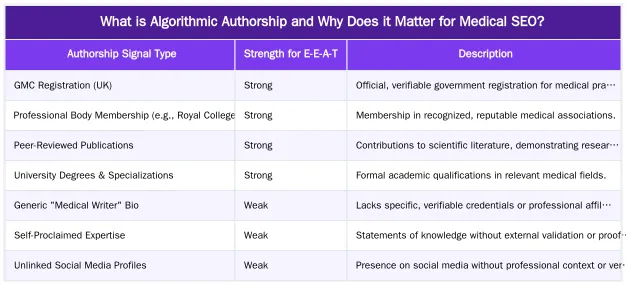
The strength of expert attribution hinges on the verifiability of real-world credentials. For medical content, this means linking digital profiles to official, external sources that confirm a professional’s qualifications and standing. Search engines prioritize signals that can be independently verified, making these credentials foundational for a credible digital identity. This is a crucial aspect of establishing foundational E-E-A-T signals for surgeons.
Leveraging GMC Registration and Professional Body Memberships
In the UK, General Medical Council (GMC) registration is a primary indicator of a medical professional’s legitimacy. Prominently displaying a surgeon’s GMC registration number and linking directly to their entry on the official GMC register provides irrefutable proof of their professional standing. Similarly, memberships in reputable professional bodies, such as Royal Colleges (e.g., Royal College of Surgeons), should be clearly stated and, where possible, linked to official directories. These external verifications are powerful signals of authority and trust for search engines and patients alike. For example, the General Medical Council website serves as a public registry for medical practitioners in the UK.
Showcasing Academic & Publication History for Enhanced Authority
Beyond basic registration, a medical professional’s academic and publication history significantly bolsters their digital authority. Linking to university profiles, detailing degrees and specializations, and showcasing peer-reviewed research papers or articles published in reputable medical journals (e.g., The Lancet, BMJ) provides concrete evidence of deep expertise. This demonstrates a commitment to advancing medical knowledge and contributes to a robust online professional profile.
The Impact of Strong Algorithmic Authorship on YMYL Rankings
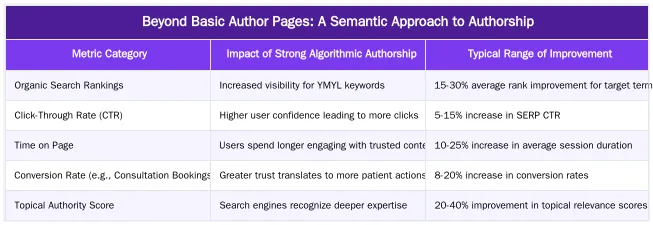
The effective implementation of expert attribution yields tangible benefits for medical websites, particularly in the competitive YMYL space. It directly influences search rankings, enhances user and search engine trust, and ultimately drives patient acquisition. By clearly signaling the verifiable expertise behind medical content, clinics can differentiate themselves and establish a dominant online presence.
Boosting Topical Authority and Reducing Cost of Retrieval
Clear and consistent expert attribution contributes significantly to a website’s overall topical authority. When search engines can easily identify and verify the credentials of authors contributing to a specific medical topic, they gain confidence in the content’s accuracy and reliability. This reduces the ‘Cost of Retrieval’ for Googlebot, meaning the search engine expends less effort to understand and trust the information. A lower Cost of Retrieval often correlates with improved crawl efficiency, better indexing, and ultimately, higher rankings for relevant queries. This systematic approach signals to search engines that the website is a definitive source of information within its medical niche.
Enhancing Patient Trust and Conversion Rates
Beyond algorithmic benefits, verifiable expertise directly impacts patient trust. When users see clear evidence of a medical professional’s qualifications, experience, and affiliations, their confidence in the information presented increases. This trust translates into higher engagement, longer time on site, and a greater likelihood of taking the desired action, such as booking a consultation. For medical clinics, this means improved conversion rates and a more efficient patient acquisition funnel.
Frequently Asked Questions
What is the primary goal of algorithmic authorship for medical content?
The goal of algorithmic authorship is to establish a machine-readable link between medical content and the real-world, verifiable credentials of its expert author. This explicit connection allows search engines to algorithmically confirm the “Expertise” and “Authoritativeness” components of E-E-A-T, which is crucial for Your Money or Your Life (YMYL) topics. It helps build trust and credibility in the eyes of search engines.
How does algorithmic authorship differ from a standard author bio?
A simple author bio is primarily text intended for human readers, offering basic information about the writer. In contrast, this structured approach leverages structured data, such as Author and Person Schema, to explicitly communicate to search engines who the author is, their verified credentials (e.g., GMC number), and their areas of expertise. This provides verifiable signals that a plain bio cannot.
What are the essential technical elements for implementing verifiable expertise through this method?
Key technical elements for establishing verifiable expertise include creating a comprehensive author page for each medical professional, implementing `Author` and `Person` schema markup, and utilizing `sameAs` properties. These properties link the on-site author profile to official, external verification sources like the GMC register, professional association websites, and reputable medical journal profiles.
Can Ruxi Data assist in automating the process of building algorithmic authorship?
Yes, Ruxi Data is designed to streamline the process of building algorithmic authorship. It can automatically generate the necessary schema markup for author pages and programmatically embed structured author data directly into articles. This ensures that every piece of content is accurately attributed to the correct expert in a scalable and efficient manner.
How can I get started with implementing a semantic SEO strategy for medical content, including verifiable authorship?
To begin enhancing your medical content with a robust semantic SEO strategy and implementing verifiable authorship, you can book a Semantic SEO Audit with Abdurrahman Şimşek. This audit will identify specific opportunities and provide a tailored roadmap for your London clinic. You can also reach out directly via WhatsApp for a strategy discussion.
How quickly can Google recognize these structured author signals?
Once the structured data for author verification is correctly implemented and the external connections are established, Google can begin processing these signals within a few weeks. However, building a strong, authoritative entity in the Knowledge Graph is an ongoing, cumulative process that gains strength and influence over time with consistent content publication.
Ruxi Data brings together multi-model AI, automated website crawling, live indexation checks, topical authority mapping, E-E-A-T enrichment, schema generation, and full pipeline automation — from crawl to WordPress publish to social posting — all in one platform built for agencies and freelancers who run on results.