
Automating Topical Maps: Building Medical Topical Authority
Automating topical maps with Ruxi Data revolutionizes medical SEO by providing a structured workflow for achieving topical authority. This approach systematically identifies content gaps and builds comprehensive content networks, crucial for medical clinics to establish E-E-A-T. By leveraging semantic SEO tools, clinics can efficiently map out all relevant entities and attributes within their specialty, ensuring complete coverage of patient queries and medical concepts. This strategic automation of topical maps transforms medical content planning, enabling scalable organic growth and enhanced search engine visibility in competitive healthcare markets.
Abdurrahman Şimşek, a Semantic SEO Strategist, specializes in building high-authority semantic content networks for medical clinics. His expertise in information retrieval and entity-attribute-value modeling provides a robust framework for advanced medical content configuration and sustained organic growth.
To explore your options, contact us to schedule your consultation.
In the competitive landscape of medical SEO, achieving topical authority is paramount. This article explores how automating topical maps with Ruxi Data provides a strategic workflow for medical clinics, enabling them to dominate search results and establish robust E-E-A-T. We delve into the methodology, benefits, and practical application of this advanced semantic SEO approach, crucial for practices aiming for organic growth in competitive markets like London.
What are Automated Topical Maps, and Why Do Medical Clinics Need Them?
A topical map is a structured representation of all relevant topics and subtopics within a specific niche, demonstrating comprehensive coverage and establishing authority on a subject. For medical clinics, these maps are essential blueprints for content strategy, ensuring that every patient query and related medical concept is addressed. They guide the creation of interconnected content, signaling to search engines a deep understanding of the subject matter and fostering trust.
In the medical field, where accuracy and comprehensiveness are critical for E-E-A-T (Experience, Expertise, Authoritativeness, Trustworthiness), a robust content plan is non-negotiable. Automated content mapping provides the necessary framework to achieve this at scale, ensuring that clinics cover the full spectrum of patient concerns and medical conditions relevant to their specialty.
The Manual Mapping Dilemma in Healthcare SEO
Manually creating comprehensive topical maps for medical specialties presents significant challenges. The vastness and complexity of medical knowledge, coupled with the constant evolution of treatments and terminology, make manual research time-consuming and prone to human error. A single medical specialty, such as plastic surgery or dermatology, can encompass hundreds of interconnected entities, attributes, and patient questions. This manual process often results in incomplete coverage, missed semantic relationships, and an inability to scale content efforts effectively. For medical clinics, this inefficiency translates to missed opportunities for organic visibility and a slower path to establishing genuine topical authority.
How Does Ruxi Data Automate Topical Map Generation for Healthcare?
Ruxi Data automates the creation of detailed topical maps by employing advanced semantic engineering principles. It systematically analyzes vast datasets, including search engine results pages (SERPs), medical journals, patient forums, and existing content, to identify core entities and their relationships within a specific medical niche. This process moves beyond simple keyword research, focusing on the underlying concepts and user intent to build a holistic understanding of a topic. The result is a highly granular content blueprint that guides medical content planning with precision.
This approach transforms a complex, manual task into an efficient, data-driven operation. By leveraging sophisticated algorithms, Ruxi Data can process and structure information at a scale impossible for human analysts, ensuring a comprehensive and accurate representation of the target topic universe. This capability is particularly valuable in the medical sector, where precision and full coverage are paramount for patient education and search engine visibility.
Leveraging Entity-Attribute-Value (EAV) and Knowledge Base Construction
At the core of Ruxi Data’s automation lies the Entity-Attribute-Value (EAV) model. This flexible data structure allows for the precise definition of medical entities (e.g., “Rhinoplasty,” “Botox,” “Acne Treatment”) and their associated attributes (e.g., “procedure type,” “recovery time,” “side effects,” “cost”). By extracting and organizing this information, Ruxi Data constructs a comprehensive knowledge base. This knowledge base serves as the foundational semantic network, mapping out all relevant concepts and their interconnections. This structured data is then used to generate a detailed content configuration for medical SEO, ensuring every facet of a topic is covered.
For instance, for “Rhinoplasty,” the EAV model would identify attributes like “types of rhinoplasty,” “surgical techniques,” “pre-operative care,” “post-operative recovery,” and “potential risks.” Each attribute can then have multiple values, creating a rich, interconnected web of information that forms the basis of the content map. This granular approach ensures that content addresses specific patient questions and concerns comprehensively.
SERP Analysis and LLM Fine-Tuning for Niche Accuracy
Ruxi Data integrates advanced SERP analysis to understand how search engines interpret and rank medical topics. It examines top-ranking content, identifying common themes, entities, and user intent signals. This analysis informs the structure and depth of the automated topical map. Furthermore, Ruxi Data utilizes large language model (LLM) fine-tuning, training models on vast corpora of specialized medical texts. This fine-tuning enhances the system’s ability to understand nuanced medical terminology, identify emerging topics, and ensure the generated content recommendations are clinically accurate and relevant to specific medical specialties, such as plastic surgery or dermatology. This combination ensures the content strategy automation is both broad in scope and precise in detail.
Identifying Content Gaps & Building E-E-A-T: A Ruxi Data Advantage
A significant benefit of Ruxi Data’s automated content mapping is its ability to systematically identify content gaps. By comparing a clinic’s existing content against the comprehensive topical map, the system highlights areas where information is missing or insufficiently covered. These gaps often represent overlooked patient questions or subtopics that competitors may also be neglecting. Addressing these specific gaps allows medical practices to create highly targeted, valuable content that directly meets user needs and demonstrates a deeper understanding of their specialty.
This targeted approach is crucial for establishing a strong online presence. Instead of broadly covering topics, clinics can focus on precise areas that will yield the most impact in terms of search visibility and patient engagement. The data-driven nature of this content gap analysis ensures that every new piece of content contributes strategically to the clinic’s overall topical authority.
From Gaps to Authority: The E-E-A-T Multiplier Effect
Filling identified content gaps with high-quality, expert-driven content significantly boosts a clinic’s E-E-A-T and overall topical authority. When a medical website consistently provides comprehensive, accurate, and trustworthy information across an entire topic cluster, search engines recognize it as a definitive source. This is particularly vital in the “Your Money Your Life” (YMYL) medical niche, where Google prioritizes content from demonstrably authoritative sources. By systematically addressing every facet of a medical topic, clinics signal their deep expertise and experience, building trust with both search engines and potential patients. This strategic approach to content creation is fundamental for achieving topical authority for plastic surgeons and other medical specialists.
For example, a plastic surgery clinic that covers not only the procedures themselves but also detailed pre-operative instructions, post-operative care, potential complications, recovery timelines, and patient testimonials for each procedure will be seen as more authoritative than one offering only basic descriptions. This comprehensive coverage, guided by automated content mapping, directly contributes to a higher E-E-A-T score.
Implementing Your Automated Topical Map: A Workflow for Medical SEO
Implementing an automated topical map involves a structured workflow designed to translate data insights into actionable content. For medical clinics, this means moving from a broad understanding of their specialty to a granular content plan that addresses specific patient journeys and informational needs. The process begins with data ingestion and culminates in the deployment of optimized, authoritative content. This systematic approach ensures that every content piece serves a strategic purpose, contributing to the clinic’s overall online visibility and reputation.
This workflow streamlines the entire content creation process, from initial research to final publication. It provides a clear roadmap for content teams, ensuring consistency, accuracy, and alignment with SEO objectives. By integrating automation, clinics can significantly reduce the time and resources traditionally required for comprehensive content planning.
Workflow Stages: From Data Ingestion to Content Deployment
- Data Collection & Ingestion: Initial data is gathered from various sources, including competitor analysis, patient queries, medical literature, and existing website content. This raw data is fed into Ruxi Data.
- Ruxi Data Processing & Map Generation: Ruxi Data applies EAV modeling, semantic analysis, and LLM fine-tuning to process the data, identify entities, attributes, and relationships, and construct the comprehensive topical map.
- Content Gap Identification: The generated map is compared against the clinic’s current content inventory to pinpoint specific areas requiring new content or updates.
- Content Brief Creation: Detailed content briefs are automatically generated for each identified gap. These briefs include target keywords, entities to cover, desired content structure, and E-E-A-T guidelines.
- Content Production & Optimization: Medical writers and experts create content based on the briefs, ensuring clinical accuracy and adherence to SEO best practices. The content is then optimized for search engines and user experience.
- Deployment & Monitoring: The new content is published, and its performance is continuously monitored to identify further optimization opportunities and inform future content strategy. This iterative process forms a robust automated SEO workflow for sustained growth.
Why Abdurrahman Şimşek’s Approach Elevates Medical Content Planning
Abdurrahman Şimşek brings over a decade of experience in semantic SEO and web development, specializing in the complex domain of medical clinics, skin clinics, and plastic surgeons. His approach transcends traditional keyword-centric SEO, focusing instead on building high-authority semantic content networks. By integrating Ruxi Data as a core component of his strategy, he provides medical practices with a data-driven framework for content planning that ensures clinical accuracy and comprehensive topical coverage. This expertise is particularly valuable in the highly competitive London private healthcare market, where establishing digital authority is critical for attracting high-value patients.
His methodology emphasizes understanding the intricate relationships between medical entities and patient intent, translating this into a structured content architecture. This ensures that content not only ranks but also genuinely serves the informational needs of prospective patients, building trust and credibility for the clinic.
Specialized Expertise for Harley Street & London Clinics
With a deep understanding of the London private healthcare landscape, Abdurrahman Şimşek offers specialized expertise for Harley Street, Marylebone, Mayfair, and other premium London postcodes. His 10+ years of experience since 2015 have been dedicated to mastering the nuances of medical SEO, information retrieval, and EAV modeling. This focus allows him to configure Ruxi Data and semantic infrastructure integration specifically for the unique demands of medical content planning and patient acquisition in this elite market. His strategic consulting helps clinics not only achieve organic growth but also establish themselves as authoritative voices in their respective medical fields. Learn more about his services at abdurrahmansimsek.com.
His work ensures that content is not just optimized for search engines but also resonates with the sophisticated audience seeking private medical care in London. This involves a meticulous approach to content configuration, ensuring every piece of information aligns with the clinic’s brand and clinical standards. For further insights into establishing digital authority, resources like Google’s Search Quality Rater Guidelines provide a foundational understanding of E-E-A-T principles, which are central to his strategy. Google’s SEO Starter Guide also offers valuable context on how search engines evaluate content quality.
The Future of Medical SEO: Sustained Growth with Automated Topical Maps
The strategic advantage of automating topical maps extends beyond initial content creation; it provides a sustainable framework for continuous organic growth in medical SEO. As search algorithms evolve and patient queries become more sophisticated, an automated system can adapt more rapidly than manual processes. It allows clinics to stay ahead of emerging trends, proactively address new medical topics, and maintain their position as authoritative sources. This ensures that their content strategy remains agile and effective, consistently attracting new patients and reinforcing their digital presence.
By integrating automated content mapping into their long-term strategy, medical practices can build a resilient online presence that withstands algorithmic shifts and competitive pressures. This forward-thinking approach to medical content planning is essential for clinics aiming for enduring success in the digital realm.
Manual vs. Automated Topical Mapping: A Strategic Comparison
The shift from manual to automated topical map creation represents a significant strategic upgrade for medical SEO. The following comparison highlights the key differences and advantages:
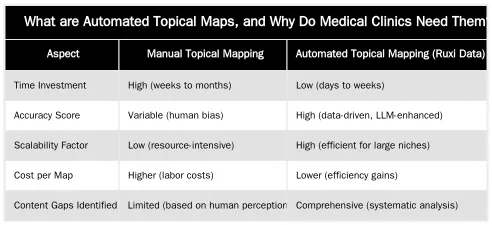
This table illustrates the clear advantages of automation in terms of efficiency, accuracy, and scalability. For medical clinics, these benefits translate directly into a more effective and sustainable SEO strategy. The ability to process vast amounts of data and identify nuanced semantic relationships ensures a more complete and authoritative content footprint. For example, a study by Semrush on topical authority highlights the importance of comprehensive coverage, which automated systems are uniquely positioned to deliver.
| Feature | Manual Mapping | Automated Mapping (Ruxi Data) |
|---|---|---|
| Methodology | Keyword research, competitor review, intuition | EAV modeling, semantic analysis, LLM fine-tuning, SERP analysis |
| Output Quality | Subjective, potentially incomplete | Objective, comprehensive, entity-rich |
| Resource Needs | Extensive human labor, expert knowledge | Software, data processing, strategic oversight |
| E-E-A-T Impact | Gradual, dependent on human insight | Accelerated, data-validated authority building |
Ready to Transform Your Medical Clinic’s Online Presence?
Elevating your medical clinic’s digital presence requires a strategic approach to content and search engine optimization. By leveraging advanced semantic engineering and Ruxi Data, you can establish robust topical authority and attract high-value patients. Discover how Abdurrahman Şimşek’s specialized expertise can help your practice dominate organic search results in London and beyond. Contact us today for a consultation to discuss a tailored semantic SEO strategy for your clinic.
Conclusion
Automating topical maps with Ruxi Data offers medical clinics a strategic advantage in the competitive digital landscape. This advanced approach moves beyond traditional SEO, enabling the construction of comprehensive knowledge bases, precise content gap identification, and the systematic building of E-E-A-T. For plastic surgeons, aesthetic clinics, and other medical practitioners in markets like London, this means a data-driven path to sustained organic growth and enhanced online authority. Embracing this semantic SEO methodology ensures that your content strategy is not only efficient but also clinically accurate and deeply aligned with patient needs.
Frequently Asked Questions
What problem does automating topical maps solve for medical clinics?
Automating topical maps with Ruxi Data addresses the significant challenge of manually researching and structuring the vast universe of topics a clinic needs to cover for authority. This data-driven content blueprint is generated in a fraction of the time, ensuring no critical patient questions or related entities are overlooked. It helps medical practices establish comprehensive E-E-A-T efficiently.
How is a Ruxi Data topical map different from a standard keyword list?
A standard keyword list is a flat collection of search queries, often lacking context and relationships. In contrast, a Ruxi Data topical map is a multi-dimensional model that outlines entities, their attributes, and the intricate relationships between them. It focuses on building a holistic knowledge base around a subject, rather than merely targeting individual keywords. This approach ensures deeper content coverage and semantic relevance.
Can this automated process be customized for a specific clinic’s focus?
Absolutely. The process begins by defining seed topics directly relevant to the clinic’s specializations, such as ‘deep plane facelift’ or ‘non-surgical rhinoplasty’. The automation then intelligently expands the comprehensive map outward from these specific areas of expertise. This ensures the generated content strategy is highly tailored and relevant to the clinic’s unique service offerings.
How does this workflow improve content quality?
By providing medically-accurate entities, attributes, and their relationships, the automated topical map forms the bedrock for highly detailed and precise content briefs. This foundational data ensures that all content created is comprehensive, factually correct, and perfectly aligned with both patient search intent and stringent search engine requirements for YMYL (Your Money Your Life) topics. It significantly elevates the authority and trustworthiness of medical content.
Is the process of automating topical maps a one-off task?
No, the process of generating these content blueprints is dynamic and iterative. Ruxi Data can periodically re-analyze search engine results pages (SERPs) to identify emerging trends, new patient questions, and competitor content movements. This continuous monitoring allows the content map to evolve, ensuring the clinic’s content strategy remains relevant, authoritative, and consistently ahead of the competition.
How does automating topical maps specifically benefit medical SEO for clinics in London?
This approach significantly enhances a medical clinic’s visibility and authority in competitive markets like London. By systematically covering all relevant topics, it builds a robust semantic network that signals expertise and trustworthiness to search engines. This leads to higher rankings, increased organic traffic, and ultimately, more patient inquiries for specialized services. To learn more or discuss your clinic’s needs, please visit Abdurrahman Şimşek’s website or contact us directly.
Ruxi Data brings together multi-model AI, automated website crawling, live indexation checks, topical authority mapping, E-E-A-T enrichment, schema generation, and full pipeline automation — from crawl to WordPress publish to social posting — all in one platform built for agencies and freelancers who run on results.