
EAV for Humans and Machines: Optimizing Data for Clarity and Comprehension
This guide explains how to structure eav for humans and machines, ensuring complex medical data is both intuitively understandable for patients and precisely parsable by AI and search engines. Readers will learn to implement semantic HTML and structured data like JSON-LD and Microdata, effectively bridging the gap between human readability and machine comprehension. This dual optimization of eav for humans and machines is crucial for medical content, enhancing accessibility, driving rich snippets, and improving overall information design. Mastering EAV modeling boosts topical authority and search performance, particularly for YMYL content in competitive sectors.
Abdurrahman Şimşek, a Semantic SEO Strategist with 10+ years of experience, specializes in EAV modeling and semantic engineering for medical clinics. His expertise ensures data architecture supports both user experience and advanced algorithmic understanding, crucial for YMYL content and achieving topical authority.
To explore your options, contact us to schedule your consultation. You can also reach us via: Book a Semantic SEO Audit, Direct WhatsApp Strategy Line: +90 506 206 86 86
Structuring data for human readers and search engines is a challenge in medical SEO. This guide explains how to master eav for humans and machines to make information accessible to patients and optimized for machine comprehension. This dual optimization drives search performance and patient acquisition for medical practices, especially in competitive markets like London’s private healthcare sector, building topical authority and online visibility.
The Dual Challenge: Structuring EAV for Humans & Machines
The challenge in structuring eav for humans and machines is presenting complex entity-attribute-value data intuitively for users while embedding structured code for search engines. On-page content and machine-readable code must align for patient comprehension and algorithmic understanding. This alignment is critical for YMYL (Your Money Your Life) medical content, where accuracy and clarity are required.
What is Entity-Attribute-Value (EAV) Data in Medical SEO?
Entity-Attribute-Value (EAV) is a data model where information is stored as entities, their attributes, and the corresponding values. In a medical context, an example is “Rhinoplasty” (Entity), “Recovery Time” (Attribute), and “2-4 weeks” (Value). Other examples include “Surgeon” (Entity), “Specialty” (Attribute), “Plastic Surgery” (Value), or “Medical Procedure” (Entity), “Anesthesia Type” (Attribute), “General Anesthesia” (Value). This model details medical procedures, physician profiles, and clinic services with granular, structured information.
The Core Conflict: Readability vs. Machine Parsability
Presenting detailed EAV data, like medical procedure attributes, intuitively for human readers often conflicts with embedding explicit, structured data (JSON-LD or Microdata) for search engines. Human readers benefit from clear headings, bullet points, and summaries. Machines require precise, unambiguous tags and properties to comprehend the relationships between entities and their attributes. The conflict arises when simplifying for readability omits machine signals, or when verbose structured data clutters the HTML. Alignment means ensuring every piece of visible information is also explicitly marked up for machine interpretation.
Bridging the Gap: Semantic HTML & Structured Data for EAV
Bridging the gap between human readability and machine parsability requires a dual approach: using semantic HTML for clear content presentation and implementing structured data like JSON-LD and Microdata for machine comprehension. This combination ensures medical information is both user-friendly and search engine-friendly.
Leveraging Semantic HTML for Clear Content Presentation
Semantic HTML provides structure, improving content presentation, accessibility, and readability for medical information. HTML5 elements like “, `
Best Practices for Presenting EAV Data on Medical Websites
Presenting EAV data on medical websites requires information design and accessibility, not just technical implementation. This ensures complex medical information is understood by search engines and potential patients.
Designing for User Experience: Information Design & Data Visualization
Presenting complex medical EAV data, such as recovery timelines, anesthesia types, or potential risks, requires clear information design and data visualization for patients. Use bullet points for lists of benefits or risks, comparison tables for treatment options, and accordions for FAQs. Clear, descriptive headings and subheadings break down information. Infographics or diagrams can illustrate anatomical changes or procedural steps to enhance comprehension. This approach makes medical information less overwhelming, fostering trust and engagement.
Enhancing Accessibility (A11y) with Structured EAV Content
Semantic HTML and structured data improve website accessibility. When EAV content is marked up correctly, screen readers and assistive technologies can interpret the information accurately for users with disabilities. For instance, using `
- ` for definition lists, `
Advanced EAV Strategies: Abdurrahman Şimşek’s Semantic Engineering Approach
Advanced EAV strategies build topical authority for medical clinics. Abdurrahman Şimşek, a Semantic SEO Strategist with over 10 years of experience, integrates EAV modeling with semantic engineering to optimize for search engine efficiency and entity understanding. This approach addresses the challenges of YMYL content, helping medical practices in London, particularly on Harley Street, improve organic search performance.
Optimizing ‘Cost of Retrieval’ with Precise EAV Modeling
Structured EAV data reduces the “Cost of Retrieval” for search engines. Cost of Retrieval refers to the computational resources and time search engines use to crawl, process, and understand content. When medical content is modeled with EAV, search engines can efficiently extract entities, attributes, and their values, requiring less effort to index and rank the information. This results in faster indexing, improved crawl budget allocation, and better ranking potential for medical topics. For example, a detailed EAV model for a “Breast Augmentation” procedure, specifying attributes like “Implant Type,” “Incision Location,” and “Recovery Time,” allows search engines to understand the offering, enhancing its relevance for patient queries.
Leveraging Ruxi Data & Semantic Networks for EAV Automation
Tools like Ruxi Data automate identifying and structuring EAV data. Ruxi Data, a component of Abdurrahman Şimşek’s semantic infrastructure, helps medical practices build semantic content networks. By analyzing data, Ruxi Data identifies entities and attributes in medical content and suggests or generates structured data markup. This automation is for scaling content production without sacrificing quality or E-E-A-T, allowing clinics to build topical authority across medical specialties. This semantic engineering approach ensures content contributes to a machine-understandable knowledge base, an advantage for semantic SEO for surgeons.
The Impact of Unified EAV: Rich Snippets, AI Overviews & Trust
A unified EAV strategy improves a medical clinic’s online presence beyond basic indexing. By structuring data, clinics can achieve improved visibility through rich snippets, better performance in generative AI results, and stronger trust signals for YMYL content. This ensures medical information is found, trusted, and understood by patients and algorithms.
Driving Rich Snippets & Enhanced Visibility with EAV Data
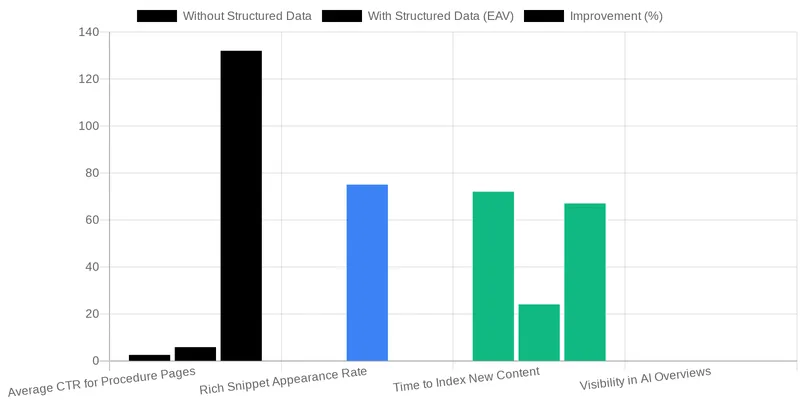
Correctly structured EAV data can lead to rich snippets in search engine results pages (SERPs), increasing click-through rates and visibility. For medical practices, this means marking up physician profiles with `Physician` schema, detailing procedures with `MedicalProcedure` schema, and structuring FAQs with `FAQPage` schema. These rich snippets, such as star ratings for doctors or estimated recovery times for procedures, provide information to potential patients in search results. This enhanced presentation makes a clinic’s offerings stand out, driving more qualified traffic.
Future-Proofing for Generative AI: EAV’s Role in AI Overviews
Machine-readable EAV data is crucial for Generative Engine Optimization (GEO) and appearing in AI Overviews. Generative AI models, like those powering Google’s AI Overviews, rely on structured, factual, and well-attributed information to synthesize answers. When a medical website’s content is structured with EAV, it provides a clear, unambiguous source for these AI systems. This increases the likelihood that your clinic’s medical information will be sourced and presented in AI-generated summaries, positioning your practice as an authority. This data structuring ensures content remains relevant as search evolves, aligning with strategies for optimizing for AI Overviews in 2026.
Ready to Master EAV for Your Medical Practice?
Unlock Your Clinic’s Full Semantic Potential
Mastering EAV data structuring is a strategic imperative for medical clinics seeking patient acquisition and search visibility. Optimizing your website’s data architecture for human comprehension and machine parsability builds a foundation for organic growth. This approach ensures your medical content reaches the right patients, builds trust, and stands out in a competitive market.
Conclusion
Structuring EAV data is a critical differentiator for medical clinics in 2026. By balancing human readability with machine comprehension, practices can enhance their online visibility, improve user experience, and build topical authority. Implementing semantic HTML with structured data formats like JSON-LD ensures complex medical information is accessible and understood by search engines and generative AI. This strategic approach is essential for competing in the London private healthcare market. To explore how a tailored semantic SEO strategy can benefit your practice, contact us. You can also Book a Semantic SEO Audit or reach out via WhatsApp Strategy Line: +90 506 206 86 86.
Frequently Asked Questions
What is the main challenge when structuring eav for humans and machines?
The primary challenge is to present complex EAV data, such as medical procedure attributes, in a clear and intuitive way for human users. Simultaneously, it requires embedding highly detailed, structured JSON-LD code for search engines. The goal is for the on-page content and the machine code to be perfectly aligned, making it effective eav for humans and machines.
Can you provide a practical example of structuring EAV for both human readers and machine comprehension?
For a human reader, you might display ‘Recovery Time: 2-3 Weeks’ in a visually appealing info box on a medical procedure page. For machines, you would embed JSON-LD schema within the page’s “ or “ that explicitly states: `”postOp”: “Typical recovery period is two to three weeks.”`, using the correct `MedicalProcedure` property. This dual approach ensures effective data presentation for both audiences.
Why is it crucial for visible content to match machine-readable data when implementing eav for humans and machines?
Google penalizes sites where structured data misleads or doesn’t match the content visible to the user. Ensuring consistency between what humans see and what machines read is fundamental for building trust with search engines and avoiding penalties, especially for YMYL (Your Money Your Life) topics. This alignment is key to successful eav for humans and machines.
How does semantic HTML contribute to effective EAV structuring for both audiences?
Using proper semantic HTML tags like “, `