
Patient Intent Mapping: Attracting High-value Medical Patients
Patient intent mapping is crucial for medical clinics seeking to attract high-value patients. This strategic SEO framework aligns content with specific patient needs across their entire journey, from initial awareness to booking a procedure. By deconstructing patient search intent using semantic SEO, practices can create targeted content that addresses YMYL queries and drives conversion rate optimization. Understanding patient intent ensures content precisely answers queries, building trust and guiding prospective patients toward high-value procedures like rhinoplasty or blepharoplasty.
Abdurrahman Şimşek, a Semantic SEO Strategist with 10+ years of experience, specializes in building high-authority semantic content networks for medical clinics. His expertise in medical SEO and information retrieval helps practices dominate organic search and attract discerning clientele.
To explore your options, contact us to schedule your consultation.
In the competitive landscape of private healthcare, attracting high-value patients requires more than just keywords; it demands a deep understanding of patient intent mapping. This strategic SEO framework helps medical clinics, plastic surgeons, and aesthetic practices align their content with the precise needs of potential patients at every stage of their journey, from initial awareness to booking a high-value procedure. Discover how to leverage semantic SEO to capture and convert your ideal clientele, particularly within the discerning London market.
What is Patient Intent Mapping and Why Does it Matter for Medical SEO?
Patient intent mapping is a strategic process that categorizes and understands the underlying goal of a patient’s search query at different stages of their healthcare journey. For medical SEO, especially concerning high-value procedures, this means aligning website content directly with what a potential patient is seeking, whether it’s basic information, comparative analysis, or a direct booking. This approach moves beyond simple keyword matching to address the complex and sensitive nature of medical inquiries, which are often classified as Your Money Your Life (YMYL) topics by search engines.
Understanding patient intent is critical for medical practices aiming to attract high-value patients. Unlike general consumer searches, medical queries often carry significant personal implications, requiring content that is not only informative but also highly trustworthy and empathetic. By accurately identifying the intent behind a search, clinics can provide precise, relevant answers, building credibility and guiding patients toward desired actions, such as booking a consultation for a specialized procedure like rhinoplasty or blepharoplasty.
Understanding the Patient Journey: From Awareness to Conversion
The patient journey typically unfolds in distinct stages: Awareness, Consideration, and Decision/Conversion. At the Awareness stage, patients might be researching symptoms or general conditions, such as “droopy eyelids” or “nose shape concerns.” During Consideration, their search intent shifts to exploring solutions and providers, using queries like “best blepharoplasty surgeon London” or “rhinoplasty options.” Finally, the Decision stage involves specific actions, often indicated by commercial intent keywords such as “blepharoplasty cost Harley Street” or “book rhinoplasty consultation.” Meeting these distinct needs with tailored content is fundamental for successful pillar page SEO strategy and patient acquisition.
Deconstructing Patient Search Intent: A Semantic SEO Approach
Identifying patient search intent requires moving beyond superficial keyword analysis. A semantic SEO approach delves into the deeper meaning and context of queries, understanding the entities involved, and how they relate to a patient’s underlying need. For complex medical conditions and high-value procedures, this means recognizing that a search for “nose job” might semantically relate to “rhinoplasty,” “nasal reshaping,” or “septoplasty,” each with slightly different implications and patient goals. Leveraging advanced techniques like entity recognition and natural language processing helps uncover these nuanced connections.
This method allows medical clinics to build a comprehensive understanding of their target audience’s information needs. By analyzing the entire query network surrounding a medical topic, rather than isolated keywords, practices can develop content that addresses a broader spectrum of related questions and concerns. This holistic view ensures that content is not only relevant to a specific search term but also provides comprehensive value, establishing the clinic as an authoritative source.
Leveraging Query Networks and Commercial Intent Keywords
Query networks reveal the interconnectedness of patient searches, mapping out how one query leads to another. Analyzing these networks helps uncover related questions, common misconceptions, and the progression of a patient’s information needs. For instance, a patient researching “rhinoplasty recovery time” might also be interested in “rhinoplasty before and after” or “what to expect after nose surgery.” Identifying these connections allows for the creation of interconnected content that guides the patient seamlessly through their journey.
Crucially, this approach helps pinpoint commercial intent keywords specific to high-value medical procedures. These are the terms that signal a patient is close to making a decision. Examples include “best rhinoplasty surgeon London,” “blepharoplasty cost Harley Street,” “dermatologist consultation Mayfair,” or “book facelift appointment.” Targeting these terms with optimized service pages and clear calls to action is vital for converting interested prospects into actual patients. For a deeper dive into understanding search intent, explore resources on deconstructing SERP intent.
Mapping Content to the Patient Journey: Strategies for High-Value Procedures
Effective content strategy for high-value medical procedures involves tailoring information to each stage of the patient journey. For plastic surgeons and aesthetic clinics, this means developing a diverse range of content types that address specific patient needs and concerns. The goal is to provide comprehensive, trustworthy information that educates, reassures, and ultimately encourages conversion. This structured approach ensures that every piece of content serves a clear purpose in the patient acquisition funnel.
Consider the specific nuances of procedures like rhinoplasty or breast augmentation. Patients seeking these services often have significant emotional and financial investments, requiring content that is not only medically accurate but also addresses aesthetic concerns, potential risks, and expected outcomes. Content should be presented in formats that are easily digestible, such as detailed procedure guides, patient testimonials, and clear pricing information, all designed to build confidence and facilitate decision-making.
Content Pillars for Awareness, Consideration, and Decision Stages
Content pillars serve as foundational resources for each stage of the patient journey:
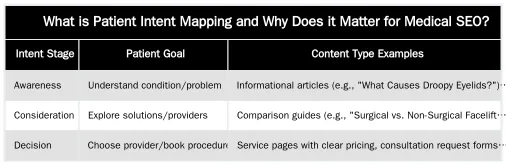
For awareness, informational articles on topics like “Understanding Rhinoplasty” or “Benefits of Dermal Fillers” educate potential patients. During consideration, content shifts to comparison guides, detailed procedure pages, and patient success stories, such as those found in a plastic surgery topical authority hub. Finally, decision-stage content includes service pages with clear calls to action, consultation forms, and direct contact information, ensuring a smooth path to booking. Each piece of content must be comprehensive and trustworthy, reflecting the high standards expected in medical information.
Why Understanding Intent is Crucial for YMYL SEO & E-E-A-T
The YMYL (Your Money Your Life) search landscape places heightened importance on content quality, accuracy, and trustworthiness. For medical content, this means search engines rigorously evaluate websites for E-E-A-T: Experience, Expertise, Authoritativeness, and Trustworthiness. Accurately addressing patient intent is not merely an SEO tactic; it is a fundamental requirement for building and demonstrating E-E-A-T. When a medical website consistently provides precise, helpful, and expert-backed answers to sensitive health queries, it signals credibility to both users and search algorithms.
Semantic search plays a pivotal role in this evaluation. Search engines use advanced algorithms to understand the context and meaning behind YMYL search queries, not just keywords. They seek to identify the most authoritative and trustworthy sources for health information. Abdurrahman Şimşek, with over 10 years of experience as a Semantic SEO Strategist specializing in medical clinics, understands this dynamic deeply. His expertise in information retrieval and entity-attribute-value modeling ensures that content is structured to meet these stringent E-E-A-T requirements, particularly for London-based private practices targeting high-value patients.
Building Trust and Authority with Algorithmic Authorship
Demonstrating expertise and authority through well-mapped, semantically rich content contributes significantly to E-E-A-T. Algorithmic authorship refers to how search engines identify and credit content creators and their associated entities (e.g., medical professionals, clinics). By consistently publishing high-quality, accurate, and comprehensive content that directly addresses patient needs at every intent stage, medical websites build a strong digital footprint of credibility. This includes ensuring that content is written by or reviewed by GMC-registered consultant surgeons or other named medical experts.
For example, a detailed article on “rhinoplasty recovery” authored by a named, board-certified plastic surgeon, published on a reputable Harley Street clinic’s website, will carry far more weight than an anonymous blog post. This meticulous approach to content creation, combined with a deep understanding of semantic engineering, helps search engines recognize the site as a trusted authority for medical topics. Further insights into Google’s quality rater guidelines, which heavily emphasize E-E-A-T for YMYL content, can be found on official Google resources or reputable SEO industry analyses like those from Search Engine Journal.
Measuring Success: Conversion Rate Optimization for Patient Consultations
Effective patient intent mapping directly impacts conversion rates for medical clinics by ensuring that visitors land on content precisely tailored to their needs. This alignment reduces bounce rates, increases engagement, and streamlines the path to booking a consultation. Tracking key metrics and analytics is essential to understand content performance and optimize the patient journey for lead generation and patient acquisition. The ultimate goal is to convert interested prospects into high-value patients efficiently.
Optimizing for conversions involves more than just traffic. It requires a deep dive into user behavior, understanding where patients drop off, and identifying opportunities to improve the user experience (UX). This includes A/B testing different calls to action, refining landing page designs, and ensuring mobile responsiveness. Furthermore, the concept of Cost of Retrieval (CoR) optimization, a specialization of Abdurrahman Şimşek, focuses on minimizing the resources (time, effort, financial) required for a patient to find the information they need and convert. This efficiency directly translates into a lower cost per acquisition for the clinic.
Key Metrics and Optimisation Strategies for Medical Practices
Measuring success in medical SEO involves tracking specific KPIs across the patient journey:
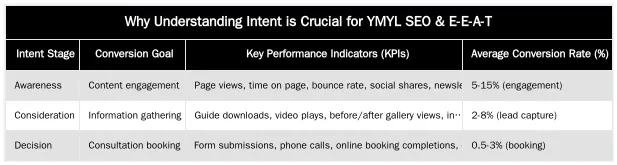
For awareness content, metrics like time on page and bounce rate indicate engagement. Consideration-stage content might track guide downloads or clicks to surgeon profiles. For decision-stage content, direct consultation bookings and form submissions are paramount. Continuous A/B testing of headlines, calls to action, and form fields can significantly improve conversion rates. Analyzing user flow through tools like Google Analytics 4 provides insights into patient behavior, allowing for targeted UX improvements on critical landing pages. For further reading on conversion rate optimization, resources like Optimizely’s guide to CRO offer valuable insights.
Ready to Attract High-Value Patients? Partner with an Expert
Implementing a robust patient intent mapping framework requires specialized expertise in semantic SEO and the unique demands of the medical sector. For London-based private clinics, plastic surgeons, and aesthetic practices, attracting high-value patients in competitive areas like Harley Street, Marylebone, and Mayfair necessitates a strategic partner. Abdurrahman Şimşek offers over a decade of experience in building high-authority semantic content networks specifically for this niche.
Leverage a proven methodology to dominate local organic search, enhance your online visibility, and secure more high-value consultations. If your clinic is ready to transform its digital presence and consistently attract its ideal clientele, explore a partnership that understands the intricacies of medical SEO and patient acquisition. Visit abdurrahmansimsek.com to learn more about tailored semantic SEO strategies.
Conclusion
Effective patient intent mapping is not merely an SEO technique; it is a foundational strategy for medical clinics aiming to thrive in the digital age. By meticulously understanding and addressing the nuanced needs of potential patients at every stage of their journey, from initial awareness to booking a high-value procedure, practices can build trust, establish authority, and significantly improve conversion rates. This semantic approach, coupled with a focus on E-E-A-T principles, ensures that medical content resonates with both human users and sophisticated search algorithms.
For private healthcare providers in London and beyond, mastering this framework is essential for attracting high-value patients and securing a dominant position in organic search. Implementing these advanced semantic SEO strategies can transform your online presence into a powerful patient acquisition engine. To discuss how a tailored semantic SEO framework can benefit your practice, visit abdurrahmansimsek.com.
Frequently Asked Questions
What is patient intent mapping in the context of medical SEO?
Patient intent mapping is a strategic SEO framework that aligns a medical clinic’s content with the precise needs of potential patients at every stage of their journey. It helps identify what a patient is truly looking for when they search online, from initial awareness to booking a high-value procedure. By understanding this, clinics can create highly relevant content that guides users effectively.
What are the typical stages involved in patient intent mapping for high-value procedures?
The stages typically include Awareness (e.g., ‘droopy eyelids’), Consideration (e.g., ‘best blepharoplasty surgeon London’), and Decision/Conversion (e.g., ‘blepharoplasty cost Harley Street’). Each stage requires a different type of content to meet the user’s specific information needs and guide them towards a consultation. Effective patient intent mapping ensures content aligns with these evolving needs.
How does effective patient intent mapping contribute to increasing consultation bookings for medical clinics?
By creating specific content that directly answers a user’s query at each stage of their journey, effective patient intent mapping builds trust and guides them through their decision-making process. This strategic alignment ensures that when patients are ready to book a consultation, your clinic is positioned as the authoritative and preferred choice. It optimizes the entire patient acquisition funnel.
What common mistakes should be avoided when optimizing content for patient search intent?
A common mistake is focusing solely on transactional, ‘bottom-of-funnel’ keywords. Failing to create comprehensive informational content for the awareness and consideration stages means missing the opportunity to engage and build trust with the vast majority of potential patients early in their journey. A holistic approach that addresses all intent types is essential for long-term success.
How does E-E-A-T (Experience, Expertise, Authoritativeness, Trustworthiness) relate to different patient journey stages?
E-E-A-T is crucial at all stages of the patient journey. For informational queries, it means providing accurate, well-researched answers from qualified professionals. For transactional queries, it involves transparent pricing, clear surgeon credentials, and patient testimonials to build trust in the final decision to book. Demonstrating strong E-E-A-T reinforces credibility throughout the patient’s research.
How can medical clinics get started with implementing a semantic SEO strategy for patient acquisition?
To begin, clinics should partner with an experienced semantic SEO strategist who understands the unique YMYL landscape of healthcare. An expert like Abdurrahman Şimşek can help analyze your target audience, map their search intent, and develop a tailored content strategy to attract high-value patients in competitive markets like London. You can explore services and learn more at abdurrahmansimsek.com.
Ruxi Data brings together multi-model AI, automated website crawling, live indexation checks, topical authority mapping, E-E-A-T enrichment, schema generation, and full pipeline automation — from crawl to WordPress publish to social posting — all in one platform built for agencies and freelancers who run on results.