Post Launch SEO Audit: Verifying Site Health and Performance
A post launch seo audit is crucial for verifying a website’s health and performance immediately after deployment. This guide details comprehensive pre-launch checks on a staging environment using a technical SEO checklist to prevent critical errors. It then outlines essential steps for a post-launch audit, including verifying indexing, crawlability, and initial performance signals. The article further explores advanced strategies like content audit, backlink analysis, and utilizing tools such as Google Search Console to ensure sustained organic visibility and search engine ranking.
Abdurrahman Şimşek, a Semantic SEO Strategist, provides expert guidance on these critical audit processes. This content delivers actionable strategies for maintaining robust site health and optimizing for search engine visibility, particularly vital for YMYL sectors.
To explore your options, contact us to schedule your consultation. You can also reach us via: Book a Semantic SEO Audit, Direct WhatsApp Strategy Line: +90 506 206 86 86
This guide details how to conduct a post launch seo audit and pre-launch checks to optimize a site’s search engine visibility and performance. It covers technical and content checks, semantic SEO strategies, and data use for success in competitive markets like London’s private healthcare sector.
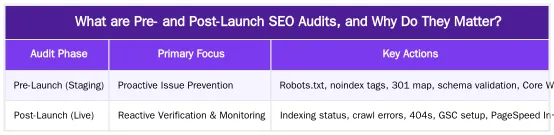
What are Pre- and Post-Launch SEO Audits, and Why Do They Matter?
Pre-launch SEO audits are proactive assessments on a staging environment before a website goes live. They identify and rectify technical and content issues that could impact search engine performance. A pre-launch SEO checklist prevents critical errors from being indexed, safeguarding existing rankings and ensuring a smooth transition.
A post-launch SEO audit is an essential review performed immediately after a site or significant changes are deployed. It verifies that all SEO elements function as intended in the live environment, confirming indexing, crawlability, and initial performance signals. Together, these audits prevent ranking drops, ensure site health, and establish a foundation for organic visibility, which is crucial for YMYL (Your Money Your Life) sites like medical clinics where accuracy and trust are paramount.
Your Essential Pre-Launch SEO Checklist for Staging Environments
Auditing a staging environment prevents SEO issues from impacting your live site. This technical SEO checklist ensures foundational elements are correctly configured before release, avoiding post-launch remediation.
Technical Foundations: Preventing Critical Errors
Verify the `robots.txt` file on the staging site blocks search engine crawlers from the development version but is ready to allow access upon launch. Check for `noindex` directives on pages intended for indexing; these tags must be removed before going live. Validate canonical tags point to the correct URLs to prevent duplicate content issues. A planned 301 redirect map is essential for site migrations or redesigns to pass authority from old URLs to new ones. Generate and validate your XML sitemap, including all indexable pages and excluding any that should not be crawled.
Content & User Experience Readiness
A pre-launch review should also include content and user experience checks. Verify meta titles and descriptions are unique and accurately reflect page content. Validate schema markup, especially for medical sites using `MedicalBusiness`, `Physician`, or `MedicalProcedure` schema. Test Core Web Vitals readiness on the staging site. Ensure mobile usability across various devices, as much traffic is mobile. Review internal linking structures for logical flow and link equity distribution.
Immediate Post-Launch SEO Audit: Verifying Your Site’s Health
Once your website is live, an immediate post launch seo audit is essential to confirm correct functionality. This audit verifies that search engines can access, crawl, and index your content and that initial user experience metrics are positive. Swift action on identified issues can prevent significant drops in organic visibility.
Confirming Indexing & Crawlability
Confirm Google is indexing your new site or pages using the URL Inspection tool in Google Search Console. Monitor the Coverage report for drops in indexed pages or increases in errors. Check the crawl error report, addressing issues like 404s, server errors, or blocked resources. Submit your updated XML sitemap to Google Search Console to expedite indexing. For medical sites, indexing all service and procedure pages is critical for patient acquisition.
Initial Performance & User Experience Checks
After launch, assess initial performance metrics. Use PageSpeed Insights to monitor Core Web Vitals (Largest Contentful Paint, Cumulative Layout Shift, First Input Delay) on key pages. Address performance bottlenecks that impact user experience and search rankings. Verify mobile usability across devices. Test site functionalities like forms, navigation, and internal search. For medical practices, GDPR and HIPAA compliance checks are also critical post-launch to ensure data security and privacy protocols are active.
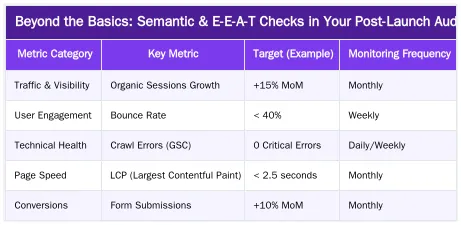
Beyond the Basics: Semantic & E-E-A-T Checks in Your Post-Launch Audit
For YMYL (Your Money Your Life) sites like medical clinics, a post launch seo audit must extend beyond technical checks to semantic coherence and E-E-A-T (Experience, Expertise, Authoritativeness, Trustworthiness) signals. Abdurrahman Şimşek, a Semantic SEO Strategist, emphasizes these audits to build topical authority and optimize for Google’s understanding of medical entities.
Validating Semantic Architecture & EAV Models
After launch, ensure your site’s content aligns with entity-attribute-value (EAV) modeling. This involves verifying the implementation of medical schema, such as `Physician`, `MedicalClinic`, and `MedicalProcedure` JSON-LD. Structured data helps Google understand the relationships between surgeons, clinics, and treatments, enhancing entity recognition. Tools like Ruxi Data can show how well your content and schema represent these entities, identifying gaps. An entity-based content audit ensures your site’s semantic architecture is effective, reducing Google’s ‘Cost of Retrieval’ by presenting information in a digestible format.
Auditing for E-E-A-T Signals & Cost of Retrieval
E-E-A-T is critical for medical sites. During the audit, review author bios for medical qualifications and experience, ensuring they are displayed and verifiable. Assess patient testimonials and case studies, confirming their authenticity and schema markup. Verify all medical information is up-to-date and supported by credible sources. A verified semantic structure and efficient site architecture reduce Google’s ‘Cost of Retrieval’. This means search engines use less effort to understand and rank your content, improving visibility. Google’s Quality Rater Guidelines provides a framework for evaluating E-E-A-T signals.
Advanced Post-Launch Audits: Content, Backlinks, and Keyword Performance
Ongoing advanced audits are vital for sustained organic growth. This involves analyzing your content strategy, backlink profile, and keyword performance. Regular analysis helps identify improvement opportunities and adapt to algorithmic changes to build topical authority.
Comprehensive Content & Backlink Analysis
A content audit should assess the relevance, freshness, and topical depth of your pages. Identify outdated information, opportunities to expand topics, or content gaps. For medical sites, ensuring content reflects the latest medical consensus is critical for E-E-A-T. A backlink analysis should monitor new link acquisitions, identify lost links, and detect potentially toxic links. Tools like Ahrefs or Semrush provide insights into your and your competitors’ backlink profiles.
Monitoring Keyword Rankings & Organic Traffic
A keyword ranking report tracks the performance of your target keywords post-launch. Monitor organic traffic trends in Google Analytics for unexpected drops or gains that might correlate with site changes or algorithm updates. Analyze which pages drive traffic and conversions, and identify underperforming content for optimization. This monitoring allows for data-driven adjustments to your SEO strategy to remain competitive.
Partner with a Specialist for Flawless Medical Site Launches
A thorough pre- and post launch seo audit is complex and critical, especially for YMYL medical websites where precision and compliance are non-negotiable. Abdurrahman Şimşek, a London-based Semantic SEO Strategist, specializes in building high-authority Semantic Content Networks for medical clinics, skin clinics, and plastic surgeons. His expertise in semantic engineering, E-E-A-T optimization, and reducing Cost of Retrieval ensures your site launches with a foundation for organic success. Partner with a specialist who understands the private healthcare market. Book a Semantic SEO Audit or connect via WhatsApp Strategy Line: +90 506 206 86 86.
Conclusion
A successful online presence for medical practices requires a rigorous pre-launch SEO audit, followed by a comprehensive post-launch audit to verify functionality and performance. Integrating semantic SEO principles, EAV modeling, and E-E-A-T validation establishes topical authority. Ongoing audits of content, backlinks, and keyword performance ensure continuous optimization. For London medical practices seeking to lead in local organic search and attract patients, partnering with a specialist like Abdurrahman Şimşek provides a strategic advantage. Contact us to secure your site’s search performance.
Frequently Asked Questions
What is the primary goal of a pre-launch SEO audit on a staging site?
The primary goal is to identify and fix critical SEO issues *before* they go live and can be indexed by Google. This proactive assessment includes checking for correct canonical tags, ensuring no-index tags are removed, and verifying the 301 redirect map is correctly implemented. It prevents costly errors from impacting search visibility upon launch.
What is the very first thing to check in a post launch seo audit?
The very first check in a post launch seo audit should be the `robots.txt` file on the live server. It’s a common and disastrous mistake for a `Disallow: /` rule from the staging environment to be accidentally carried over, which would block Google from crawling the entire site. Immediately verifying this file prevents total de-indexing.
How do I use Google Search Console for a post launch seo audit?
For a comprehensive post launch seo audit, immediately check the Coverage report in GSC for a spike in 404 errors or other server issues. You should also submit your new XML sitemap and monitor the Indexing progress to ensure Google is discovering and indexing your new pages efficiently. This tool provides vital insights into how Google perceives your live site.
Why is comparing crawl data from pre- and post-launch crucial?
Comparing a pre-launch crawl of the old site with a post-launch crawl of the new site helps you spot discrepancies and potential issues. You can quickly identify missing pages, unexpected changes in title tags or meta descriptions, and ensure that internal linking structures have been preserved or improved. This comparative analysis is vital for a smooth transition and maintaining search performance.
How long after launch should I conduct my first major post launch seo audit?
You should perform an initial, immediate check upon launch for critical showstoppers like `robots.txt` issues. A more comprehensive post launch seo audit should be done after about one week, once Google has had some time to crawl the new site and data begins to populate in Google Search Console. This allows for data-driven adjustments based on real-world indexing.
How can I get expert help with my website’s post-launch SEO or migration?
For specialized assistance with your website’s post-launch SEO, especially for complex migrations or competitive sectors like medical SEO, consider partnering with an expert. Abdurrahman Şimşek offers holistic SEO strategies and semantic engineering to ensure flawless launches and sustained performance. You can Book a Semantic SEO Audit or reach out via WhatsApp at +90 506 206 86 86 for direct strategy advice.
Ruxi Data brings together multi-model AI, automated website crawling, live indexation checks, topical authority mapping, E-E-A-T enrichment, schema generation, and full pipeline automation — from crawl to WordPress publish to social posting — all in one platform built for agencies and freelancers who run on results.