
EAV for Treatment Comparison: Empowering Patient Choices With Dynamic Tools
The Entity-Attribute-Value (EAV) data model is crucial for building dynamic ‘compare treatments’ functionality on medical websites. EAV for treatment comparison directly addresses patient confusion by simplifying the management of diverse medical procedure attributes, enabling clear, side-by-side comparisons. This approach enhances user experience and patient education, driving conversion rate optimization by providing transparent, accessible information. The article details how EAV structures complex data, powers interactive tools, and empowers patients to make informed choices, ultimately optimizing website functionality for private medical clinics.
Abdurrahman Şimşek, a Semantic SEO Strategist, specializes in leveraging advanced data models like EAV for medical websites. His expertise in semantic engineering and information retrieval ensures robust, high-converting digital platforms for private healthcare providers, focusing on optimal patient engagement and data-driven design.
To explore your options, contact us to schedule your consultation. You can also reach us via: Book a Semantic SEO Audit, Direct WhatsApp Strategy Line: +90 506 206 86 86
Patients struggle to compare complex medical treatments, which causes confusion and delayed decisions. This article explains how the Entity-Attribute-Value (EAV) data model builds dynamic ‘compare treatments’ functionality, enhancing user experience and driving conversions on medical websites. eav for treatment comparison simplifies data management and empowers patients to make informed choices, helping private medical clinics provide transparent, accessible information.
What is EAV and Why is it Essential for Treatment Comparison?
The Entity-Attribute-Value (EAV) data model is a flexible way to store information about entities with many diverse, optional attributes. For medical websites, EAV simplifies managing complex procedural data, enabling dynamic comparison tools. The model is suited for healthcare because of the varied nature of medical treatments and patient needs.
The Challenge of Comparing Complex Medical Procedures
Patients struggle to compare medical procedures because of the volume and variability of information. Factors like recovery time, cost, invasiveness, anesthesia type, and expected results differ between treatments. Presenting this data in a consistent, digestible format challenges medical websites. Without clear comparison tools, patients may feel overwhelmed, leading to indecision or seeking information elsewhere.
How EAV Structures Diverse Treatment Attributes
EAV addresses this by breaking down each treatment (the ‘Entity’) into ‘Attributes’ (e.g., “Procedure Name,” “Recovery Time,” “Anesthesia Type,” “Ideal Candidate”) and their corresponding ‘Values’ (e.g., “Facelift,” “2-4 weeks,” “General,” “Patients seeking significant facial rejuvenation”). This structure creates a flexible schema where new attributes can be added without altering the core database structure. This uniformity makes data retrieval and comparison straightforward, regardless of how many unique characteristics a treatment possesses. For more on the foundational concepts, refer to Wikipedia’s explanation of the EAV model.
How EAV Powers Dynamic ‘Compare Treatments’ Functionality
EAV for treatment comparison allows medical websites to build interactive tools. The data model provides the foundation for dynamic content generation, enabling patients to select multiple procedures and view their characteristics side-by-side. This capability enhances patient understanding and engagement.
From Data Model to Interactive Comparison Tables
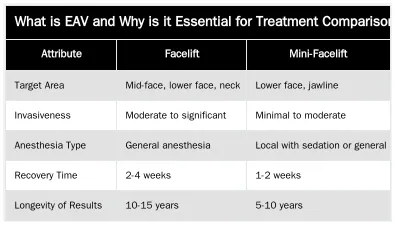
With an EAV model, when a patient selects treatments for comparison, the system queries the database for the relevant attributes and values for each chosen entity. This data is rendered dynamically into a comparison table on the front-end. JavaScript frameworks like React or Vue facilitate this process by efficiently displaying dynamic content. For instance, comparing a Facelift and a Mini-Facelift might involve these attributes:
Enabling Faceted Search and Advanced Filtering Options
The structure of EAV data also enables faceted search. Patients can filter treatments based on specific attributes, such as “recovery time less than 1 week,” “non-surgical options,” or “treatments for skin laxity.” These filtering options allow users to narrow choices from many procedures, improving user experience (UX) on medical websites. This functionality guides patients through complex medical information.
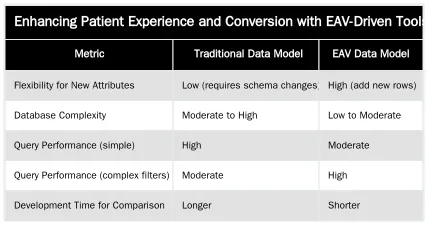
Enhancing Patient Experience and Conversion with EAV-Driven Tools
EAV-powered comparison tools benefit patients and medical clinics. These interactive tools improve patient education, foster trust, and contribute to higher conversion rates for private medical practices, particularly in competitive markets like London.
Improving Patient Education and Decision-Making
Clear, side-by-side comparisons empower patients to make informed healthcare decisions. By presenting complex medical information in an accessible format, these tools reduce anxiety and increase confidence in their chosen procedure and clinic. This transparency is critical for Your Money or Your Life (YMYL) content, which requires accuracy and comprehensibility. Well-informed patients are more likely to proceed with a consultation.
Boosting Conversion Rates and Reducing Bounce Rates
Interactive tools keep users engaged longer, reducing bounce rates. When patients can find all necessary comparison information in one place, they are less likely to visit competitor sites. This streamlined patient journey, from research to booking, contributes to conversion rate optimization (CRO) for medical websites. By providing filtering options and clear comparisons, clinics can guide prospective patients toward booking a consultation more efficiently.
Implementing EAV for Medical Procedures: Technical & Strategic Considerations
Implementing an EAV model for medical procedures requires technical and strategic planning. Abdurrahman Simsek, a Semantic SEO Strategist, emphasizes this approach is not just about website functionality but also about optimizing for search engine understanding and long-term topical authority. The correct architecture supports both user experience and search visibility.
Integrating EAV with Headless CMS and Modern Web Architectures
EAV data is often managed within a headless CMS, which separates the content management backend from the presentation layer. The EAV data, representing treatment attributes, is delivered via APIs to front-end JavaScript frameworks. This setup offers flexibility and scalability for complex medical content, allowing for rapid updates and integration of new treatments or comparison features. It ensures dynamic content is delivered efficiently, improving website functionality.
EAV’s Role in Semantic SEO and Cost of Retrieval Optimization
EAV modeling plays a direct role in semantic SEO. By structuring medical data into entities and their precise attributes, search engines better understand the relationships between treatments, conditions, and specialists. This granular data contributes to a website’s topical authority, signaling to Google that the site is a resource for specific medical topics. Well-structured EAV data can reduce the ‘Cost of Retrieval’ for Googlebot, making it more efficient for search engines to crawl, understand, and index content. This efficiency can lead to improved rankings and visibility. For a deeper dive, explore our guide on EAV model for surgical procedures and how it contributes to reducing Cost of Retrieval. This approach is a cornerstone of a semantic SEO for surgeons strategy.
Achieving Competitive Advantage with Advanced Comparison Functionality
EAV-powered comparison tools offer a strategic advantage. For private medical clinics in competitive areas like London, this functionality can be a differentiator, attracting patients and strengthening their online presence.
Standing Out in the London Aesthetic Market
In a competitive market like Harley Street, providing interactive tools sets a clinic apart. Patients in London seek transparency and information to make health and aesthetic decisions. A website with intuitive comparison features demonstrates a commitment to patient education and service. This value proposition can attract patients who prioritize research and clear communication, leading to higher quality leads and bookings. It also contributes to an SEO guide for private healthcare strategy.
Future-Proofing Your Website with Data-Driven Design
An EAV foundation makes a website more adaptable to future content needs and algorithm updates. As new treatments emerge or procedures evolve, the EAV model allows for expansion of comparison features and addition of new treatment data without extensive re-development. This data-driven design ensures your website can incorporate new information and maintain its competitive edge. It aligns with an advanced medical schema approach for long-term success.
Ready to Transform Your Clinic’s Online Patient Experience?
Using the EAV data model for comparison functionality improves your medical website’s utility and patient engagement. This strategic enhancement improves patient education, drives conversions, and strengthens your clinic’s online authority. If you are a plastic surgeon or clinic owner in London looking to optimize your digital presence and patient journey, consider a data-driven approach. Discover how a semantic SEO strategy can benefit your practice at abdurrahmansimsek.com. Book a Semantic SEO Audit, or reach out via WhatsApp Strategy Line: +90 506 206 86 86.
Conclusion
The Entity-Attribute-Value (EAV) data model is a flexible framework for medical websites to implement dynamic ‘compare treatments’ functionality. By structuring complex medical data efficiently, EAV enhances patient education, improves user experience, and boosts conversion rates for private clinics. This approach is a strategic asset for medical practices aiming to stand out in a competitive digital landscape, like London. EAV for treatment comparison leads to a more informed patient base and a stronger online presence. To explore how this can be tailored for your clinic, Book a Semantic SEO Audit or connect via Direct WhatsApp Strategy Line: +90 506 206 86 86.
Frequently Asked Questions
How does an EAV data model simplify building a dynamic eav for treatment comparison tool?
An EAV model structures all treatment data as uniform attributes, such as ‘Recovery Time’ or ‘Cost’. This standardized approach makes it straightforward to query and display specific attributes for multiple procedures in a comparison table. Without eav for treatment comparison, manually extracting unstructured data from each page would be inefficient and impossible to scale for a comprehensive tool.
What is the main benefit of a ‘Compare Treatments’ tool for a plastic surgery clinic?
This functionality empowers patients by allowing them to make informed decisions based on factors most important to them. This enhanced user experience builds significant trust, increases time on site, and directly boosts conversion rates for consultations. Patients feel more confident in their choices, leading to higher engagement.
From an SEO standpoint, what is the value of using eav for treatment comparison?
A well-implemented comparison tool can become a prime target for featured snippets for ‘vs’ or ‘compare’ type queries (e.g., ‘tummy tuck vs liposuction’). The underlying EAV structure ensures the data is organized and machine-readable, making it easy for Google to extract and feature. This drives high-intent organic traffic directly to your clinic’s website.
What are the essential attributes to include in a treatment comparison table?
Focus on the key decision-making factors for patients to provide maximum value. These typically include ‘Ideal For’ (the problem it solves), ‘Procedure Time’, ‘Anesthesia Type’, ‘Recovery Time’, ‘Results Duration’, and ‘Cost Range’. Such attributes offer a comprehensive, at-a-glance overview that aids patient understanding.
Does implementing eav for treatment comparison functionality require custom development?
While a bespoke solution offers the most flexibility and scalability, this functionality can be achieved within platforms like WordPress. By using tools such as Advanced Custom Fields (ACF) to create the EAV structure, you can then employ custom code or advanced plugins to query and display this data dynamically. This allows for a filterable comparison table that enhances user interaction.
How can I begin leveraging EAV to enhance my clinic’s online patient experience?
Abdurrahman Şimşek specializes in building high-authority Semantic Content Networks for medical clinics, leveraging EAV modeling. You can book a Semantic SEO Audit to discuss your specific needs and explore how this approach can transform your site. Alternatively, reach out directly via WhatsApp for a strategy discussion.
Ruxi Data brings together multi-model AI, automated website crawling, live indexation checks, topical authority mapping, E-E-A-T enrichment, schema generation, and full pipeline automation — from crawl to WordPress publish to social posting — all in one platform built for agencies and freelancers who run on results.