
Patient Acquisition Cost: Optimizing Clinic Profitability
This guide defines patient acquisition cost (PAC) and provides a comprehensive framework for its calculation and reduction. Readers will learn to accurately measure the total expenditure incurred to gain a new patient, encompassing all marketing and sales expenses. The article details strategies for optimizing marketing budget allocation, improving cosmetic surgery marketing ROI, and enhancing clinic profitability by effectively managing the cost per lead and the crucial LTV:CAC ratio. Understanding PAC is essential for sustainable clinic growth.
Abdurrahman Şimşek, a Semantic SEO Strategist, offers insights into reducing patient acquisition cost through semantic authority and topical authority mapping. His expertise in medical SEO and content architecture helps clinics optimize their digital presence for long-term, cost-effective patient acquisition.
To explore your options, contact us to schedule your consultation.
This guide explains patient acquisition cost (PAC), providing a framework to calculate and reduce your clinic’s cost per patient to boost profitability. Understanding PAC is essential for marketing budget allocation and achieving a return on investment in the private healthcare sector. This article provides insights for medical, plastic surgery, and aesthetic clinics.
What is Patient Acquisition Cost (PAC) and Why Does it Matter?
Patient Acquisition Cost (PAC), or Customer Acquisition Cost (CAC), is the total expenditure a medical clinic incurs to gain one new patient. This metric includes all marketing and sales expenses over a specific period, divided by the number of new patients acquired during that timeframe. Understanding PAC is crucial for assessing marketing efficiency, optimizing budget allocation, and ensuring the clinic’s long-term financial viability.
A clinic’s financial health depends on managing this cost. High PAC erodes profitability, even with increasing patient volume. A well-managed PAC allows reinvestment into patient care, staff development, or clinic expansion. It measures how efficiently marketing converts prospects into patients.
The Core Formula: Calculating Your Clinic’s CAC
The formula for calculating client acquisition cost is:
Client Acquisition Cost (CAC) = Total Marketing & Sales Spend / Number of New Patients Acquired
Accurate application requires tracking all relevant expenditures. “Total Marketing & Sales Spend” includes direct advertising costs, salaries for marketing staff, agency fees, software subscriptions, content creation expenses, and other resources dedicated to attracting new patients. “Number of New Patients Acquired” refers to individuals who have completed their first appointment or procedure within the defined period. Accurate data collection is essential for a meaningful calculation.
Beyond the Basics: A Comprehensive Framework for CAC Calculation
Calculating patient acquisition cost requires more than tracking ad spend. A comprehensive framework considers all contributing factors for a clear picture of marketing efficiency. This approach is essential for medical practices with high-value services like plastic surgery or aesthetic treatments, where each patient’s value is higher.
Unpacking All Marketing & Sales Expenses for Accuracy
A precise cost per lead requires itemizing both direct and indirect expenses. Direct costs include:
- Paid advertising spend (PPC, social media ads)
- Marketing agency fees
- Website development and maintenance costs
- Software subscriptions (CRM, email marketing, analytics tools)
- Content creation (blog posts, videos, photography)
Indirect costs, often overlooked, also impact the true client acquisition cost:
- Salaries and benefits for marketing and sales staff
- Overhead allocated to marketing (e.g., office space, utilities)
- Training costs for patient-facing staff on conversion techniques
- Promotional event expenses
Tracking these expenses over a defined period (e.g., monthly, quarterly) allows for a reliable calculation and enables cost segmentation by channel for analysis.
Understanding the LTV:CAC Ratio for Sustainable Growth
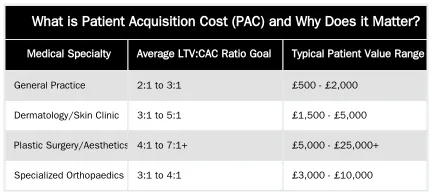
Patient acquisition cost gains its full meaning when paired with the Lifetime Value (LTV) of that patient. LTV is the total revenue a clinic expects from a patient over their entire relationship. The LTV:CAC ratio is a key performance indicator for long-term clinic profitability, showing if the acquisition investment yields a positive return.
Calculate LTV using average revenue per patient visit, average visits per year, and average patient retention period. For high-value patients, like those in aesthetic medicine, LTV is substantial because of repeat procedures, follow-up treatments, and referrals. An ideal LTV:CAC ratio is 3:1 or higher, meaning a patient generates three times more revenue than their acquisition cost.
Strategic Levers: How Can Clinics Effectively Reduce Patient Acquisition Cost?
Reducing patient acquisition cost involves optimizing clinic operations and marketing. Several strategies can enhance efficiency and lower marketing spend per patient.
Optimizing Your Marketing Funnel for Conversion Efficiency
An inefficient conversion funnel wastes marketing expenditure. Optimizing each stage can reduce the cost per lead. This includes:
- Website Conversion Rate Optimization (CRO): A user-friendly website that loads quickly and guides visitors to book appointments or fill contact forms. This requires quality content, clear calls-to-action, and intuitive navigation.
- Refining Lead Nurturing Processes: Use automated email sequences or personalized follow-ups for prospects who have not converted. Providing information and addressing concerns moves leads through the funnel without more ad spend.
- Enhancing the Initial Patient Experience: A positive experience from the first call to the consultation improves conversion rates. Trained staff who communicate value and address queries help convert prospects into patients.
Leveraging Patient Referrals and Retention for Lower PAC
Leveraging existing patient relationships is a cost-effective way to reduce PAC. Satisfied patients are advocates and a source of qualified referrals.
- Word-of-Mouth Marketing: Encourage satisfied patients to share positive experiences through direct requests, online reviews, or testimonials. Organic word-of-mouth is low-cost and trustworthy.
- Patient Referral Programs: Implement structured programs that reward existing patients for referrals. This formalizes and incentivizes the behavior, providing a measurable acquisition channel.
- Fostering Patient Loyalty: Patient retention strategies like follow-up care, personalized communication, and loyalty programs reduce the need for constant new patient acquisition. Retained patients often return for more services and refer others. The American Academy of Medical Administrators highlights patient retention for clinic growth. Learn more about patient retention strategies.
SEO vs. PPC: Which Delivers Lower PAC for Medical & Aesthetic Clinics?
Medical and aesthetic clinics must weigh Search Engine Optimization (SEO) against Pay-Per-Click (PPC) advertising for their impact on patient acquisition cost, especially for high-value services.
The Immediate Impact vs. Long-Term Value of PPC
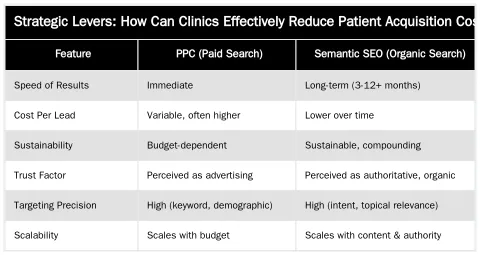
PPC advertising offers immediate visibility. Bidding on relevant keywords places clinics at the top of search results instantly, driving traffic and leads. This is effective for new clinics needing patient volume or promoting time-sensitive procedures. The cost per lead in PPC can be precisely tracked, allowing for campaign optimization.
PPC’s effectiveness is tied to budget; when ad spend stops, visibility disappears. For competitive medical terms, especially in locations like London’s Harley Street, cost per click (CPC) can be high, increasing long-term PAC if not managed carefully. PPC often results in a higher sustained client acquisition cost than organic strategies because clinics must pay for every click.
Semantic SEO: Building Topical Authority for Sustainable PAC Reduction
In contrast, a Semantic SEO strategy focuses on building topical authority and organic visibility. This approach involves creating comprehensive content that covers a topic or entity, establishing the clinic as an authoritative source. For medical clinics, this means demonstrating expertise across conditions, treatments, and patient concerns.
SEO requires an initial investment, but its benefits compound. As a clinic’s website gains topical authority, it ranks for more relevant queries, attracting qualified patients seeking specific services. These organic leads often have higher intent and conversion rates, leading to a lower cost per patient long-term. Unlike PPC, organic visibility continues to drive traffic without per-click costs, making it a sustainable and cost-effective channel. For specialized practices, Semantic SEO for plastic surgeons and building topical authority for medical clinics are critical for attracting high-value patients.
Achieving Clinic Growth: What to Expect from Optimized PAC
Managing and reducing patient acquisition cost transforms marketing from a cost center into a strategic investment, driving sustainable growth and improving market position.
Optimized patient acquisition strategies improve financial performance. Lower costs per patient increase profitability, providing resources for reinvestment in medical technologies, facility upgrades, or expanded services. This also allows for more flexible marketing budgets to explore new channels or scale campaigns without compromising financial stability.
Measuring ROI and Long-Term Clinic Profitability
A lower cost per patient increases return on marketing investment (ROI). Tracking PAC alongside patient LTV helps clinics understand which marketing channels are most profitable. This data-driven approach informs budget allocation, directing resources to the most efficient channels.
Enhanced clinic profitability is a direct result. A better LTV:CAC ratio enables sustainable growth, stronger financial reserves, and greater resilience to market fluctuations. This strategic advantage positions the clinic for long-term success and helps attract high-value patients.
Ready to Transform Your Clinic’s Patient Acquisition Strategy?
Optimizing patient acquisition cost builds a foundation for sustainable, profitable growth. Medical, plastic surgery, or aesthetic clinics in London can implement a specialized semantic SEO strategy to attract high-value patients. A tailored approach can lower your cost per patient and improve your clinic’s digital presence.
Take the next step towards a more efficient and profitable patient acquisition model. Connect with Abdurrahman Şimşek today to discuss a bespoke semantic SEO strategy for your practice.
Conclusion
Managing patient acquisition cost is essential for long-term profitability and growth. Using a comprehensive calculation framework, optimizing marketing funnels, and leveraging patient retention can reduce cost per patient. Semantic SEO and topical authority offer a cost-effective way for medical, plastic surgery, and aesthetic clinics to attract high-value patients organically. This approach, used by strategists like Abdurrahman Şimşek, helps ensure marketing investments yield maximum returns. For clinics in London wanting to improve local organic search and attract high-value patients, a specialized semantic strategy is necessary. Learn more about optimizing your clinic’s digital strategy.
Frequently Asked Questions
What is the basic formula for calculating patient acquisition cost (CAC)?
The fundamental formula for calculating patient acquisition cost is to divide your total marketing and sales expenditure over a specific period by the number of new patients acquired in that same timeframe. It’s crucial to encompass all related costs, from advertising spend and agency fees to staff salaries and technology subscriptions, for an accurate figure. This metric provides a clear understanding of the investment required to bring in each new patient.
Why is lowering the cost of acquiring new patients so important for a clinic?
Reducing your patient acquisition expenses directly enhances your clinic’s profitability for every service or procedure offered. It signifies that you are attracting new clients more efficiently, allowing you to either boost your profit margins or strategically reinvest the saved capital into further growth initiatives. This efficiency is vital for long-term financial health and scalability.
How does investing in Semantic SEO help reduce the cost per patient over time?
Semantic SEO builds a powerful, long-term digital asset for your clinic. While it requires an initial investment, the organic traffic it generates has no recurring “per-click” cost, unlike paid advertising. Over time, as your clinic’s authority and rankings solidify, the effective cost of acquiring patients from organic search trends towards zero, significantly lowering your overall blended acquisition costs across all channels.
What is a common mistake clinics make when trying to lower their patient acquisition expenses?
A frequent error clinics make is focusing solely on reducing the cost per lead without adequately assessing lead quality. Acquiring numerous inexpensive, unqualified leads that rarely convert into actual patients will ultimately inflate your final patient acquisition cost. It’s more effective to pursue fewer, higher-quality leads that have a strong potential for conversion.
What is the LTV:CAC ratio and why does it matter for patient acquisition?
The LTV:CAC ratio compares the Lifetime Value (LTV) a patient brings to your clinic against the cost of acquiring them (CAC). A healthy ratio, typically 3:1 or higher, indicates a sustainable and profitable business model. It ensures that the total revenue a patient generates over their engagement with your clinic significantly outweighs the initial investment made to bring them in.
How can my clinic start optimizing its patient acquisition strategy?
To begin transforming your clinic’s patient acquisition strategy, consider a comprehensive audit of your current marketing efforts and their associated costs. Identifying inefficiencies and opportunities for improvement, particularly through data-driven approaches like Semantic SEO, is key. Abdurrahman Şimşek specializes in developing tailored frameworks to reduce acquisition costs and boost profitability for medical and aesthetic clinics.
Ruxi Data brings together multi-model AI, automated website crawling, live indexation checks, topical authority mapping, E-E-A-T enrichment, schema generation, and full pipeline automation — from crawl to WordPress publish to social posting — all in one platform built for agencies and freelancers who run on results.