Automating E-e-a-t Signals: Scaling Medically Accurate Content
Automating E-E-A-T signals is crucial for scaling medically accurate YMYL content. This article details systematic workflows and semantic engineering techniques to embed Experience, Expertise, Authoritativeness, and Trust into digital content. Readers will learn how algorithmic authorship and structured data ensure content credibility and discoverability. The approach focuses on programmatic methods to convey author qualifications and source reliability, essential for building topical authority and improving search visibility for medical practices. This strategy helps maintain content governance while efficiently expanding a knowledge base.
Abdurrahman Şimşek, a Semantic SEO Strategist, specializes in building high-authority semantic content networks for medical clinics. His expertise in algorithmic authorship and content configuration ensures robust E-E-A-T implementation for YMYL domains, particularly in the London private healthcare market.
To explore your options, contact us to schedule your consultation.
For YMYL (Your Money or Your Life) medical content, E-E-A-T (Experience, Expertise, Authoritativeness, and Trust) is paramount. Automating e-e-a-t signals helps medical clinics and plastic surgeons scale content production while maintaining medical accuracy and building topical authority. This article covers workflows, semantic engineering, and content configuration to improve online presence and trustworthiness.
What Does ‘Automating E-E-A-T Signals’ Truly Mean for Medical Content?
Automating E-E-A-T signals uses systematic processes and technology to embed indicators of Experience, Expertise, Authoritativeness, and Trust into digital content. For medical content, this goes beyond basic SEO. It ensures published information is discoverable, credible, and accurate—a critical requirement for any YMYL content strategy. The approach uses programmatic methods to convey author qualifications, information veracity, and source reliability.
The Imperative of E-E-A-T in YMYL Healthcare
Google’s Quality Rater Guidelines emphasize E-E-A-T for health-related queries. Content lacking clear E-E-A-T signals can be demoted in search results, impacting organic visibility and patient acquisition. For medical practices, non-compliance risks reduced patient trust and potential misinformation. A medical content workflow must prioritize these signals to protect patients and the practice’s reputation.
Implementing an E-E-A-T Workflow: Structured Data & Content Governance
An effective E-E-A-T workflow requires technical implementation and strategic oversight. Its technical backbone is structured data, which gives search engines explicit information about content and its creators. A content governance plan ensures accuracy and compliance are maintained throughout the content lifecycle as production scales.
Mastering Medical Schema for Surgeons: A Foundation for Trust
Structured data, particularly medical schema, explicitly communicates E-E-A-T signals to search engines. For surgeons and medical clinics, implementing schema types like MedicalOrganization, Physician, and MedicalWebPage details qualifications, specializations, and affiliations. This includes links to professional licenses, board certifications, and academic appointments. Medical schema for surgeons provides a machine-readable foundation for trust and authority.
Developing a Medical Content Governance Plan for Scalability
Human oversight remains critical, even with automation. A content governance plan outlines processes for expert human review, collaboration with GMC-registered consultant surgeons, and version control. This ensures automated content adheres to medical standards and regulatory requirements. The plan should define roles, responsibilities, and review cycles, integrating with automated content configuration systems to maintain accuracy and compliance at scale. Explore more on E-E-A-T content automation.
Abdurrahman Şimşek’s Strategic Approach to E-E-A-T for London Clinics
Abdurrahman Şimşek specializes in building high-authority semantic content networks for London’s private healthcare sector. His methodology integrates semantic engineering with an understanding of the YMYL search landscape. Using a data infrastructure, his approach systematically embeds E-E-A-T signals, helping medical clinics, particularly in competitive areas like Harley Street, establish a dominant online presence. This involves entity-attribute-value (EAV) modeling and cost of retrieval (CoR) optimization.
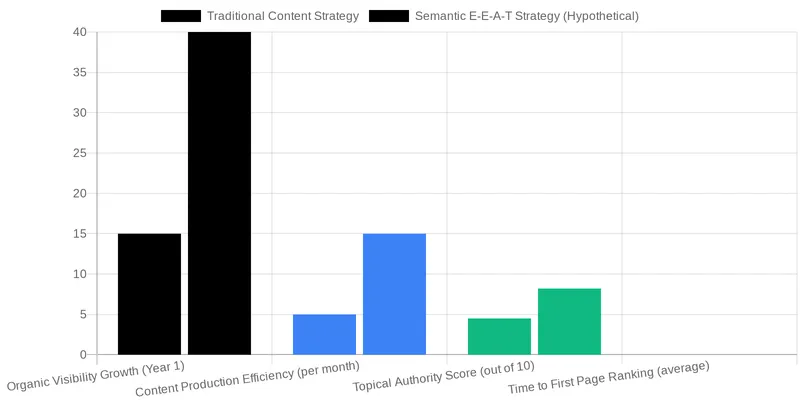
Elevating Harley Street Presence with Semantic SEO
The London private healthcare market, especially areas like Harley Street, Marylebone, and Mayfair, requires a specialized E-E-A-T strategy. These areas have intense competition and patients seeking verifiable expertise. Semantic SEO establishes topical authority around specific medical procedures and conditions, linking content to consultant surgeon credentials and ensuring all information contributes to a trustworthy digital identity. This targeting helps clinics stand out.
The Tangible Benefits: What to Expect from Automated E-E-A-T Signals
Automating E-E-A-T signals provides measurable advantages for medical practices. Benefits include improved search rankings, patient trust, content scalability, and a stronger competitive position. Systematically embedding expertise and authority leads to more efficient content production and a credible online footprint.
Comparing Traditional vs. Automated E-E-A-T Workflows
The shift from manual to automated E-E-A-T workflows increases efficiency. Automated systems streamline time-consuming and inconsistent manual processes.
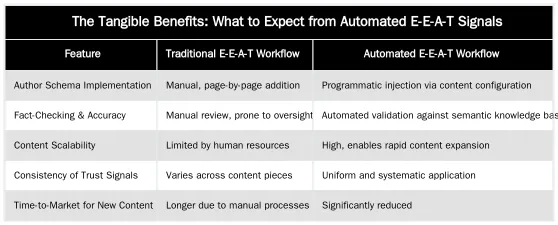
Automation enhances efficiency and consistency, allowing medical practices to produce more medically accurate and trustworthy content. Tools like Python for SEO can further optimize these workflows, enabling data processing and content generation.
Ready to Transform Your Medical Content Strategy?
Scaling medically accurate content while upholding E-E-A-T standards is a challenge, particularly in London’s competitive private healthcare market. A specialist in semantic SEO and web development can provide a strategic advantage. Abdurrahman Şimşek offers solutions to build high-authority semantic content networks, helping your practice dominate local organic search and attract high-value patients.
Discover how to build a high-converting website and dominate local organic search.
Conclusion
Integrating E-E-A-T signals through automation is the future of medical content marketing in YMYL niches. Using algorithmic authorship, semantic engineering, and content governance, medical clinics can scale content production without compromising accuracy or trust. This approach improves search visibility and solidifies a practice’s reputation as a reliable source of health information. For London-based plastic surgeons and aesthetic clinics, implementing these workflows is essential for a competitive edge and patient confidence.
Frequently Asked Questions
What does automating e-e-a-t signals truly mean for medical content?
It involves creating systematic processes and technological workflows to consistently embed indicators of Experience, Expertise, Authoritativeness, and Trust into your digital content at scale. For medical content, automating e-e-a-t signals includes programmatic author schema injection, automated fact-checking against a verified knowledge base, and systematic internal linking to enhance credibility.
Is it safe to use automation for E-E-A-T in YMYL medical topics?
Yes, it is safe when implemented with a human-centric approach. The automation focuses on structuring, formatting, and enriching content with verifiable trust signals, not on generating the core medical information itself. Human experts, such as GMC-registered surgeons, still create and verify the foundational medical content.
How does Algorithmic Authorship contribute to automating e-e-a-t signals?
Algorithmic Authorship leverages structured data to programmatically link content to its expert author, making their credentials and professional profile clear to search engines. This process helps in automating e-e-a-t signals by consistently associating every article with a verified expert, building a robust web of expertise and authority.
Can a solo medical practitioner benefit from automating e-e-a-t signals?
Absolutely. While comprehensive workflows can be complex, the core principles of automating e-e-a-t signals are scalable. A solo surgeon can begin by implementing structured data templates for procedure pages, ensuring consistent inclusion of author, reviewer, and last updated dates to signal expertise and trust effectively.
What are the most impactful E-E-A-T signals to automate for medical websites?
Automating the implementation of ‘author’ and ‘reviewedBy’ schema is highly impactful. This directly informs search engines about the expert who created and verified the medical content, which is a fundamental component of E-E-A-T for YMYL websites. Consistent application of these signals significantly boosts perceived trustworthiness.
How can London clinics get started with enhancing their E-E-A-T through these strategies?
London-based clinics, especially those in Harley Street, can begin by consulting with a specialist in Semantic SEO for healthcare. Abdurrahman Şimşek offers strategic consulting to develop tailored workflows for medical content configuration, ensuring robust E-E-A-T optimization and topical authority.
Ruxi Data brings together multi-model AI, automated website crawling, live indexation checks, topical authority mapping, E-E-A-T enrichment, schema generation, and full pipeline automation — from crawl to WordPress publish to social posting — all in one platform built for agencies and freelancers who run on results.