
Pre-launch SEO Checklist: Safeguarding Clinic Website Redesigns
A pre-launch seo checklist is essential for medical clinics undergoing a website redesign. This guide outlines critical steps to prevent ranking loss and maintain patient trust during a website migration. It covers technical SEO audits on staging servers, proper URL mapping with 301 redirects, and E-E-A-T verification for YMYL content. Implementing this checklist ensures a smooth transition, safeguarding organic visibility and patient acquisition for medical websites.
Abdurrahman Şimşek, a Semantic SEO Strategist, specializes in building high-authority Semantic Content Networks for medical clinics. His expertise ensures robust SEO foundations and E-E-A-T compliance for healthcare websites.
To explore your options, contact us to schedule your consultation.
A clinic website redesign without a pre-launch seo checklist can jeopardize rankings and patient traffic. This guide provides a framework for a smooth transition, safeguarding online visibility and patient acquisition. It addresses challenges medical websites face, from technical intricacies to E-E-A-T compliance.
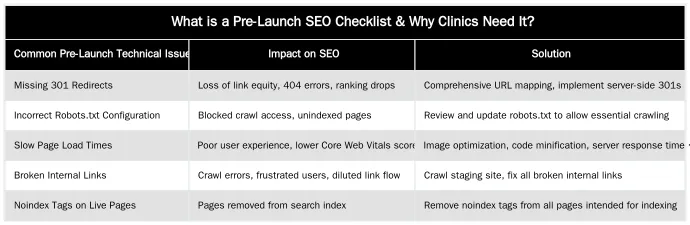
What is a Pre-Launch SEO Checklist & Why Clinics Need It?
A pre-launch SEO checklist is a structured set of tasks performed on a new or redesigned website before it goes live. For medical clinics, this checklist is critical to prevent loss of search engine rankings, maintain patient trust, and ensure compliance with Google’s stringent YMYL (Your Money Your Life) guidelines. Neglecting these steps can lead to significant drops in organic traffic and patient inquiries.
Medical websites fall under the YMYL category, meaning Google applies higher scrutiny to their content and technical foundation. A review ensures E-E-A-T (Experience, Expertise, Authoritativeness, Trustworthiness) signals are implemented. This safeguards the clinic’s online reputation and visibility, essential for patient acquisition in markets like London’s private healthcare sector.
- Prevent Ranking Loss: Identify and fix issues that could cause pages to drop from search results.
- Maintain Patient Trust: Ensure user experience and accurate, accessible medical information.
- Ensure YMYL Compliance: Verify E-E-A-T signals, crucial for health-related content.
- Optimize for Performance: Address Core Web Vitals and mobile-friendliness before launch.
- Verify Tracking: Confirm analytics and conversion tracking are correctly installed.
Technical Checks on Your Staging Site
A technical SEO audit on the staging server before launch is non-negotiable. This identifies and rectifies issues that could hinder crawlability, indexability, and performance. It is a critical step in managing website migrations and redesigns for medical clinics, ensuring a smooth transition.
URL Mapping & 301 Redirects
Improper URL mapping is a common pitfall in website redesigns. Every old URL must be mapped to its new equivalent. A 301 redirect strategy guides search engines and users from old to new pages, preserving link equity and preventing broken links. Automated tools can assist, but manual verification of critical pages is essential. Testing redirects on the staging environment is crucial to avoid post-launch 404 errors. For detailed guidance, explore automated redirect management for migrations.
Core Web Vitals for Medical Procedure Pages
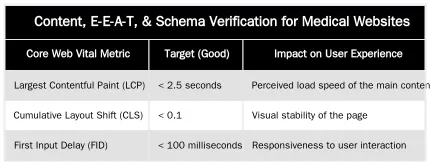
Core Web Vitals directly impact user experience and search rankings. Optimizing these metrics is paramount for medical procedure pages, which often feature high-resolution ‘before and after’ images and dynamic content. Focus on Largest Contentful Paint (LCP) by compressing and lazy-loading images. Minimize Cumulative Layout Shift (CLS) by reserving space for dynamic elements like video testimonials or booking forms. Assessing mobile-friendliness and page speed on the staging server provides a baseline for optimization. Learn more about Core Web Vitals for surgeons.
Other technical checks include:
- Robots.txt: Verify it’s correctly configured to allow search engine crawlers access to all essential pages while blocking irrelevant ones.
- XML Sitemap: Ensure a new, clean XML sitemap is generated, includes all canonical URLs, and is ready for submission to Google Search Console.
- Canonical Tags: Confirm canonical tags point to the preferred version of each page, preventing duplicate content issues.
- Broken Links: Conduct a full crawl of the staging site to identify and fix any internal or external broken links.
Content, E-E-A-T, & Schema Verification for Medical Websites
Content quality and demonstrating E-E-A-T are paramount for medical websites. Before launch, all content must be reviewed for accuracy, clarity, and adherence to medical best practices. This includes verifying author credentials, ensuring proper citations for medical claims, and presenting information in a patient-friendly manner. Google emphasizes these signals for YMYL topics, impacting clinic rankings and patient perception.
Medical Schema for Entity Recognition
Structured data, or schema markup, helps search engines understand the context and entities on your pages. Implementing Physician, MedicalClinic, and Procedure schema is vital for medical clinics. This tells Google who the medical professionals are, what services the clinic offers, and details about specific treatments. This entity recognition can lead to rich snippets in search results, improving visibility and click-through rates. Understanding medical schema for surgeons is part of a technical SEO framework.
Confirming Analytics & Tracking
A launch without proper tracking is a missed opportunity. Before launch, verify that Google Analytics 4 (GA4), Google Search Console, and other conversion tracking pixels (e.g., for booking forms, phone calls) are installed and firing. Test conversion paths to ensure accurate data capture. This data is essential for understanding user behavior, measuring SEO performance, and making post-launch decisions.
Semantic SEO for Launch & Beyond
A website redesign extends beyond technical checks. Integrating Semantic SEO principles future-proofs a site against algorithm updates and establishes topical authority. Abdurrahman Şimşek, a London-based Semantic SEO Strategist with over 10 years of experience, specializes in building high-authority Semantic Content Networks for medical clinics. This approach focuses on how search engines understand the relationships between entities, not just keywords.
Beyond Keywords: Entity-Based Content Mapping
Traditional keyword research is insufficient for modern SEO. Semantic SEO involves understanding entities—specific concepts like ‘Rhinoplasty’, ‘Dr. Smith’, or ‘Harley Street’—and their attributes. Mapping these entities and their relationships allows content to be structured for Google’s Knowledge Graph. This helps content be perceived as authoritative and relevant.
Reducing ‘Cost of Retrieval’ for Crawlability
Googlebot has a finite crawl budget. For complex medical sites, optimizing the ‘Cost of Retrieval’ (CoR) is crucial. This involves streamlining site architecture, cleaning code, and ensuring efficient server responses. A lower CoR means Googlebot can crawl and index more content, improving indexing efficiency and visibility. This is vital for fixing indexing issues and ensuring content discovery.
Pre-Launch Opportunities
Medical website redesigns offer opportunities beyond standard technical and content checks. Considering these elements can enhance long-term success, especially in regions like London.
Preparing for Generative AI & AI Overviews
Structuring content and schema for Generative AI and AI Overviews is increasingly important. Clear, factual, well-attributed information with structured data increases the likelihood of content being sourced for authoritative answers. This involves anticipating patient questions and providing concise answers within the content.
Local SEO Elements for London’s Private Practices
Local SEO is paramount for clinics targeting London postcodes like Harley Street, Marylebone, or Chelsea. During a redesign, ensure Google Business Profile (GBP) information is consistent and accurate. Verify geo-targeted content on service pages, and confirm local citation accuracy. This includes consistent Name, Address, Phone (NAP) details across all online directories. Optimizing for local search ensures the clinic appears for “near me” searches, critical for patient acquisition.
Patient data privacy and GDPR compliance are critical for medical websites. Ensure all forms, tracking, and data storage on the new site adhere to privacy regulations before launch. This builds trust and avoids legal complications.
What to Expect Post-Launch
Launch begins a new phase of monitoring and optimization. Minor issues can arise even with a pre-launch SEO checklist. After launch, monitor metrics like organic traffic, keyword rankings, Google Search Console crawl errors, and Core Web Vitals performance. Use Google Analytics to identify drops in engagement or conversions.
Initial ranking fluctuations are normal as Google re-crawls and re-indexes the new site. Focus on quickly identifying and rectifying critical issues. Ongoing SEO, including content updates, link building, and technical optimization, is essential to sustain and grow the clinic’s online presence. Post-launch monitoring ensures setbacks are addressed swiftly, maintaining visibility and patient flow.
Expert Guidance
A clinic website redesign is a significant investment. Ensuring SEO integrity requires expertise in medical digital marketing and technical SEO. Partnering with a Semantic SEO strategist like Abdurrahman Şimşek ensures a new website is semantically optimized for long-term organic growth. Leverage 10 years of experience in London’s private healthcare market to build a website that converts, performs in local search, and attracts patients.
Contact Abdurrahman Şimşek for specialist medical SEO and web development services.
Frequently Asked Questions
What are the most critical items on a pre-launch seo checklist for a clinic website redesign?
The most critical items include verifying all old URLs are 301 redirected to their new equivalents to preserve link equity. You must also ensure all analytics and tracking codes are correctly installed for accurate data collection. Finally, a full crawl of the staging site is essential to identify and fix any broken links or crawl errors before launch, ensuring a smooth transition.
Why is verifying canonical tags crucial before a new website launch?
Incorrect canonical tags can cause severe duplicate content issues, confusing search engines about which page to prioritize. Including this verification in your pre-launch SEO checklist ensures that all canonical tags point to the correct, final version of each page, preventing indexing problems and maintaining search visibility.
How does a pre-launch SEO checklist address the risk of ‘noindex’ tags remaining on a live site?
Forgetting to remove ‘noindex’ tags is a common and catastrophic error that a thorough pre-launch SEO checklist specifically prevents. These tags instruct search engines not to index your pages, leading to your entire website being removed from search results. A dedicated check ensures these are removed, safeguarding your organic traffic.
Why is a comprehensive pre-launch SEO checklist especially vital for medical clinic websites?
For medical clinics, a pre-launch SEO checklist is paramount due to Google’s stringent YMYL (Your Money Your Life) guidelines and E-E-A-T requirements. It prevents loss of crucial search rankings, maintains patient trust, and ensures compliance with industry standards. Neglecting these steps can lead to significant drops in organic traffic and patient inquiries, directly impacting patient acquisition.
What is the importance of a new XML sitemap for a redesigned site?
A new XML sitemap is absolutely necessary as it reflects the final URL structure of your redesigned website. It should be generated and ready for immediate submission to Google Search Console upon launch. This action significantly accelerates the discovery and indexing of your new pages by search engines, ensuring your content is found quickly.
How can Abdurrahman Şimşek assist my London clinic with its website redesign and SEO?
Abdurrahman Şimşek, a London-based Semantic SEO Strategist, specializes in building high-authority Semantic Content Networks for medical clinics. He provides expert guidance on technical SEO, E-E-A-T optimization, and holistic strategy to ensure a flawless launch and sustained organic growth. You can learn more about his services and secure your clinic’s online future by visiting his website or contacting him directly.
Ruxi Data brings together multi-model AI, automated website crawling, live indexation checks, topical authority mapping, E-E-A-T enrichment, schema generation, and full pipeline automation — from crawl to WordPress publish to social posting — all in one platform built for agencies and freelancers who run on results.