
Medical Disclaimer SEO: Enhancing E-e-a-t and Trust for YMYL Content
Medical disclaimer SEO is crucial for YMYL content, ensuring compliance and building trust. This article explains how implementing effective medical disclaimers and accuracy statements enhances E-E-A-T and improves search engine visibility. It details best practices for integrating these statements to signal credibility to Google’s Quality Rater Guidelines, differentiating responsible medical websites. Understanding medical disclaimer SEO is vital for healthcare content to achieve higher rankings and establish authority in competitive digital landscapes. Proper application supports content accuracy and liability waiver considerations, directly impacting organic performance.
Abdurrahman Şimşek, a Semantic SEO Strategist, provides expert guidance on navigating complex healthcare content policies and E-E-A-T guidelines. This content offers actionable strategies for integrating legal disclaimers for websites, ensuring both compliance and enhanced digital authority.
To explore your options, contact us to schedule your consultation. You can also reach us via: Book a Semantic SEO Audit, Direct WhatsApp Strategy Line: +90 506 206 86 86
For Your Money or Your Life (YMYL) content from medical clinics and plastic surgeons, understanding medical disclaimer SEO is essential. Disclaimers and accuracy statements are not just legal necessities but critical components of a semantic SEO strategy that enhance E-E-A-T and build patient trust. Correct implementation signals credibility to users and search engines, affecting medical content ranking in 2026.
What are Medical Disclaimers and Accuracy Statements in SEO?
Medical disclaimers and accuracy statements are declarations on a website that clarify the nature and limitations of the medical information presented. Their primary SEO purpose is to signal trustworthiness and adherence to Google’s YMYL (Your Money or Your Life) guidelines. This helps establish E-E-A-T (Experience, Expertise, Authoritativeness, Trustworthiness) by stating that the content is for informational purposes only and not a substitute for professional medical advice.
Defining Medical Disclaimers for Digital Health Content
A medical disclaimer is a legal statement informing users that website content is for general informational purposes and should not be considered professional medical advice, diagnosis, or treatment. Accuracy statements, often integrated with disclaimers, declare the site’s commitment to providing precise, evidence-based information, noting review dates and the credentials of the medical professionals who vetted the content. These statements differentiate a responsible medical website from one offering unsubstantiated claims.
The Core SEO Purpose: Signalling Trust and YMYL Compliance
Content on medical websites, especially for plastic surgery or aesthetic medicine, is considered YMYL by Google because it can impact a user’s health or finances. Search engines, guided by the Google Quality Rater Guidelines, prioritize accuracy and trustworthiness for this content. Comprehensive disclaimers and accuracy statements address these guidelines by demonstrating a commitment to responsible information sharing, which is foundational to building E-E-A-T and improving organic visibility. This transparency helps search engines understand the content’s intent and reliability. For a deeper dive into compliance, see our YMYL SEO Compliance: A Practical Checklist for Medical Websites.
Why Disclaimers are Essential for YMYL Medical Content
Clear disclaimers on medical websites are a fundamental aspect of digital credibility, extending beyond legal protection. For content that influences health decisions, like information on surgical or aesthetic treatments, disclaimers establish boundaries and manage expectations. They communicate that the site’s information does not replace a personalized consultation with a qualified healthcare professional.
Meeting Google’s YMYL & E-E-A-T Requirements
Google’s Quality Rater Guidelines emphasize the E-E-A-T of YMYL content. Disclaimers are explicit signals to human quality raters and algorithmic systems that a medical website understands its responsibility. Stating the informational nature of content demonstrates a commitment to accuracy and ethical practice. This contributes to the perception of expertise, authoritativeness, and trustworthiness—critical ranking factors. For more context, see How Google’s Quality Rater Guidelines Directly Apply to Surgical Content.
Mitigating Risk: Legal and Ethical Considerations
The legal and ethical dimensions of disclaimers are inseparable from their digital impact. Disclaimers protect medical clinics from liability by defining the scope of information provided. Ethically, they ensure users are not misled into self-diagnosing or self-treating based on website content. This transparency fosters a responsible online environment consistent with professional medical standards.
Implementing Effective Medical Disclaimers: Best Practices
Effective medical disclaimers require strategic placement and clear language to ensure users understand the information’s limitations while signaling compliance and trustworthiness to search engines. Disclaimers should be integrated without disrupting the user experience.
Strategic Placement for Visibility and User Trust
Disclaimers should be readily accessible. Common placements include the website footer, a dedicated “Disclaimer” or “Terms of Use” page, and near the top of sensitive medical content pages. For specific procedure pages, a concise disclaimer below the main heading or in a sidebar can be effective. Linking to a comprehensive disclaimer page from relevant content makes detailed information available. Visibility without intrusiveness is key; the disclaimer’s presence should reinforce trust. For guidance, see A Step-by-Step Guide to Fact-Checking and Citing Medical Content.
Crafting Clear and Concise Accuracy Statements
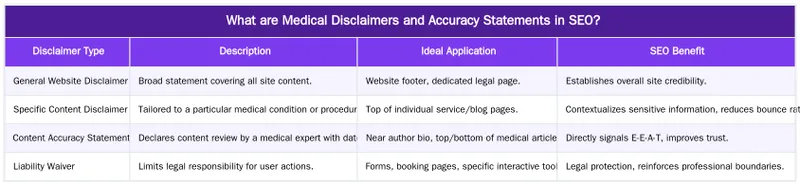
Disclaimer language must be unambiguous and avoid legal jargon. It should state that the content is for informational purposes, is not a substitute for professional medical advice, and that individual results may vary. Accuracy statements should include the last review date and the name or title of the medical professional who verified it. This practice boosts perceived E-E-A-T. The following table compares disclaimer types and their applications:
Measuring the Impact: Disclaimers, Trust Signals, and Ranking
A disclaimer’s direct impact on search rankings is not a trackable metric, but its indirect contributions to SEO performance are significant. Disclaimers foster user trust, generating positive user engagement signals valued by search engines. These signals contribute to improved organic visibility.
Indirect SEO Benefits: User Engagement and Trust Signals
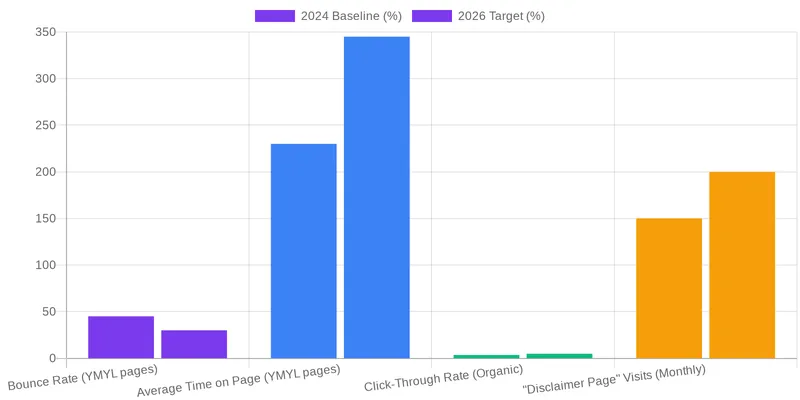
Visible and clear disclaimers improve user experience by setting appropriate expectations. When users trust an information source, they are more likely to spend longer on the page, explore more content, and return. These positive user signals—reduced bounce rates, increased time on page, and higher click-through rates—can indirectly influence search rankings. Google’s algorithms interpret these engagement metrics as indicators of content quality and relevance. A website providing trustworthy information, delineated by disclaimers, builds a reputation that benefits its SEO, especially for YMYL topics where user confidence is critical.
Auditing Your Disclaimers for Ongoing SEO Effectiveness
Regularly auditing disclaimers maintains their relevance and effectiveness. Audits should ensure disclaimers are legally compliant, reflect current medical content policies, and follow SEO best practices. An outdated or poorly placed disclaimer can undermine trust signals. The following metrics can evaluate disclaimer effectiveness:
For a comprehensive approach to compliance, revisit our YMYL SEO Compliance: A Practical Checklist for Medical Websites.
Conclusion
Medical disclaimers and accuracy statements are fundamental for establishing trust and authority for medical YMYL content. They are integral components of a semantic SEO strategy, directly influencing E-E-A-T and indirectly impacting search rankings through user trust signals. By strategically implementing and auditing clear disclaimers, medical clinics can build a credible online presence for patients and search engines. For expert guidance on optimizing your medical website’s semantic content network and ensuring full compliance, contact us. You can also Book a Semantic SEO Audit or reach out via Direct WhatsApp Strategy Line: +90 506 206 86 86.
Frequently Asked Questions
What is the primary SEO purpose of a medical disclaimer?
The primary SEO purpose of a medical disclaimer is to signal trustworthiness and adherence to Google’s YMYL (Your Money or Your Life) guidelines. It helps establish E-E-A-T (Experience, Expertise, Authoritativeness, Trustworthiness) by clearly stating that the content is for informational purposes and not a substitute for professional medical advice. This strategic implementation is crucial for effective content ranking.
How does an accuracy statement impact rankings for medical keywords?
An accuracy statement, which details the content review process and medical expert verification, directly supports the ‘Expertise’ and ‘Trustworthiness’ pillars of E-E-A-T. While not a direct ranking factor, strong E-E-A-T signals are crucial for ranking in competitive medical niches, and proper implementation of these statements contributes significantly to search visibility.
What are the best practices for placing a medical disclaimer SEO-wise?
For maximum visibility to both users and search engine crawlers, a comprehensive medical disclaimer should be linked from the website footer on every page. Additionally, a concise, context-specific disclaimer should appear on each blog post or article containing medical information, often at the top or bottom of the content. This dual placement strategy is key for robust medical disclaimer SEO.
How does a per-post disclaimer contribute to medical disclaimer SEO?
While a site-wide disclaimer in the footer is essential, it’s a best practice to include a concise, context-specific disclaimer on each individual medical post. This reinforces the informational nature of the content on a per-page basis, which is a strong signal for YMYL content evaluation and enhances overall search engine trust.
How can schema markup enhance the impact of a medical disclaimer SEO strategy?
While there isn’t a specific schema type for disclaimers, you can use WebPage or Article schema to highlight accountability and review properties. Referencing the author/reviewer’s Person schema with their credentials within the article’s schema can further strengthen E-E-A-T signals. This integrated approach supports your overall content authority.
How can I get expert help with my clinic’s medical disclaimer SEO and overall strategy?
To secure your clinic’s authority and optimize your medical disclaimer SEO, consider partnering with a specialist like Abdurrahman Şimşek. You can book a Semantic SEO Audit through his website or connect directly via WhatsApp at +90 506 206 86 86 for a tailored strategy. His expertise in medical and plastic surgery SEO ensures robust E-E-A-T implementation.
Ruxi Data brings together multi-model AI, automated website crawling, live indexation checks, topical authority mapping, E-E-A-T enrichment, schema generation, and full pipeline automation — from crawl to WordPress publish to social posting — all in one platform built for agencies and freelancers who run on results.