
SEO Kpis for Clinics: Driving Measurable Patient Growth
Understanding seo kpis for clinics is crucial for private medical practices aiming for sustainable growth. This guide details how to identify, track, and leverage essential medical SEO metrics that directly translate digital efforts into patient acquisition and revenue. It emphasizes moving beyond vanity metrics to focus on conversion tracking, patient acquisition cost, and local SEO reporting, ensuring marketing investments contribute to tangible clinic growth strategy. Realistic goal setting, informed by current performance and competitive analysis, is key to achieving predictable outcomes.
Abdurrahman Şimşek, a Semantic SEO Strategist specializing in London’s private healthcare sector, provides expert insights into optimizing digital presence. His approach focuses on semantic content networks and E-E-A-T principles to build topical authority for medical clinics, ensuring superior organic search outcomes.
To explore your options, contact us to schedule your consultation.
For private medical clinics in London, setting realistic seo kpis for clinics is essential for sustainable growth. This guide shows how to identify, track, and leverage SEO metrics that translate digital efforts into patient acquisition and revenue, moving beyond vanity metrics. These KPIs inform strategic decision-making and demonstrate the value of organic search.
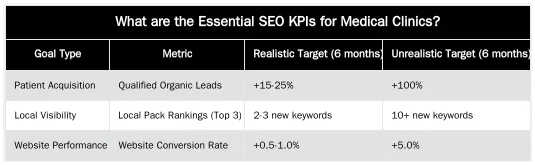
What are the Essential SEO KPIs for Medical Clinics?
Essential SEO KPIs for medical clinics directly correlate with patient acquisition and revenue. They focus on qualified leads and measurable financial outcomes over website traffic or keyword rankings, ensuring marketing efforts contribute to business growth.
Beyond Vanity Metrics: Focusing on Revenue-Driving KPIs
Metrics like raw organic traffic or high keyword rankings alone do not reflect SEO success. High traffic to a blog post may not lead to patient bookings. Clinics require a focus on qualified leads, such as form submissions, phone calls, or online appointment bookings. Understanding the patient acquisition cost (PAC) from organic channels is crucial for assessing return.
Key Categories of Medical SEO Metrics
Impactful metrics for clinics fall into distinct categories:
- Organic Traffic Quality: Focus on traffic to high-value pages (e.g., procedure pages, surgeon profiles), bounce rate on these pages, and time spent on conversion-oriented content.
- Conversion Metrics: Track form submissions, phone calls from organic search, online booking clicks, and virtual consultation requests as direct indicators of patient interest.
- Local SEO Performance: Monitor Google Business Profile (GBP) actions like direction requests, direct calls, and website clicks. Local pack rankings for services like “plastic surgeon Harley Street” are vital.
- Financial Impact: Measure new patients acquired through organic search, the revenue generated, and the overall SEO ROI.
How to Set Realistic SEO Goals for Your Clinic’s Growth
Achievable healthcare marketing goals are fundamental to a successful SEO strategy. Goals should be SMART: Specific, Measurable, Achievable, Relevant, and Time-bound. This framework ensures objectives are clear, trackable, and aligned with the clinic’s growth strategy. Realistic goals consider current performance, market dynamics, and the competitive landscape in London’s private healthcare sector.
Benchmarking Your Current Performance and Competitors
Goal setting begins with analyzing your clinic’s digital footprint, including organic traffic, conversion rates, and local search visibility. Analyze competitor strategies to identify benchmarks and opportunities. For a comprehensive approach, consider a strategic blueprint for plastic surgery SEO success, which details competitive analysis.
Forecasting Organic Traffic and Patient Leads
Forecasting organic traffic and patient leads involves projecting future performance based on current data and strategic initiatives. This uses keyword research, search volume trends, and estimated click-through rates to anticipate traffic increases. Applying historical conversion rates to these traffic projections helps estimate future organic patient leads.
Tracking & Measuring Medical SEO Performance with GA4
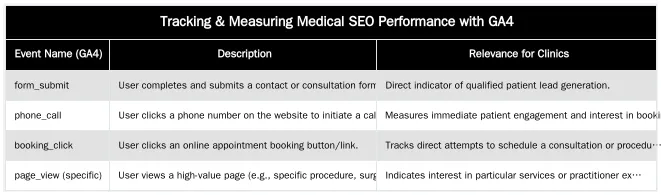
Accurate tracking is essential to understand SEO impact. Google Analytics 4 (GA4) is a platform for monitoring user behavior and conversion tracking for medical clinics. Proper GA4 configuration provides a detailed view of the patient journey, from initial search to consultation booking. Tools like Google Business Profile offer insights into local search performance.
Configuring Google Analytics 4 for Patient Journey Tracking
Setting up GA4 involves defining key events and conversions that signify patient interest, such as form submissions, phone number clicks, and interactions with booking systems. Implementing conversion tracking for these actions provides data on how organic traffic contributes to patient acquisition. This data allows clinics to optimize their website and content for lead generation.
Leveraging Google Business Profile for Local SEO Reporting
Google Business Profile (GBP) is essential for clinics targeting local patients, especially in competitive markets like London. GBP insights provide data on patient interactions with your listing, including direct calls, direction requests, and website visits from local searches. Monitoring these metrics measures local SEO effectiveness and its contribution to clinic growth. For guidance, refer to the Google Business Profile Help Center.
Connecting SEO Performance to Patient Booking & Revenue
The measure of SEO success for a medical clinic is its impact on patient bookings and revenue. Connecting digital metrics to financial outcomes demonstrates the value of SEO investment. This involves calculating return on investment (ROI) and integrating data across systems for a complete view of performance.
Calculating the True ROI of Your Clinic’s SEO Investment
Calculating SEO ROI requires more than tracking traffic; it involves assigning a monetary value to each organic conversion. This includes the patient acquisition cost (PAC) from organic channels and the estimated lifetime patient value (LTV). By comparing revenue from organically acquired patients against SEO costs, clinics can determine their SEO ROI. For more on marketing ROI, see Harvard Business Review’s insights on marketing ROI.
Integrating SEO Data with CRM and Booking Systems
Integrating analytics data with your clinic’s Customer Relationship Management (CRM) and booking systems is essential to connect SEO performance with patient bookings. This integration allows clinics to track a patient from their initial organic search query through to their consultation and procedure. This view provides evidence of how organic search contributes to the bottom line, detailed in the definitive guide to SEO for private healthcare clinics in London.
Why Specialist Semantic SEO Drives Superior KPI Outcomes
For London’s private healthcare sector, a specialist semantic SEO approach yields sustainable KPI improvements. This method focuses on building topical authority and demonstrating E-E-A-T (Experience, Expertise, Authoritativeness, Trustworthiness). It goes beyond keyword matching to establish a clinic as a definitive source of information, influencing the quality and quantity of organic patient leads.
E-E-A-T and Topical Authority: The Foundation for High-Value Leads
Google’s emphasis on E-E-A-T is critical for Your Money Your Life (YMYL) topics like healthcare. A semantic SEO strategy builds topical authority by creating comprehensive, interconnected content that covers a subject exhaustively. This signals to search engines that a clinic is a trusted expert, leading to higher rankings and attracting qualified patients seeking specific treatments. This approach is detailed in Why Topical Authority is Non-Negotiable for Medical Practices and Establishing E-E-A-T: Foundational Content and Signals for Surgeons.
Strategic Reporting for Clinic Directors: Beyond the Numbers
A specialist semantic SEO strategist translates SEO data into actionable insights for clinic directors. This involves explaining the strategic implications of performance, focusing on long-term growth and patient lifetime value. Reports highlight how topical authority improvements lead to higher-value patient inquiries, demonstrating SEO’s impact on the clinic’s reputation and financial health.
Monthly SEO Reporting: A Template for Clinic Directors
Clear SEO reporting is vital for clinic directors to understand the impact of digital marketing investments. A structured monthly report communicates key performance indicators effectively, focusing on business growth.
Key Sections for an Impactful Clinic SEO Report
An effective monthly SEO report should include:
- Executive Summary: A concise overview of performance highlights and key takeaways.
- Performance Overview (KPIs): A dashboard showcasing core metrics like qualified organic leads, conversion rates, local search visibility, and organic revenue.
- Goal Progress: An update on how current performance aligns with established SEO goals.
- Key Activities: A summary of SEO tasks completed during the month (e.g., new content published, technical optimizations).
- Next Steps: A clear outline of planned activities for the upcoming month, linking back to strategic objectives.
A reputable SEO reporting template can be adapted for your clinic’s needs. This structure helps clinic directors grasp the value delivered.
Translating Data into Actionable Insights for Growth
An SEO report should translate data into actionable insights. This involves explaining trends, identifying opportunities, and recommending strategic adjustments. For instance, a decline in local calls might prompt a review of Google Business Profile optimization, while an increase in procedure page conversions could justify further content investment. This approach aligns with the framework offered by medical SEO services for surgeons.
Achieve Predictable Growth with Expert Medical SEO
For private medical clinics in London, organic search requires specialized expertise. Focusing on the right seo kpis for clinics and implementing a semantic SEO strategy makes predictable growth and consistent patient acquisition achievable. Partnering with a specialist who understands the London private healthcare market aligns digital efforts with business objectives.
Conclusion
Setting and tracking the right SEO KPIs is a strategic imperative for medical clinics aiming for sustainable growth. Focusing on revenue-driving metrics, establishing realistic goals, and using tracking tools like Google Analytics 4 can turn a digital presence into a consistent source of qualified patient leads. A specialist semantic SEO approach builds topical authority and E-E-A-T, which is crucial for the YMYL sector. For guidance on building a website that converts and improving local search presence in London, visit abdurrahmansimsek.com.
Frequently Asked Questions
What are the most important seo kpis for clinics to track for growth?
The most important seo kpis for clinics are those directly linked to patient acquisition and revenue. These include the number of qualified patient leads from organic search (e.g., form submissions, phone calls), organic traffic to high-value service pages, and improved local search visibility in platforms like Google Maps. Focusing on these metrics ensures your SEO efforts contribute directly to your clinic’s financial success.
Why are patient inquiries considered superior seo kpis for clinics compared to keyword rankings?
While keyword rankings indicate visibility, they are often vanity metrics that don’t always translate to business growth. Patient inquiries, such as new patient form submissions or direct calls, are far more valuable as they directly reflect interest and potential revenue. Prioritizing these seo kpis for clinics ensures your strategy is aligned with acquiring new patients and driving actual clinic growth.
What constitutes realistic SEO growth goals for a plastic surgery clinic using seo kpis for clinics?
For an established clinic in a competitive market like London, a realistic goal might be a 15-25% year-over-year increase in organic patient leads. Newer clinics should initially focus on establishing baseline visibility and ranking for long-tail keywords, with lead growth accelerating after 6-9 months. These goals are measured using specific seo kpis for clinics that track lead generation and conversion.
How can clinics accurately track phone call leads generated through SEO efforts?
Accurate phone call tracking is vital for understanding SEO’s impact. This is typically achieved using dynamic number insertion (DNI), which displays unique phone numbers to visitors arriving from organic search. These calls can then be attributed back to your SEO campaigns in analytics platforms like Google Analytics, providing clear data on lead generation.
Should a clinic prioritize national or local search performance metrics?
For most private clinics, even those with a broader reputation, the most valuable patients often come from their immediate city or region. Therefore, local SEO performance metrics, such as rankings in the Google Map Pack for ‘[procedure] in [city]’ and overall local organic search visibility, should be a primary focus. These local efforts directly target the most accessible and likely patient base.
How can my clinic get started with a specialized semantic SEO strategy?
To begin enhancing your clinic’s online presence and patient acquisition, you can contact Abdurrahman Şimşek for an initial consultation. We specialize in building high-authority semantic content networks specifically for medical clinics, focusing on YMYL and E-E-A-T optimization. This strategic approach ensures your clinic achieves predictable growth and superior KPI outcomes.
Ruxi Data brings together multi-model AI, automated website crawling, live indexation checks, topical authority mapping, E-E-A-T enrichment, schema generation, and full pipeline automation — from crawl to WordPress publish to social posting — all in one platform built for agencies and freelancers who run on results.