
Website Migration for Medical Clinics: Preserving SEO & Patient Trust
A website migration for medical clinics is a critical process requiring meticulous planning to prevent SEO ranking loss and maintain patient acquisition. This guide outlines strategies for London’s private healthcare providers to navigate website redesigns and platform changes effectively. It emphasizes the importance of a technical SEO checklist, precise 301 redirects, and comprehensive URL mapping to preserve organic visibility. Understanding potential pitfalls like E-E-A-T disruption and monitoring with Google Search Console are essential for a successful transition, safeguarding a clinic’s digital presence and trust.
Abdurrahman Şimşek, a London-based Semantic SEO Strategist with 10 years of experience, specializes in building high-authority semantic content networks for medical clinics. His expertise in holistic SEO strategy and technical web development ensures robust digital foundations for healthcare providers.
To explore your options, contact us to schedule your consultation.
A website migration for medical clinics is a complex process, offering opportunities for digital enhancement but risking established search engine rankings and patient acquisition. This guide provides London’s private healthcare providers a framework to navigate these transitions, preserve organic visibility and patient traffic, and strengthen their online presence and semantic authority. Understanding these changes is critical for maintaining trust and discoverability.
Why SEO Rankings Plummet: Common Migration Pitfalls for Clinics
Medical websites often lose search rankings during or after a migration due to critical oversights. These stem from misunderstanding how search engines process changes, particularly for Your Money Your Life (YMYL) content. Common culprits are technical errors, content integrity issues, and failure to preserve authority signals, which impact a clinic’s online visibility and patient acquisition.
The Critical Role of 301 Redirects and URL Mapping
Incorrect or missing 301 redirects are a primary cause of ranking loss. When old URLs are not mapped to new ones, search engines encounter 404 “page not found” errors, which breaks link equity and disrupts user experience. A comprehensive URL mapping file is essential, mapping every old URL to its new destination. This passes authority from old pages to the new site structure, preventing a drop in organic performance.
E-E-A-T Disruption and Content Integrity Issues
Medical websites require high Expertise, Experience, Authoritativeness, and Trustworthiness (E-E-A-T). During a migration, changes to content, removal of author bios, or alterations to medical information can disrupt E-E-A-T signals. If content loses factual accuracy, or author profiles are not transferred and linked, search engines may see the site as less credible. Preserving the semantic integrity of medical content and attributing expert authors is vital for maintaining topical authority and patient trust. This requires an advanced technical SEO framework for healthcare.
Your Pre-Migration SEO Checklist: Safeguarding Your Clinic’s Traffic
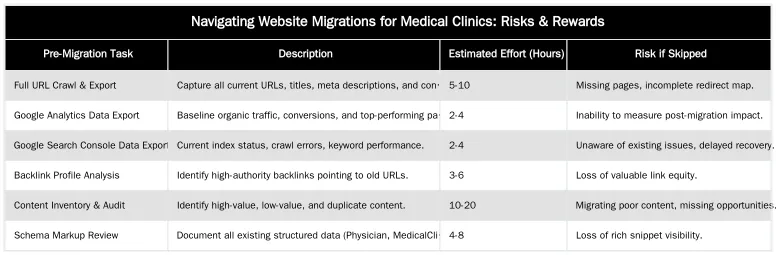
A detailed pre-migration SEO checklist mitigates risks and ensures a smooth transition for medical clinics. It involves planning, auditing, and testing to safeguard existing organic traffic and rankings.
Setting Up a Staging Environment for Rigorous Testing
A staging environment, a replica of the new website on a private server, is essential for testing before launch. This allows verification of technical SEO elements like 301 redirects, schema markup, internal links, and Core Web Vitals. Specific tests for medical content include checking the display of patient testimonials, before-and-after galleries, and medical disclaimers. This testing minimizes the risk of issues on the live site.
Comprehensive Content & Technical Audit
A detailed audit of the existing website is critical before migration. This identifies high-value pages, such as procedure descriptions or surgeon profiles, and documents their rankings and traffic. Existing schema markup, internal linking structure, and Core Web Vitals performance must be cataloged. The audit is an opportunity for Cost of Retrieval optimization, designing the new site for efficient crawling and indexing.
Post-Migration Monitoring & Recovery: What to Watch For
After migration, continuous monitoring is essential to quickly identify and resolve SEO issues. Rapid detection and remediation are critical to minimize ranking loss and ensure recovery. This requires using tools and metrics to track site health and user engagement.
Leveraging Google Search Console for Rapid Issue Detection
Google Search Console (GSC) is essential for post-migration monitoring. Check GSC regularly for new crawl errors, especially 404s indicating broken links. The ‘Index Coverage’ report shows if new pages are indexed, and the ‘Sitemaps’ section confirms sitemap processing. Performance reports show keyword rankings and organic traffic trends, identifying any drops. Check for redirect chains to improve crawl efficiency.
Tracking Key Performance Indicators (KPIs) and User Experience
Monitoring key performance indicators (KPIs) is also vital. Track organic traffic, keyword rankings for medical procedures, and conversion rates for patient inquiries. A sudden dip in these metrics signals a problem. Observe user experience metrics like bounce rate and time on page, especially on high-value procedure pages. Maintaining strong Core Web Vitals for surgeons on mobile devices is crucial for mobile-first indexing. Poor page speed or visual stability negatively impacts rankings and patient engagement.
Why a Specialist SEO Strategist is Non-Negotiable for Medical Migrations
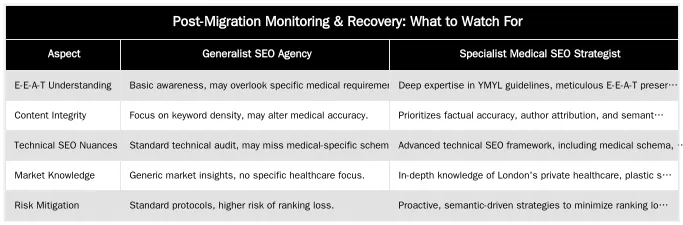
Entrusting a medical clinic’s website migration to a generalist SEO agency is risky, especially in competitive markets like London. The complexities of YMYL (Your Money Your Life) content, E-E-A-T requirements, and patient trust demand a specialist Semantic SEO Strategist. A specialist understands technical SEO and healthcare, ensuring the migration avoids pitfalls and enhances the clinic’s digital authority.
Preserving E-E-A-T and Topical Authority Through Transition
A specialist SEO strategist knows search engines judge medical websites on Expertise, Experience, Authoritativeness, and Trustworthiness. During a migration, they ensure author profiles, medical credentials, and factual content are transferred and semantically reinforced. They maintain topical authority by preserving semantic relationships between content entities, preventing dilution of trust signals. Generalists often overlook these elements, causing ranking declines for YMYL queries. A specialist like Abdurrahman Şimşek uses semantic engineering to keep the site’s knowledge graph robust, protecting and enhancing E-E-A-T during the transition.
Strategic Planning for London’s Elite Private Healthcare Market
The London private healthcare market, especially areas like Harley Street, is highly competitive, requiring a tailored approach. A specialist SEO strategist understands the local search landscape, patient demographics, and the search intent of high-value patients. They develop migration strategies for geo-targeted content, local SEO signals, and the branding requirements of elite clinics. This includes optimizing for local pack rankings and ensuring the new site architecture supports local service pages. Their expertise aligns the migration with the clinic’s broader healthcare digital marketing objectives to secure dominance in premium London postcodes.
Secure Your Clinic’s Digital Future: Partner with an Expert
A medical clinic website migration can propel a practice forward or set it back, impacting organic rankings, patient trust, and revenue. Partnering with a specialist SEO strategist who understands healthcare digital marketing and the London private aesthetic market is a strategic imperative. For guidance on your website transition, consult with Abdurrahman Şimşek.
Conclusion
A medical clinic website migration demands planning, technical precision, and an understanding of SEO’s impact on YMYL content. The risks of ranking and traffic loss require a strategy that prioritizes URL mapping, 301 redirects, and preserving E-E-A-T signals. A pre-migration checklist, staging environment testing, and post-launch monitoring mitigate these risks. Engaging a specialist SEO strategist with expertise in the London private healthcare sector safeguards digital assets while enhancing topical authority and long-term patient acquisition. Explore how expert semantic SEO can benefit your clinic today.
Frequently Asked Questions
What is the single biggest risk during website migration for medical clinics?
The biggest risk during a website migration for medical clinics is a significant loss of organic rankings and patient traffic due to improper implementation of 301 redirects. A meticulous URL mapping process is non-negotiable to ensure all link equity from old procedure and doctor pages is passed to the new URLs, preserving your online visibility.
Why is a specialist agency crucial for a clinic’s website redesign, especially concerning website migration for medical clinics?
A specialist understands the nuances of medical SEO, including YMYL content requirements and patient privacy (GDPR/HIPAA). Managing a website migration for medical clinics requires expertise in preserving rankings for high-value procedure keywords, which a generalist agency may overlook, potentially leading to significant patient loss.
How far in advance should a clinic plan its SEO strategy for a website migration for medical clinics?
Planning for a website migration for medical clinics should begin at least 3-6 months before the proposed launch date. This allows ample time for a comprehensive SEO audit of the old site, strategic URL mapping, content review, and thorough testing on a staging server to mitigate any risks and ensure a smooth transition.
What is a “staging environment” and why is it essential for a medical site redesign?
A staging environment is a private, non-public copy of your new website. It allows your SEO and development teams to thoroughly test every aspect of the migration, from redirects to schema markup. This ensures a flawless launch without affecting your live patient-facing website or existing search rankings.
Can a clinic merge two websites into one without losing SEO value during a redesign?
Yes, merging two clinic websites is possible through a carefully executed 301 redirect strategy. This involves mapping all URLs from the secondary site to the most relevant pages on the primary domain. This process consolidates authority and can actually boost the primary site’s overall SEO performance if done correctly, preserving your digital assets.
How can Abdurrahman Şimşek help my clinic with its website redesign or migration?
Abdurrahman Şimşek specializes in building high-authority Semantic Content Networks for medical clinics. With 10+ years of experience, he provides holistic SEO strategy, semantic engineering, and technical web development to ensure your migration preserves and enhances your organic visibility and patient acquisition. Partnering with an expert like Abdurrahman Şimşek can secure your clinic’s digital future.
Ruxi Data brings together multi-model AI, automated website crawling, live indexation checks, topical authority mapping, E-E-A-T enrichment, schema generation, and full pipeline automation — from crawl to WordPress publish to social posting — all in one platform built for agencies and freelancers who run on results.