
Physician Schema Hascredential: Enhancing Medical E-e-a-t and Trust
Implementing physician schema hascredential and ‘knowsAbout’ properties strategically enhances a medical professional’s online presence. This guide details how nesting these structured data elements within Physician schema clearly communicates verifiable professional qualifications and specific medical specialties to search engines. Leveraging physician schema hascredential effectively boosts E-E-A-T signals, improving author authority and trust signals for medical content. This approach is crucial for entity disambiguation and achieving higher visibility in competitive healthcare markets, ultimately building patient confidence.
Abdurrahman Şimşek, a Semantic SEO Strategist specializing in medical clinics, provides expert guidance on leveraging structured data for enhanced digital authority. His 10+ years of experience in semantic engineering and medical SEO inform strategies for building high-authority content networks.
To explore your options, contact us to schedule your consultation. You can also reach us via: Book a Semantic SEO Audit, Direct WhatsApp Strategy Line: +90 506 206 86 86
Using physician schema hascredential and ‘knowsAbout’ properties within Physician schema boosts a medical professional’s E-E-A-T signals, helping search engines understand their expertise. This guide explains the strategic importance of these structured data elements for medical SEO, particularly in competitive markets like London’s private healthcare sector, to enhance online visibility and patient confidence.
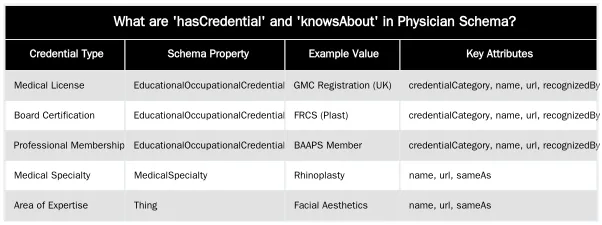
What are ‘hasCredential’ and ‘knowsAbout’ in Physician Schema?
The ‘hasCredential’ and ‘knowsAbout’ properties within schema.org’s Physician type are structured data that communicate a medical professional’s qualifications and expertise to search engines. They help algorithms understand a doctor’s background and specializations to build digital trust and authority.
Defining ‘hasCredential’: Proving Professional Qualifications
‘hasCredential’ is a schema.org property that lists a physician’s formal qualifications, such as medical licenses, board certifications, and memberships in professional bodies. For instance, a surgeon in the UK would list their registration with the General Medical Council (GMC) or membership in a Royal College. This property establishes verifiable credentials, supporting a medical professional’s trustworthiness and expertise.
Defining ‘knowsAbout’: Signaling Medical Expertise and Specialization
The ‘knowsAbout’ property details a physician’s specific areas of expertise, medical specialties, and procedures. For example, a plastic surgeon might use ‘knowsAbout’ to specify ‘Rhinoplasty’, ‘Breast Augmentation’, or ‘Dermatological Surgery’. Defining these specializations allows search engines to match a physician’s profile to relevant patient queries, improving search result precision and aiding entity disambiguation.
Why Nesting These Properties Boosts E-E-A-T for Medical Experts
Nesting ‘hasCredential’ and ‘knowsAbout’ within the ‘Physician’ schema enhances E-E-A-T (Experience, Expertise, Authoritativeness, Trustworthiness) signals. This method gives search engines a clear understanding of a professional’s background, which is critical for Your Money Your Life (YMYL) content and essential for medical websites in 2026.
Enhancing Author Authority and Trust Signals
Nesting ‘hasCredential’ and ‘knowsAbout’ signals an author’s qualifications and expertise to Google. This is crucial for YMYL content, where information credibility is paramount. By linking verifiable credentials and specializations to the physician entity, search engines can attribute ‘author authority’ to their content, building trust with algorithms and patients. For more on this topic, explore automated E-E-A-T signals.
Improving Entity Disambiguation for Medical Specialties
The ‘knowsAbout’ property helps Google differentiate between similar medical terms or specialties. For example, while ‘cosmetic surgery’ is broad, specifying ‘knowsAbout’: ‘Rhinoplasty’ or ‘Facelift’ helps Google associate the physician’s expertise with specific queries. This reduces ambiguity and improves entity recognition, ensuring the physician’s profile appears for relevant searches. E-E-A-T in YMYL contexts is detailed in E-E-A-T for YMYL in 2026.
Implementing ‘hasCredential’ and ‘knowsAbout’ with JSON-LD
JSON-LD provides a machine-readable way to embed structured data into your website’s HTML. This section explains how to craft JSON-LD with proper nesting for ‘hasCredential’ and ‘knowsAbout’ within a ‘Physician’ schema.
Crafting Your JSON-LD: A Step-by-Step Guide
Define the main entity as "@type": "Physician". Within this object, nest ‘hasCredential’ and ‘knowsAbout’ as arrays of objects. For ‘hasCredential’, each object is "@type": "EducationalOccupationalCredential", detailing the credential’s name, category, and issuing body, with a URL to an official registry. For ‘knowsAbout’, each object is "@type": "MedicalSpecialty" or "@type": "Thing", specifying the specialty’s name and linking to authoritative sources via ‘url’ or ‘sameAs’. This is key for implementing advanced medical schema.
Key Attributes for ‘MedicalSpecialty’ and ‘EducationalOccupationalCredential’
For ‘MedicalSpecialty’ within ‘knowsAbout’, key attributes include "name" (e.g., “Plastic Surgery”), "url" (linking to a Wikipedia page or professional body), and "sameAs" (for other authoritative links). For ‘EducationalOccupationalCredential’ within ‘hasCredential’, attributes include "credentialCategory" (e.g., “MedicalLicense”), "name" (e.g., “GMC Registration”), "url" (to the official registry entry), and "recognizedBy" (an organization object for the issuing body).
Best Practices for Nesting and Entity Recognition
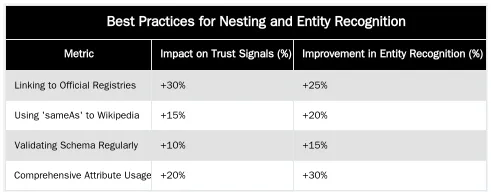
Optimal nesting and entity recognition require strategic linking and validation to ensure Google correctly understands the medical entities in your structured data.
Linking to Authoritative Sources: GMC, Wikipedia, and Professional Bodies
Linking to authoritative external sources amplifies the effectiveness of ‘hasCredential’ and ‘knowsAbout’. For credentials, use the ‘url’ property to point to official registries, like a physician’s entry on the GMC register or a Royal College website. For specialties in ‘knowsAbout’, use ‘url’ or ‘sameAs’ to link to knowledge bases like Wikipedia or medical organizations. This provides verifiable evidence of expertise, strengthens trust signals, and helps Google connect your entities to its Knowledge Graph.
Avoiding Common Schema Nesting Errors for Medical Practitioners
Common schema implementation mistakes can undermine its benefits. These include incorrect property usage (e.g., using ‘description’ instead of ‘knowsAbout’ for specialties), improper nesting depth, or missing attributes like ‘name’ or ‘url’. Ensure all URLs are valid and accessible. Regularly validate your structured data with Google’s Rich Results Test or Schema Markup Validator to find and correct errors.
The Impact on Search Visibility and Patient Trust
Correctly implementing and nesting these schema properties benefits medical websites by improving search visibility, raising rankings for YMYL queries, and increasing patient trust and conversions, especially in competitive markets like London’s private healthcare sector.
How Structured Data Influences Google’s Understanding of Expertise
Google’s algorithms use structured data to better understand a physician’s expertise. Defining credentials and specialties provides clear signals that help Google connect the professional to relevant topics. This understanding impacts rankings for medical queries requiring high E-E-A-T. The structured information also feeds into Google’s Knowledge Graph, enhancing the entity’s authority. For more on this connection, explore Knowledge Graph and E-E-A-T SEO.
Translating Schema into Patient Confidence and Conversions
Enhanced E-E-A-T signals, visible through rich snippets or improved rankings, build patient confidence. A search result indicating a physician’s board certification or expertise instills trust. This technical detail contributes to the patient acquisition funnel. In competitive markets like London, this trust can be the deciding factor for booking a consultation for high-value procedures.
Future-Proofing Your Medical Website with Semantic Schema
Advanced schema implementation, including the nesting of ‘hasCredential’ and ‘knowsAbout’, is a critical component of a long-term SEO strategy for medical clinics. A semantic approach communicates expertise and trustworthiness to search engines and patients, maintaining authority and visibility in 2026 and beyond.
Conclusion
Nesting ‘hasCredential’ and ‘knowsAbout’ properties within Physician schema is fundamental for establishing strong E-E-A-T signals. This structured data approach enhances search engine understanding and builds patient trust. For medical clinics and plastic surgeons in London seeking to improve local organic search and attract high-value patients, a semantic SEO strategy is indispensable. To improve your digital presence, contact us, Book a Semantic SEO Audit, or use our Direct WhatsApp Strategy Line: +90 506 206 86 86.
Frequently Asked Questions
What is the purpose of the `hasCredential` property in physician schema hascredential?
The `hasCredential` property allows you to explicitly list a surgeon’s professional qualifications, such as their medical license, board certifications, or memberships in prestigious organizations. It’s a direct, machine-readable way to prove their credentials and build trust, forming a key part of a robust physician schema hascredential implementation.
How does the `knowsAbout` property complement the `hasCredential` information in medical structured data?
While `hasCredential` specifies formal qualifications, `knowsAbout` details the concepts, conditions, and procedures the physician specializes in. Together, they provide a comprehensive profile of expertise, distinguishing formal proof from specific areas of knowledge. This helps search engines understand both what a doctor is qualified for and what they are an expert on.
Can you provide a simple example of how to use `knowsAbout` for a medical specialist?
For a plastic surgeon specializing in facial procedures, `knowsAbout` could link to established medical concepts like ‘Rhinoplasty’, ‘Blepharoplasty’, or ‘Facelift’. This connects the surgeon’s entity to relevant medical topics in the knowledge graph, enhancing their topical authority and demonstrating specific areas of expertise.
Why is nesting these properties, including the physician schema hascredential data, crucial for E-E-A-T?
Nesting this data within the `Physician` schema creates a comprehensive block of information about the surgeon’s expertise. It signals to Google that the author of your medical content has verifiable, specific, and relevant expertise, which is the cornerstone of E-E-A-T for YMYL topics, especially when using physician schema hascredential. This holistic approach builds significant digital trust.
Where should the detailed physician schema hascredential and `knowsAbout` properties be implemented on a medical website?
This detailed `Physician` schema should primarily be on the surgeon’s main biography page. Additionally, a concise version can be nested within the `author` property of articles they write and the `performer` property of procedure pages, reinforcing their expertise across the site. Implementing physician schema hascredential consistently helps search engines connect the dots across your entire web presence.
How can I begin optimizing my clinic’s online presence with advanced semantic strategies?
To enhance your clinic’s online visibility and patient trust, consider a Semantic SEO Audit. This will identify opportunities to leverage structured data like `Physician` schema effectively and build topical authority. You can book a Semantic SEO Audit or contact Abdurrahman Şimşek directly via WhatsApp at +90 506 206 86 86 for strategic consulting.
Ruxi Data brings together multi-model AI, automated website crawling, live indexation checks, topical authority mapping, E-E-A-T enrichment, schema generation, and full pipeline automation — from crawl to WordPress publish to social posting — all in one platform built for agencies and freelancers who run on results.