
Topical Authority Vs Domain Authority: Optimizing Surgeon SEO
The debate between topical authority vs domain authority is crucial for surgeons aiming to attract high-value patients in competitive medical fields. For YMYL (Your Money Your Life) websites, Google prioritizes demonstrable expertise and comprehensive coverage on specific medical subjects, making a robust topical strategy essential. This approach, focusing on semantic relevance and niche authority, ensures a site becomes a definitive resource, outranking those relying solely on generic website authority metrics like Ahrefs Domain Rating or Moz DA. Understanding these SEO metrics is vital for achieving sustainable search visibility and patient trust.
Abdurrahman Şimşek, a Semantic SEO Strategist, emphasizes that building deep topical authority is fundamental for medical practices to achieve sustainable search visibility and patient trust, aligning with Google’s E-E-A-T imperative for healthcare content.
To explore your options, contact us to schedule your consultation. You can also reach us via: Book a Semantic SEO Audit, Direct WhatsApp Strategy Line: +90 506 206 86 86
For plastic surgeons and medical clinics, the debate between topical authority vs domain authority is critical for attracting high-value patients in 2026. Google prioritizes demonstrable expertise and comprehensive coverage on specific medical subjects, making a topical strategy essential for YMYL (Your Money Your Life) sites.
Building Topical Authority: A Strategic Blueprint for Surgeons
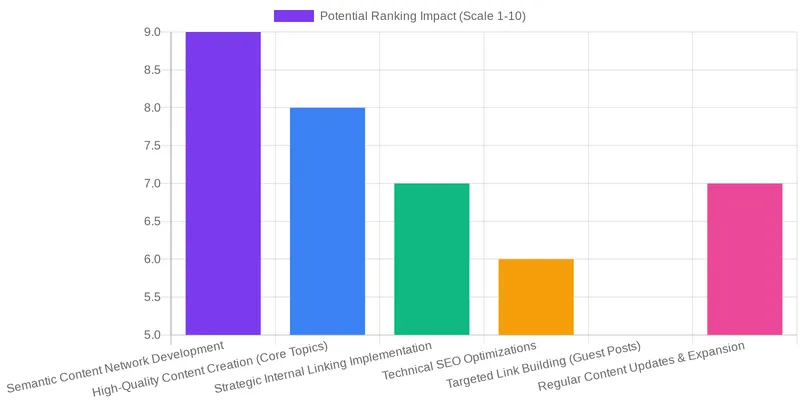
To dominate organic search, surgeons need a structured approach to building topical authority. This requires a content strategy centered on semantic relationships and user intent, not just individual blog posts. The goal is to become the definitive online resource for your specialized procedures.
Developing a Semantic Content Network for Medical Procedures
A semantic content network uses interconnected content clusters around specific surgical procedures. For instance, a plastic surgeon specializing in breast augmentation creates a core “pillar” page and supporting articles on sub-topics like “types of breast implants,” “breast augmentation recovery timeline,” “cost of breast augmentation in London,” and “choosing a surgeon for breast augmentation.” This topic cluster strategy provides comprehensive coverage, answers patient questions, and demonstrates expertise. This structured approach is fundamental for building topical authority for medical practices.
Leveraging Internal Linking for Semantic Depth
Strategic internal linking reinforces topical relationships on your website. Linking related articles with descriptive, relevant anchor text signals semantic connections to search engines. For example, an article on “post-operative care for rhinoplasty” should link to the main “rhinoplasty procedure” page and to “managing swelling after nose surgery.” This helps search engines understand your site’s structure and expertise and guides users through a logical information journey. Effective internal linking is a cornerstone of an entity-driven SEO strategy.
The Role of Domain Authority in a Topical World
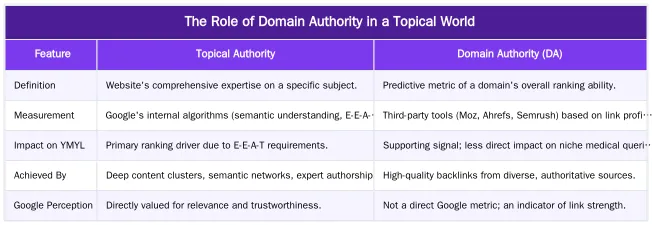
While topical authority is the primary driver for medical sites in 2026, Domain Authority (DA) plays a supporting, indirect role. DA is a third-party metric, not a direct Google ranking signal, but it can offer insights into a competitor’s link profile strength.
Domain Authority as a Supporting Signal (Not a Google Metric)
Domain Authority, page authority, and website authority are predictive scores from SEO tools; Google does not use them in its ranking algorithms. Google evaluates individual links and the overall quality of a domain’s backlink profile. A high DA score often correlates with a strong backlink profile, which can indirectly help a site rank. However, a site with a lower DA but superior topical depth and E-E-A-T can outrank a high-DA generalist site for niche medical queries. A “good” domain authority score is relative; what matters is how it compares to direct, topically relevant competitors.
Topical Authority vs. Domain Authority: Key Differences for Surgeons
For a plastic surgeon, investing in content that builds deep subject matter expertise yields greater returns than pursuing generic link building to boost a third-party DA score.
Achieving Niche Dominance: Low DA, High TA Success Stories
Topical authority’s strategic advantage is evident when specialized medical websites with modest Domain Authority outrank larger domains. This is common in competitive YMYL niches like plastic surgery, where Google prioritizes expertise over generic brand recognition. Semantic depth allows a clinic to become the go-to resource for specific procedures.
The Power of Semantic SEO for Competitive Medical Niches
Abdurrahman Şimşek’s semantic SEO framework, supported by the Ruxi Data infrastructure, enables medical clinics to build topical authority. The methodology focuses on entity-level search intent and creating content that comprehensively covers a medical topic. Using Ruxi Data for automated topical map creation and EAV (Entity-Attribute-Value) modeling, clinics can identify and fill content gaps, reducing Google’s Cost of Retrieval. This allows newer practices to compete with high-DA health portals and become the authoritative voice for specific surgical procedures in London.
Case Studies: Outranking High DA Competitors with Topical Depth
A London-based aesthetic clinic specializing in rhinoplasty can illustrate this. A large health information website may have a DA of 70+ but superficial rhinoplasty content. A focused clinic with a DA of 30 can create a semantic content network covering every aspect of rhinoplasty: techniques, recovery, testimonials, galleries, and FAQs. This deep, interconnected content from an experienced surgeon signals superior topical authority to Google. The specialized clinic can then outrank the high-DA generalist site for high-value queries like “best rhinoplasty surgeon London” or “ethnic rhinoplasty techniques.” This shows topical authority is a ranking factor influencing visibility and patient acquisition. Measuring this impact is crucial, as explored in measuring topic cluster ROI.
Conclusion
For plastic surgeons and medical clinics, the strategic focus should be building topical authority. While Domain Authority indicates link strength, topical authority, underpinned by E-E-A-T and semantic relevance, drives rankings in the YMYL space. Creating comprehensive, interconnected content networks that demonstrate expertise in specific medical procedures enhances visibility, attracts qualified patients, and builds trust with users and search engines. Book a Semantic SEO Audit with Abdurrahman Şimşek today, or connect directly via WhatsApp Strategy Line: +90 506 206 86 86.
Frequently Asked Questions
For a plastic surgeon, what is the key difference in importance between topical authority vs domain authority?
For medical practices, topical authority is significantly more important. Google’s algorithms for YMYL (Your Money Your Life) queries prioritize demonstrable expertise on specific medical subjects over generic site-wide authority. A website that is the definitive resource on a niche procedure will outrank a high-DA general health website for relevant queries.
How does Google’s algorithm evaluate the topical authority vs domain authority dynamic for ranking?
Google does not directly use third-party metrics like “Domain Authority” as a ranking factor. Instead, its algorithms assess a website’s expertise and trustworthiness at a granular, topic-specific level. This means a site can be highly authoritative on one medical procedure but not necessarily across all health topics.
Does focusing on building topical expertise indirectly improve a website’s overall domain strength?
Yes, building deep topical expertise often leads to an indirect increase in domain strength. By creating comprehensive, high-quality content, your site naturally attracts valuable backlinks from other reputable sources. These backlinks are a significant factor in how third-party tools calculate metrics like Domain Authority, so growth in one often influences the other.
In the context of topical authority vs domain authority, how can a surgeon with lower domain strength compete against higher-DA competitors?
A surgeon with lower domain strength can effectively compete by focusing intensely on building deep topical expertise within a specific niche. Instead of trying to match a competitor’s broad backlink profile, concentrate on becoming the undeniable expert for a set of high-value procedures. This strategy allows you to win on relevance and specialized knowledge, which Google highly values for medical queries.
Which is generally faster to establish for a medical practice: deep subject matter expertise or overall site strength?
Establishing deep subject matter expertise is generally much faster. While overall site strength, heavily reliant on acquiring numerous external backlinks, can take years to develop, a focused content strategy can build strong topical signals within 6-12 months. This targeted approach leads to quicker ranking improvements for specific, high-value medical niches.
How can Abdurrahman Simsek help my clinic build strong topical expertise and improve search visibility?
Abdurrahman Simsek, a Holistic SEO Strategist and Semantic Engineer, specializes in helping medical and plastic surgery clinics build unassailable topical expertise using his Semantic SEO Framework. You can book a Semantic SEO Audit to identify opportunities and develop a strategic blueprint, or connect directly via WhatsApp at +90 506 206 86 86 for strategy discussions.
Ruxi Data brings together multi-model AI, automated website crawling, live indexation checks, topical authority mapping, E-E-A-T enrichment, schema generation, and full pipeline automation — from crawl to WordPress publish to social posting — all in one platform built for agencies and freelancers who run on results.