
Remove Fake Google Review: Safeguard Your Clinic’s Online Reputation
To remove fake Google review entries, UK medical clinics must understand Google’s content policies and utilize their Google Business Profile effectively. This guide outlines a practical strategy for UK doctors to identify fraudulent online reviews, flag them as inappropriate, and gather evidence to support removal requests. It also explores advanced reputation management techniques and legal considerations, such as defamation UK law, to protect patient confidentiality and maintain professional standing against malicious online reviews.
Abdurrahman Şimşek, a Semantic SEO Strategist specializing in medical clinics, provides expert guidance on online reputation management. His expertise helps healthcare providers navigate complex digital challenges, ensuring brand protection and maintaining trust through strategic SEO and content practices.
To explore your options, contact us to schedule your consultation.
For UK medical clinics, removing fake Google review entries is crucial for maintaining trust and professional standing. This guide provides UK doctors a strategy to identify, report, and address fraudulent online reviews. It also explores advanced reputation management techniques to protect your brand.
What Constitutes a Fake Google Review for UK Medical Clinics?
A fake Google review is one that does not reflect a genuine patient experience or violates Google’s content policies. For UK medical clinics, these can originate from competitors, disgruntled non-patients, or automated bots. Google’s review policy ensures authenticity and relevance, which is critical for Your Money Your Life (YMYL) content like healthcare, where accuracy and trust are paramount.
Reviews that violate Google’s guidelines include spam, fabricated content, off-topic comments, hate speech, or conflicts of interest.
Understanding Google’s Review Policies for Healthcare
Spam and fake content include reviews posted by bots, duplicate reviews, or those based on an intentionally false experience. Off-topic reviews contain personal rants or political commentary unrelated to the clinic’s services. Conflict of interest arises when reviews are posted by current or former employees, competitors, or individuals paid to leave feedback. Hate speech, harassment, and sexually explicit content are also strictly prohibited.
False reviews can mislead potential patients, distort a clinic’s reputation, and undermine the credibility of genuine patient feedback.
How to Report and Remove a Fake Google Review: A Practical Guide
When a UK medical clinic encounters a fraudulent review, flag it within your Google Business Profile. Gathering evidence is crucial to support your removal request and increase the likelihood of a successful outcome.
Step-by-Step: Flagging a Review in Google Business Profile
To report a review, sign in to your Google Business Profile dashboard and navigate to the “Reviews” section. Locate the review, click the three-dot menu icon, and select “Report review” or “Flag as inappropriate.” Google will prompt you to specify the violation type (e.g., “Off-topic,” “Spam,” “Conflict of interest”). This action sends the review to Google for moderation.
Gathering Evidence to Support Your Claim
Providing evidence strengthens your case for review removal. For medical practices, this involves cross-referencing patient records and appointment systems. Screenshots of the review, including the reviewer’s name and content, are fundamental. Consider internal records that disprove a claim, such as a lack of appointment history, no record of communication, or discrepancies in the described treatment.
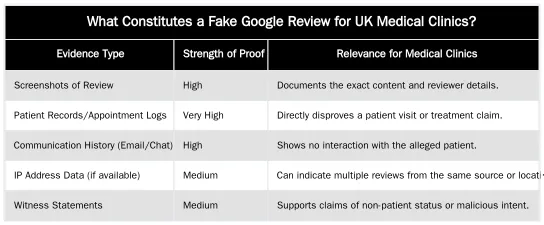
When compiling evidence, focus on factual discrepancies and direct contradictions to the review’s claims. This objective data helps Google’s moderators assess the validity of your removal request.
What If Google Doesn’t Remove It? Advanced Strategies for UK Doctors
Google may decline a request to remove a fake review, even with clear evidence. Advanced strategies exist to address this, from escalating your case with Google to exploring legal avenues under UK defamation law.
Escalating Your Case to Google Business Profile Support
If your initial flagging attempt is unsuccessful, appeal Google’s decision. Access Google Business Profile support channels in your dashboard’s help section. Prepare a concise summary of your case, explaining the policy violation and providing all evidence. Be persistent and polite. Google Business Profile support can offer a more in-depth review, potentially leading to a different outcome. Providing context on the impact to patient trust or your clinic’s reputation can be beneficial.
Understanding UK Defamation Law for Online Reviews
For highly damaging or persistent false reviews, UK defamation law offers legal recourse. The Defamation Act 2013 applies to online content, requiring that a statement causes or is likely to cause “serious harm” to a claimant’s reputation. For medical clinics, this could include significant financial loss or damage to professional standing. Before pursuing legal action, seek expert legal counsel. A solicitor specializing in media or defamation law can assess your case, guide you through the process, and advise on outcomes and costs. More information is on the UK government’s guidance on defamation.
Protecting Your Clinic’s Online Reputation: Beyond Review Removal
Reputation management for medical clinics extends beyond addressing negative or fake reviews. It involves proactive measures to build a positive online presence and brand protection. Abdurrahman Şimşek, a London-based Semantic SEO Strategist, states that building topical authority and a semantic content network can mitigate the impact of isolated negative feedback, reinforcing a clinic’s credibility.
Proactive Reputation Management and Patient Feedback Systems
Encouraging genuine positive online reviews is a cornerstone of proactive reputation management. This includes asking satisfied patients for feedback, providing links to review platforms, and integrating feedback mechanisms into the patient journey. Monitoring online mentions helps catch potential issues early. When responding to feedback, maintain strict patient confidentiality, adhering to GDPR and medical ethical guidelines. Never disclose patient details or treatment information in public replies.
The Role of Semantic SEO in Brand Protection for Healthcare
A semantic SEO strategy builds a clinic’s digital authority around its core services. Creating a semantic content network helps a clinic dominate search results for relevant medical queries, establishing it as a trusted source. This topical authority dilutes the impact of negative reviews by ensuring positive, authoritative content ranks higher. For instance, optimizing your local business schema can enhance your clinic’s visibility and credibility in local search.
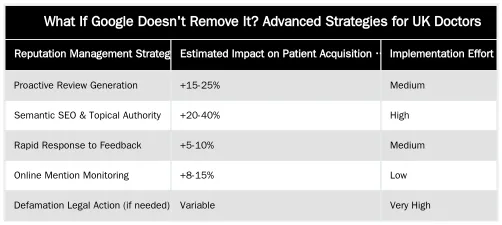
These strategies create a resilient online presence that can withstand malicious or inaccurate reviews.
What to Expect After Reporting a Fake Review & Next Steps
After you report a fake review, Google’s moderation team assesses your claim against their content policies. The timeline can vary from a few days to several weeks, depending on case complexity and report volume.
Google’s Review Process: Timelines and Outcomes
Once flagged, Google’s team investigates the review. Possible outcomes include removal, no action, or a request for more information. If no action is taken, you may need to escalate the issue through Google Business Profile support. Google balances user expression with business protection. For details on Google’s policies and reporting process, refer to the official Google Business Profile Help documentation.
Responding to Negative Reviews: A Professional Approach
A professional response is vital, even for fake or critical reviews. Public responses should be concise, address the concern without admitting fault, and invite the reviewer to contact the clinic directly to resolve the issue offline. Never disclose patient-specific information due to confidentiality and GDPR regulations. A response like, “We take all patient feedback seriously and would like to understand your experience better. Please contact us directly at [phone number/email] so we can address your concerns,” is professional. This approach can mitigate negative perceptions, even if the review remains visible.
Secure Your Clinic’s Online Reputation with Expert SEO Guidance
Protecting your clinic’s reputation requires more than addressing fake reviews. Building a digital presence through semantic SEO and reputation management is essential. Partnering with a specialist who understands the healthcare sector can ensure lasting authority and trust.
Conclusion
Managing fake online reviews is a critical component of reputation management for UK medical clinics. By understanding Google’s policies, gathering evidence, and using the right reporting channels, clinics can challenge fraudulent content. If removal is difficult, escalating to Google Business Profile support or exploring legal options under UK defamation law provides recourse. A proactive strategy using semantic SEO and patient feedback systems builds a resilient online presence, maintaining professional integrity. For expert guidance in building a semantic content network and safeguarding your clinic’s online reputation, visit abdurrahmansimsek.com.
Frequently Asked Questions
What is the first step to remove a fake Google review for my clinic?
To initiate the process to remove a fake Google review, you should immediately flag it within your Google Business Profile dashboard. Sign in, navigate to ‘Reviews,’ locate the specific review, click the three dots, and select ‘Report review’ to inform Google of the violation. This action is crucial for getting the review assessed.
What types of content violate Google’s policies for online reviews?
Google’s policies prohibit reviews that are spam, fake, off-topic, contain hate speech, or represent a conflict of interest. While genuine negative feedback is allowed, content that is demonstrably false or malicious can be reported for policy violation. Understanding these guidelines is key to successful review moderation.
What should I do after I’ve flagged a review to initiate the process to remove a fake Google review?
After flagging, it’s vital to document everything by taking screenshots of the review and the reviewer’s profile. This evidence can be crucial if Google requires more information or if you need to pursue further legal action, especially if the review contains defamatory statements. This documentation is a critical step in your efforts to remove a fake Google review.
Should I publicly respond to a review that I suspect is not genuine?
It is generally advisable not to engage directly with a review you believe is fake, as this can inadvertently give it more visibility. For genuine negative feedback, a professional and calm response is appropriate, but for fraudulent content, focus on the reporting process rather than public engagement. Your priority should be the formal reporting channels.
What is the most effective long-term strategy to prevent and mitigate the impact of fake reviews, beyond just trying to remove fake Google review entries?
A proactive online reputation management strategy is the most effective long-term solution. Consistently generating a high volume of genuine, positive reviews from real patients helps to dilute the impact of any single fake or negative entry. This approach builds a strong, authentic online presence that naturally pushes down less credible content and reduces the need to constantly remove fake Google review entries.
How can Abdurrahman Şimşek assist my clinic with online reputation and SEO?
Abdurrahman Şimşek specializes in building high-authority Semantic Content Networks for medical clinics, focusing on YMYL and E-E-A-T optimization. We provide expert guidance on holistic SEO strategy, reputation management, and technical web development to ensure your clinic maintains a strong, trustworthy online presence. Contact us for a tailored strategy to protect and grow your digital footprint.
Ruxi Data brings together multi-model AI, automated website crawling, live indexation checks, topical authority mapping, E-E-A-T enrichment, schema generation, and full pipeline automation — from crawl to WordPress publish to social posting — all in one platform built for agencies and freelancers who run on results.