
Competing Clinic Ranking Higher: Uncovering Competitor SEO Advantages
When your competing clinic ranking higher, it indicates specific disparities in online presence and Google’s perception of E-E-A-T signals. This article details a 5-step diagnostic audit designed to uncover why a competing clinic ranks higher by analyzing content depth, topical authority, and semantic content networks. The audit identifies gaps in your digital footprint, allowing medical and aesthetic clinics to develop targeted strategies. Understanding competitor advantages in areas like comprehensive patient information and technical SEO infrastructure is crucial for improving visibility and attracting high-value patients.
Abdurrahman Şimşek, a Semantic SEO Strategist, provides this structured audit framework. It helps medical and aesthetic clinics identify specific SEO advantages held by competitors. The insights gained enable the development of data-driven strategies for enhanced search visibility and patient acquisition.
To explore your options, contact us to schedule your consultation.
This guide outlines a 5-step diagnostic audit to uncover why your competing clinic ranking higher on Google. Medical and aesthetic clinics in competitive markets, like London’s private healthcare sector, can use these insights and semantic SEO principles to improve visibility, attract high-value patients, and establish topical authority.
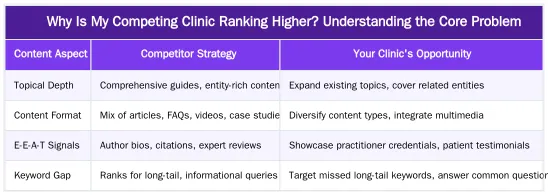
Why Is My Competing Clinic Ranking Higher? Understanding the Core Problem
A competitor outranking your medical practice signals a difference in how Google perceives your online presences. For “Your Money Your Life” (YMYL) medical websites, Google prioritizes E-E-A-T (Experience, Expertise, Authoritativeness, Trustworthiness). A higher-ranking clinic likely demonstrates superior knowledge, credibility, and more comprehensive patient information.
The problem is often an underdeveloped digital footprint compared to competitors, manifesting across SEO pillars from content depth to technical infrastructure. A structured diagnostic audit is required to identify these disparities and uncover the factors influencing search results.
The First Step: A Comprehensive Content & Topical Authority Audit
Diagnosing a competitor’s advantage begins with their content strategy. The audit assesses their topical coverage, how they address patient queries, and how they establish E-E-A-T signals. Google seeks helpful and authoritative sources for medical information. A clinic providing comprehensive, well-structured content across a medical specialty is more likely to be seen as an expert, leading to higher search visibility.
The 5-Step Diagnostic Audit: Uncovering Your Competitors’ SEO Advantage
A structured diagnostic audit reveals competitors’ SEO strengths and your opportunities. Analyzing critical areas helps clinics develop targeted strategies to attract more patients.
This competitor analysis goes beyond keyword comparisons, examining the architectural and semantic foundations of high-ranking sites. For detailed analysis, explore live competitor analysis with AI to gain deeper market insights.
Step 1: Content & Topical Authority Analysis
This step analyzes competitor content for comprehensiveness, entity coverage, and topical depth. A keyword gap analysis identifies topics where competitors rank, but your clinic does not. Analyzing their semantic content networks reveals how they interlink concepts to build authority around medical procedures or conditions. Assess the quality, length, and structure of their articles, service pages, and blog posts.
Understand how competitors address user intent throughout the patient journey to identify opportunities for more authoritative content. For further strategies, review data-driven workflows for competitor outranking.
Step 2: Technical SEO Health Check & User Experience (UX)
A strong technical SEO foundation is essential for visibility. The audit evaluates site speed, mobile responsiveness, and Core Web Vitals, which impact user experience. Structured data, like MedicalBusiness and Physician schema, helps search engines understand your clinic’s services and practitioners, enhancing local search ranking. A clean site architecture ensures easy navigation for users and crawlers.
Poor user experience (UX) metrics, such as high bounce rates or low time on page, can signal to Google that your site is less valuable than a competitor’s. A fast, accessible, and intuitive website is paramount. This supports all other SEO efforts, allowing your content to be discovered.
Beyond Keywords: Leveraging Semantic SEO & Entity Architecture
In 2026, targeting keywords is insufficient. SEO for medical clinics requires understanding semantic SEO and entity architecture. This approach builds a knowledge graph around your specialties, allowing Google to understand your expertise conceptually, not just via keywords.
Entity-Attribute-Value (EAV) modeling structures information about medical procedures, conditions, and practitioners in a way that aligns with how search engines process knowledge. This creates an authoritative digital presence that generic SEO advice overlooks, providing a competitive advantage.
Building Topical Authority for YMYL Medical Domains
Google assesses expertise and trust for YMYL (Your Money Your Life) sites with extreme scrutiny. Building topical authority means demonstrating knowledge across a medical specialty, not just ranking for keywords. This involves creating a semantic content network that covers all related entities, sub-topics, and patient queries within a domain.
Tools like the Ruxi Data Semantic Engine help automate topical maps and EAV modeling, ensuring content comprehensively addresses a medical topic. This signals to Google that your clinic is a definitive source, strengthening E-E-A-T signals and improving search visibility.
Optimizing for Google’s Cost of Retrieval (CoR)
Cost of Retrieval (CoR) is the computational effort Google expends to understand, process, and rank your content. A well-structured semantic content network with clear entity relationships reduces this effort. When information is organized semantically, Google can efficiently extract meaning and context.
This efficiency improves rankings, as search engines favor content that is easy to categorize. Optimizing for CoR improves search performance. For more on information retrieval principles, see Wikipedia’s Information Retrieval page.
Why Your Clinic Needs a Specialist Semantic SEO Strategist
London’s competitive private healthcare market, especially around Harley Street, demands more than generic SEO. Medical SEO requires a specialist who understands YMYL content, E-E-A-T optimization, and the patient journey for high-value aesthetic and surgical procedures. A generalist approach often fails in these specialized and regulated environments.
A specialist semantic SEO strategist understands entity-attribute-value modeling, topical authority construction, and healthcare web development challenges. This expertise ensures your clinic’s online presence is visible, credible, and trustworthy to patients and search engines.
The Abdurrahman Şimşek Advantage: Expertise in Medical & Aesthetic SEO
Abdurrahman Şimşek, a London-based Semantic SEO Strategist and Web Developer, has over 10 years of experience building high-authority Semantic Content Networks for medical clinics, skin clinics, and plastic surgeons. His methodology uses the Ruxi Data Semantic Engine to automate topical maps and EAV modeling, designed to reduce Google’s Cost of Retrieval for medical information.
With a track record including +400% organic growth for medical practitioners, Abdurrahman Şimşek provides an advantage in the London private healthcare market. His expertise in medical content configuration and Generative Engine Optimization (GEO) helps clinics dominate local organic search and attract high-value patients. For medical SEO best practices, consult authorities like the American Medical Association.
Reclaim Your Rankings: What to Expect After a Strategic Audit
A diagnostic audit and implementing its strategies improves online performance. The outcome is improved search visibility, leading to more organic traffic and qualified patient inquiries. This fosters long-term growth, positioning your clinic as an authority.
A well-executed SEO strategy builds a resilient digital foundation. This foundation helps your clinic remain competitive through algorithm updates, securing new patients and strengthening your brand.
Measuring Success: Key Performance Indicators for Medical SEO
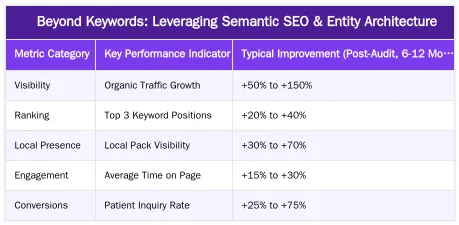
Tracking progress validates SEO efforts. Medical SEO KPIs include organic traffic growth, improved rankings for high-value keywords, and increased local pack visibility, especially for clinics targeting areas like Harley Street. Conversion rates, like appointment bookings and patient inquiries, are critical for assessing ROI.
Continuous monitoring and adaptation are vital. Regular rank tracking and user behavior analysis allow for ongoing optimization. This process ensures your SEO strategy remains effective, maximizing patient acquisition and growth.
Ready to Outrank Your Competitors? Book Your Semantic SEO Audit Today
If a competing clinic is ranking higher, a specialized approach is needed. A Semantic SEO Audit provides the strategic direction to transform your online presence. It outlines the steps to dominate local search, attract high-value patients, and establish your clinic as an authority. Don’t let competitors capture your potential patients.
Conclusion
Understanding why a competitor outranks you requires a diagnostic audit of content, technical SEO, backlinks, local presence, and user experience. For medical clinics in competitive markets like London, establishing E-E-A-T signals and building topical authority via semantic content networks are paramount. Specialized expertise in medical SEO and entity architecture helps clinics identify gaps and implement strategies for organic growth. To attract more high-value patients, book a Semantic SEO Audit with Abdurrahman Şimşek today.
Frequently Asked Questions
Why is my competing clinic ranking higher? What’s the first diagnostic step?
The initial step is a thorough content and topical authority audit. Analyze their website to identify if they cover patient-focused topics more comprehensively, as Google often favors clinics perceived as the most helpful and expert. This audit helps pinpoint specific content gaps that might explain why a competing clinic ranking higher.
How do backlinks influence a competitor’s higher search ranking?
High-quality backlinks from authoritative medical directories and health websites are crucial trust signals for Google. If a rival clinic ranks higher, they likely possess a stronger profile of these E-E-A-T-boosting backlinks. These links signal to search engines that they are a recognized authority, contributing significantly to their improved visibility.
Can technical website issues explain why another clinic ranks better?
Absolutely. A slower website, poor mobile experience, or a high ‘Cost of Retrieval’ can hinder your performance even with excellent content. Your competitor’s site might be technically superior, making it easier for Google to crawl and understand, which gives them a distinct advantage in search results. Addressing these technical aspects is vital for improving your own rankings.
If my content is superior, why is a rival clinic still outranking me?
Google’s perception of “better” extends beyond just the words on the page. Your competitor might have stronger E-E-A-T signals, such as more detailed author bios, more patient reviews, or better-structured data (schema markup) that clearly defines their expertise. These elements collectively build trust and authority in Google’s eyes, even if your content quality seems higher.
What’s the best way to systematically address a competitor’s ranking advantage?
A systematic approach involves a keyword gap analysis to find topics they rank for that you don’t, and a backlink gap analysis to identify their high-authority links. Additionally, a technical audit benchmarks your site’s performance against theirs. This comprehensive data provides a clear roadmap for a targeted SEO strategy to overtake them.
How can I start an audit to understand why my competitors are outperforming me?
To begin uncovering why your competitors are outperforming you, you can book a semantic SEO audit. This specialized service will analyze your online presence against your rivals, focusing on E-E-A-T and topical authority. It provides actionable insights to help your clinic reclaim its rightful position in search rankings.
Ruxi Data brings together multi-model AI, automated website crawling, live indexation checks, topical authority mapping, E-E-A-T enrichment, schema generation, and full pipeline automation — from crawl to WordPress publish to social posting — all in one platform built for agencies and freelancers who run on results.