
Topical Authority Medical: Building Trust and Patient Acquisition
Establishing topical authority medical is crucial for healthcare practices seeking enhanced digital visibility and patient trust. This article explains how to build comprehensive subject matter expertise, moving beyond isolated keywords to become a definitive information source. By implementing semantic SEO strategies, including topic clusters and pillar pages, medical websites can satisfy Google’s E-E-A-T and YMYL requirements. This approach improves information retrieval, strengthens a practice’s presence in the knowledge graph, and ultimately drives patient acquisition.
Abdurrahman Şimşek, a Semantic SEO Strategist, details how to develop comprehensive content strategies that align with Google’s E-E-A-T and YMYL guidelines. This approach ensures medical practices establish deep subject matter expertise and secure organic visibility.
To explore your options, contact us to schedule your consultation. You can also reach us via: Book a Semantic SEO Audit, Direct WhatsApp Strategy Line: +90 506 206 86 86
Establishing topical authority medical is essential for digital visibility and patient trust for private healthcare providers in London. In London’s competitive private healthcare market, ranking for a few keywords is insufficient. Deep subject matter expertise, demonstrated through a comprehensive content strategy, builds trust, enhances E-E-A-T signals, and drives patient acquisition for London clinics. A topical strategy is key to long-term organic success.
Beyond Keywords: Leveraging Entities & Ruxi Data for Medical SEO
Advanced semantic SEO concepts differentiate a medical practice’s online presence. This requires moving beyond keywords to model entities within a medical niche. Abdurrahman Şimşek’s approach uses Entity-Attribute-Value (EAV) modeling and AI tools like Ruxi Data to automate this process, reducing Google’s ‘Cost of Retrieval’ for medical information.
Entity-Attribute-Value (EAV) Modeling for Surgical Procedures
EAV modeling deconstructs medical procedures into entities and their attributes and values. For example, ‘Rhinoplasty’ is an entity. Its attributes might include ‘Anesthesia Type’ (value: ‘General’), ‘Recovery Time’ (value: ‘2-4 weeks’), ‘Cost Range’ (value: ‘£5,000-£8,000’), or ‘Potential Risks’ (value: ‘Swelling, bruising’). Structuring content around these entity-attribute relationships gives search engines a richer, more accurate understanding of the information. This enhances relevance, improves information retrieval, and strengthens perceived authority. Explore this in detail with our guide on Entity-Attribute-Value (EAV) SEO.
Automating Topical Map Creation with Ruxi Data’s Semantic Engine
Manually creating topical maps for complex medical fields is resource-intensive. Ruxi Data’s semantic engine automates this by analyzing SERP data, knowledge graphs, and related entities. It identifies semantic relationships, finds topical gaps, and generates content briefs and topical maps for medical clinics. This automation accelerates building semantic content networks, ensuring exhaustive coverage and reducing the ‘Cost of Retrieval’ for search engines, which helps them understand and rank your content. Learn more about this automation in Semantic SEO for Surgeons.
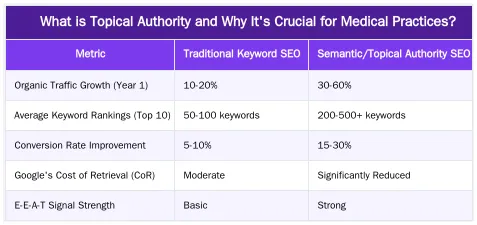
| Feature | Traditional Keyword SEO | Semantic/Topical Authority SEO |
|---|---|---|
| Primary Focus | Individual keywords | Comprehensive topics & entities | Content Strategy | Standalone articles | Interconnected topic clusters & pillar pages |
| Search Engine Understanding | Lexical matching | Conceptual relationships, Knowledge Graph integration |
| E-E-A-T Contribution | Limited, often superficial | Fundamental, deep expertise & trust signals |
| Algorithm Resilience | Vulnerable to updates | More robust, “algorithm-proof” |
Ready to Dominate Your Niche? Partner with a Semantic SEO Expert
Achieving online visibility and patient trust in London’s competitive private healthcare market requires a specialized approach. Abdurrahman Şimşek, a London-based Semantic SEO Strategist, offers semantic SEO and web development for medical clinics, skin clinics, and plastic surgeons. With 10 years of experience and Ruxi Data, he builds semantic content networks that make your practice stand out. Elevate your digital presence and secure your position as a leader in your medical field.
Conclusion
For medical practices in 2026, a content authority strategy is essential for building trust, demonstrating expertise, and achieving patient acquisition. By developing topic clusters, using semantic SEO techniques like EAV modeling, and tools like Ruxi Data, clinics can establish themselves as authorities. This structured content enhances E-E-A-T signals, reduces search engine ‘Cost of Retrieval’, and drives qualified organic traffic and conversions. Partnering with a specialist is crucial for success in London’s competitive private healthcare market.
Ready to transform your clinic’s online presence? Contact us today to discuss a tailored strategy. You can also Book a Semantic SEO Audit or connect via Direct WhatsApp Strategy Line: +90 506 206 86 86.
Frequently Asked Questions
What defines topical authority medical for a healthcare practice?
Topical authority medical refers to Google’s recognition of your website as a definitive, comprehensive expert on a specific medical niche. This is achieved by systematically creating a deep network of content that addresses all facets of a subject, satisfying diverse user intents and demonstrating profound expertise. It signals to search engines that your practice is a trusted source of information.
Why is building topical authority medical crucial for surgeons, even more than backlinks?
For Your Money or Your Life (YMYL) topics like surgery, Google prioritizes E-E-A-T (Experience, Expertise, Authoritativeness, Trustworthiness) above all else. While backlinks indicate popularity, a deep well of expert-written, interconnected content proves genuine expertise and builds trust. Strong topical authority medical signals can allow a site to outrank competitors with more backlinks but shallower content.
How does a topic cluster strategy help establish strong topical authority?
A topic cluster strategy involves a central “pillar page” covering a broad medical topic, supported by numerous “cluster pages” that delve into specific subtopics. These pages are interconnected through internal links, creating a dense, semantically related network. This structure clearly signals to Google that your site possesses comprehensive expertise on the subject.
Can a new medical clinic effectively build topical authority?
Yes, a new medical website can absolutely achieve topical authority, often faster than older, less focused sites. By concentrating on a tightly-defined medical niche and systematically publishing comprehensive, expert-vetted content within a topic cluster, new clinics can quickly establish themselves as authoritative sources. This focused approach is far more effective than creating disconnected content.
How does semantic SEO specifically enhance topical authority medical for clinics?
Semantic SEO forms the bedrock of building robust topical authority medical. It involves structuring content around key entities like medical procedures, conditions, and specialists, utilizing schema markup, and optimizing for concepts rather than just keywords. This advanced approach helps Google’s algorithms deeply understand the scope and depth of your clinic’s expertise, significantly accelerating authority building.
How can a medical practice begin building its topical authority?
To start building your practice’s topical authority, consider a strategic approach that maps out your niche and content needs. Abdurrahman Şimşek, a Semantic SEO Strategist, offers a Semantic SEO Audit to identify opportunities and create a tailored strategy. You can book an audit via his website or reach out directly on WhatsApp at +90 506 206 86 86 for a strategy discussion.
Ruxi Data brings together multi-model AI, automated website crawling, live indexation checks, topical authority mapping, E-E-A-T enrichment, schema generation, and full pipeline automation — from crawl to WordPress publish to social posting — all in one platform built for agencies and freelancers who run on results.