Using H2s for SEO: Optimizing Content for AI Overviews and Patients
Using h2s for seo, H3s, and lists creates a clear content hierarchy crucial for medical clinics. This strategy optimizes content for patient comprehension and search engine visibility, directly targeting AI Overviews and ‘People Also Ask’ features. Effective using h2s for seo with semantic HTML reduces the ‘Cost of Retrieval’ for search algorithms, enhancing indexing and discoverability. Structured headings, framed as common patient questions, improve user experience and position content for high-visibility SERP features. This approach ensures medical information is scannable, authoritative, and aligned with modern search intent.
Abdurrahman Şimşek, a Semantic SEO Strategist with over 10 years of experience, specializes in building high-authority semantic content networks for medical clinics. His expertise in semantic engineering and topical authority ensures content is optimized for complex YMYL search landscapes and future AI-driven search.
To explore your options, contact us to schedule your consultation. You can also reach us via: Book a Semantic SEO Audit, Direct WhatsApp Strategy Line: +90 506 206 86 86
For medical clinics, using h2s for seo, H3s, and lists optimizes content for patients and search engines. This approach creates a clear content hierarchy that enhances user experience, targets AI Overviews, and boosts visibility in search results.
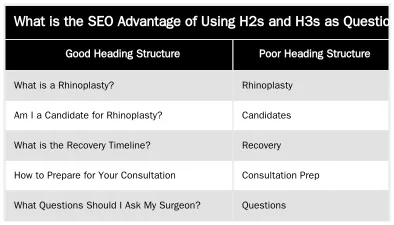
What is the SEO Advantage of Using H2s and H3s as Questions?
Structuring H2s and H3s as patient questions creates a clear content hierarchy for search engines. This format targets ‘People Also Ask’ boxes and makes content a prime candidate for AI Overviews, boosting visibility and user engagement. It aligns content with natural language queries, improving relevance and discoverability.
Capturing Featured Snippets and People Also Ask
Headings phrased as questions mirror how patients search. This question-answer format makes content eligible for SERP features like Featured Snippets and People Also Ask (PAA) boxes. An H2 like “What is the recovery time for rhinoplasty?” directly answers a common query, increasing the chance of Google extracting that answer. This provides value to users and positions your clinic as a trusted information source.
Search engines prioritize content with concise, direct answers. Anticipating patient questions and framing headings accordingly optimizes for these high-visibility placements. This is effective for medical content, where users seek quick, reliable information on procedures, symptoms, and recovery.
How Semantic HTML Enhances Content Hierarchy for AI Overviews
Semantic HTML, using heading tags (H2, H3) and lists, builds a logical content hierarchy. This structure helps search crawlers and AI models parse and understand relationships between information. A clear hierarchy reduces the ‘Cost of Retrieval’ for search engines, lowering the computational effort to understand your content’s topics and entities. This efficiency improves indexing and the chance of being featured in AI Overviews.
For medical websites, where accuracy and clarity are paramount, a semantic structure presents complex information in an organized, digestible manner. This benefits readers and facilitates machine comprehension, a factor in the 2026 search landscape. Defining sections and subsections guides users and algorithms, reinforcing topical relevance and authority.
Structuring Content for Generative AI Consumption
Generative AI models, which power features like AI Overviews, use well-structured, factual content. Question-answer formats in headings with concise paragraphs or lists make content digestible for these models. If an H2 poses a question and the paragraph provides a direct answer, AI can extract and attribute the information. This reduces the ‘Cost of Retrieval’ for AI systems, making your content a preferred source for summaries and direct answers.
Optimizing for AI Overviews in 2026 requires explicit content organization. A semantic HTML structure with logical flow and direct answers increases the chance of appearing in these search features. This makes your expertise visible and consumable by new search interfaces. For more details, see optimizing for AI Overviews in 2026.
Best Practices for Structuring Headings in Medical Content
Heading structure is key to on-page SEO and user experience for medical content. Use a single H1 tag as the page title. Use H2s for main topics and H3s for sub-points within H2 sections. This creates a logical flow for patients and search engines. Integrate keywords naturally into headings, prioritizing clarity over density.
This transforms complex medical information into an accessible format. A structured page can cover a procedure from introduction to recovery, with headings delineating each stage. This improves scannability and signals content comprehensiveness to search engines, contributing to perceived authority.
Crafting Question-Based H2s and H3s for Patients
Transform patient questions into H2s and H3s. For example, instead of “Procedure Details,” use “What Does a Tummy Tuck Involve?” or “How Long is the Recovery Period After Breast Augmentation?” This addresses patient concerns with natural language queries, making content relevant, improving engagement, and reducing bounce rates.
On medical procedure pages, anticipate all patient inquiries. Each stage, from consultation to post-operative care, can be a question-based heading. This aligns with user intent and signals content comprehensiveness to search engines. For more, see our guide on how to structure all medical procedure pages.
The Power of Lists (<ul>, <ol>) for Scannability and SEO
Unordered (<ul>) and ordered (<ol>) lists improve content scannability, user experience, and SEO. They break down complex medical information into digestible chunks, helping patients absorb details. Search engines can extract and display lists as list-based Featured Snippets, enhancing visibility.
In medical content, lists are useful for presenting symptoms, benefits, risks, procedure steps, or recovery timelines. This format reduces cognitive load and signals concise, actionable information to search engines. List clarity improves user experience, an important ranking factor.
Integrating Lists for Clarity and Rich Snippets
Lists can highlight critical information and help secure rich snippets. A list detailing “Steps in a Facelift Procedure” or “Post-Operative Care Instructions” provides clear, sequential information. This aids patient understanding and makes the content suitable for extraction by search engines for rich results.
Consider these applications for lists in your medical content:
- Symptoms: List common indicators of a condition.
- Benefits: Outline the advantages of a specific treatment.
- Steps: Detail the stages of a surgical procedure or recovery process.
- Eligibility Criteria: Present who is an ideal candidate for a treatment.
- FAQs: Use lists to organize brief answers to common questions.
Effective lists create scannable content for patients and search algorithms, driving qualified traffic.
Leveraging Semantic Engineering for Optimal Heading Structure
A semantic engineer views heading structure beyond keyword integration. It involves understanding entity relationships and building topical authority, which is critical for YMYL (Your Money Your Life) medical content. Abdurrahman Şimşek, with over 10 years of experience in search engineering, specializes in this. His approach, using infrastructure like Ruxi Data, ensures content hierarchy answers questions and establishes semantic connections across a website.
This strategy involves mapping how medical entities (e.g., ‘Rhinoplasty’, ‘Surgeon’, ‘Recovery Time’) relate. Headings are structured to reflect these relationships, creating a cohesive knowledge graph that search engines can interpret. This precision is vital for London’s private clinics, where expertise and trustworthiness are paramount. An information architecture that mirrors medical knowledge makes your content an authoritative source.
For more on advanced semantic HTML strategies that influence AI Overviews, see advanced semantic HTML for AI Overviews.
Building E-E-A-T Through Structured Medical Information
A heading and list structure informed by semantic principles signals Expertise, Experience, Authoritativeness, and Trustworthiness (E-E-A-T) to Google. For YMYL medical topics, Google prioritizes these signals. Logically organized, comprehensive, and navigable content demonstrates subject matter understanding. This structure helps Google’s algorithms recognize your clinic as a credible source.
Structuring headings to cover a medical topic from symptoms to recovery builds a complete picture for patients and search engines. This approach, guided by semantic engineering, helps content rank and establishes your clinic’s reputation as an expert. This is important for competitive markets like Harley Street, where trust and authority are key differentiators. The Google Search Quality Rater Guidelines provide a framework for evaluating content quality (Google Search Quality Rater Guidelines).
Future-Proof Your Medical Content with Semantic Headings
Strategic heading and list structures offer long-term benefits. They improve organic visibility, patient engagement, and resilience against algorithm updates. Clear, comprehensive, and semantically rich content builds an online presence that attracts patients. This approach keeps content relevant and discoverable, providing value for London’s private clinics.
A durable content strategy anticipates changes in user search and search engine interpretation. Focusing on user intent, semantic relationships, and clear content hierarchy aids patient acquisition. Structured content yields consistent organic traffic and a stronger brand reputation.
Measuring the Impact on Patient Engagement and Conversions
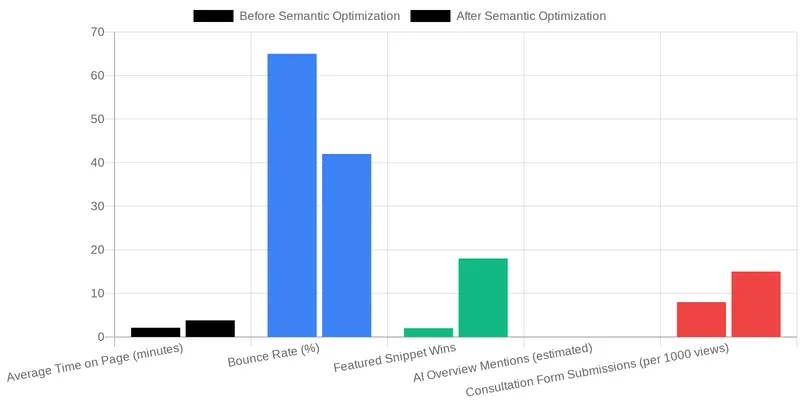
Better content structure affects business outcomes beyond search rankings. Readable, navigable content leads to longer dwell times, lower bounce rates, and increased page depth. Patients spend more time engaging with your information, which builds trust. This engagement correlates with higher conversion rates, leading to more consultations and bookings.
Tracking metrics like time on page, scroll depth, and conversion rates shows the effectiveness of semantic heading strategies. For example, a well-structured procedure page might see a 15% increase in consultation form submissions compared to a poorly organized one. This data allows clinics to refine their content strategy for patient acquisition.
Ready to Optimize Your Clinic’s Content for AI Overviews?
The medical digital landscape is competitive, with AI Overviews reshaping search results. Structuring content for visibility and engagement requires expertise. Abdurrahman Şimşek offers semantic SEO strategies for London’s private healthcare sector.
Book a Semantic SEO Audit. Direct WhatsApp Strategy Line: +90 506 206 86 86.
Conclusion
Strategic use of H2s, H3s, and lists is necessary for medical clinics seeking top search visibility. A patient-centric, semantic content structure enhances user experience and positions a site as an authoritative source for search engines and AI Overviews. This information architecture and content hierarchy builds topical authority and E-E-A-T. To optimize your content, contact us, Book a Semantic SEO Audit, or use the Direct WhatsApp Strategy Line: +90 506 206 86 86.
Frequently Asked Questions
What is the primary SEO advantage of structuring content with H2s and H3s as patient questions?
This approach creates a clear content hierarchy easily understood by search engines, directly targeting “People Also Ask” boxes and making your content a prime candidate for AI Overviews. It significantly boosts visibility and user engagement by aligning with natural language queries, especially when using h2s for seo in a question-based format.
How do formatted lists enhance content for search engines and users?
Formatted lists are frequently pulled by search engines into featured snippets and AI Overviews. Employing ordered or unordered lists immediately after a question-based heading provides concise, structured answers that are ideal for rich results and enhanced scannability, complementing effective content structuring.
Is there a recommended limit for the number of H2 headings on a single page?
There is no strict numerical limit to the number of H2s. Instead, their usage should be dictated by the logical flow and comprehensive structure of your content, with each major subtopic or key patient question receiving its own heading tag. This ensures thorough coverage without sacrificing readability, a key aspect of using h2s for seo effectively.
How does using H2s and H3s as questions benefit the user experience?
This structured approach significantly enhances user experience by making content highly scannable. Patients can quickly locate specific information, which in turn improves engagement metrics like time on page and reduces bounce rates, demonstrating the dual benefit of good content organization.
What is the ideal length for answers immediately following H2 headings for search visibility?
For optimal featured snippet and AI Overview inclusion, the initial paragraph directly following an H2 should be a concise, factual answer, ideally between 40-60 words. Further elaboration and detail can then follow within the section, ensuring both quick answers and comprehensive information.
How can I get expert help to optimize my clinic’s content with semantic headings?
Abdurrahman Şimşek specializes in building high-authority Semantic Content Networks for medical clinics. You can book a Semantic SEO Audit directly through his website or reach out via WhatsApp for a strategic discussion on optimizing your content, including effective strategies for using h2s for seo.
Ruxi Data brings together multi-model AI, automated website crawling, live indexation checks, topical authority mapping, E-E-A-T enrichment, schema generation, and full pipeline automation — from crawl to WordPress publish to social posting — all in one platform built for agencies and freelancers who run on results.