
Algorithmic Authorship: Verifying Medical Expertise Online
Algorithmic authorship defines Google’s process for verifying medical expertise online, crucial for surgeons in YMYL fields. This article explains how Google’s algorithms identify and attribute content to qualified professionals, moving beyond simple bylines to assess a surgeon’s digital identity and E-E-A-T signals. Understanding these mechanisms helps medical experts establish trust, enhance their knowledge graph presence, and improve search visibility for expert content. It details the intricate signals Google uses to confirm credentials and professional reputation, ensuring accurate information reaches patients.
Abdurrahman Şimşek, a Semantic SEO Strategist, specializes in building high-authority semantic content networks for medical clinics. His expertise in medical SEO and entity reconciliation helps surgeons establish robust digital authority and topical authority, crucial for Google’s verification processes.
To explore your options, contact us to schedule your consultation.
In the digital age, simply publishing content isn’t enough; Google demands verifiable expertise, especially for critical medical topics. This article demystifies algorithmic authorship for surgeons, explaining how Google recognizes and rewards genuine medical authority online, ensuring your expertise translates into digital trust and visibility. We’ll explore the intricate signals Google uses and provide actionable strategies for medical professionals to establish their digital identity. Understanding these mechanisms is crucial for surgeons aiming to secure their online reputation and reach patients effectively in 2026.
How Does Google Verify a Surgeon’s Expertise Online?
Google employs a multi-faceted approach to verify the identity and expertise of medical authors. This involves analyzing both explicit data provided on a website and implicit connections found across the web. For surgeons, understanding these mechanisms allows for strategic optimization of their digital presence to align with Google’s verification processes.
The Role of Author Schema and Entity Reconciliation
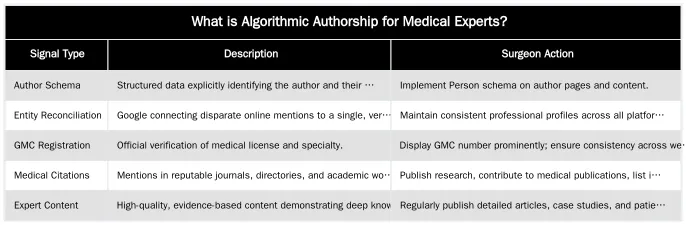
Structured data, specifically Author Schema, plays a foundational role. By implementing schema markup on content pages, surgeons can explicitly tell Google who authored a piece, linking it to their professional profile. This includes details like their name, professional title, affiliations, and links to their official website or social media profiles.
Beyond explicit declarations, Google uses entity reconciliation to connect disparate pieces of information about an individual into a single, cohesive entity within its Knowledge Graph. For a surgeon, this means Google aggregates data from various sources—their website, professional directories, academic publications, and news mentions—to build a comprehensive understanding of their identity and credentials. A strong, consistent digital identity across these platforms strengthens Google’s confidence in the author’s expertise.
Off-Site Signals: GMC Registration and Medical Citations
External validation is critical for establishing trust. For UK-based surgeons, active General Medical Council (GMC) registration serves as a primary trust signal. Google’s algorithms can cross-reference information on a surgeon’s website with official GMC records, confirming their licensed status and specialty. Consistent referencing of GMC registration across a surgeon’s digital footprint reinforces this connection.
Furthermore, mentions and citations in reputable medical journals, academic papers, professional association websites, and established healthcare directories act as powerful indicators of authority. These medical citations signal to Google that other recognized entities within the medical community acknowledge the surgeon’s expertise. The more frequently and consistently a surgeon is cited by authoritative sources, the stronger their perceived authority becomes.
Building Your Digital Medical Identity: A Surgeon’s Blueprint
Establishing a robust digital identity requires a strategic and consistent effort. Surgeons can proactively build their online authority by focusing on specific areas that Google’s algorithms prioritize for verification. This blueprint outlines practical steps to enhance your online presence and strengthen your standing as a recognized medical expert.
Strategic Content Creation for E-E-A-T
Producing high-quality, expert content is fundamental. This involves creating articles, guides, and case studies that showcase your experience, expertise, authoritativeness, and trustworthiness. Content should be evidence-based, clearly attributed to you, and reflect your professional insights. For instance, a plastic surgeon might publish detailed articles on specific procedures, backed by clinical knowledge and patient outcomes.
Ensure your content addresses patient queries comprehensively and accurately. Regularly updating existing content with the latest medical advancements and linking to authoritative research further demonstrates ongoing expertise. Consider how to automate E-E-A-T content processes to maintain a consistent flow of high-quality information, ensuring your digital presence remains current and authoritative.
Leveraging Professional Registries and Medical Networks
Your professional affiliations are vital signals. Ensure your GMC registration number, specialist register details, and other professional body memberships (e.g., Royal College of Surgeons) are prominently displayed on your website’s ‘About Us’ page, author bios, and contact sections. These details should be consistently presented across all your online profiles.
Actively participate in medical networks and associations. Ensure your profiles on these platforms are complete and link back to your primary website. Seek opportunities for medical citations through publishing in peer-reviewed journals or contributing to reputable healthcare news outlets. These external validations create a strong network of trust signals for Google.
Measuring the Impact: What to Expect from Enhanced Authorship
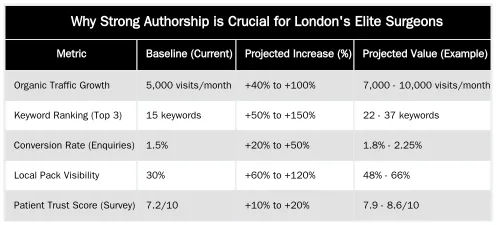
Investing in your digital identity and strengthening your online authority yields tangible benefits that can be measured. Surgeons can anticipate improvements across various key performance indicators, reflecting enhanced visibility and patient engagement.
Improved Visibility and Patient Trust
A primary outcome of higher E-E-A-T signals is improved search engine rankings. Content authored by a verified expert is more likely to rank higher for relevant medical queries, leading to increased organic traffic to your website. This enhanced visibility means more potential patients discover your practice.
Beyond rankings, strong authorship cultivates greater credibility. When Google confidently presents you as an expert, potential patients are more likely to trust the information you provide and, by extension, your medical services. This increased trust often translates into higher conversion rates, as patients feel more assured in choosing a practitioner whose expertise is algorithmically validated.
Conclusion
The digital landscape for medical professionals demands more than just a website; it requires a verifiable and authoritative online presence. Algorithmic authorship is the mechanism through which Google assesses and validates a surgeon’s expertise, directly influencing search rankings and patient trust. By strategically implementing author schema, leveraging professional registrations like GMC, securing medical citations, and consistently publishing expert content, surgeons can significantly strengthen their digital identity.
For elite surgeons in competitive markets such as London’s Harley Street, mastering these principles is essential for local search dominance and attracting discerning patients. Proactive management of your online authority ensures your medical expertise is accurately reflected and rewarded in search results. To build a high-converting website and dominate local organic search, visit AbdurrahmanSimsek.com.
Frequently Asked Questions
What is algorithmic authorship in the context of medical SEO?
Algorithmic authorship refers to Google’s advanced method of linking online content to a real-world, verifiable expert, such as a surgeon. It involves analyzing a web of data points to confirm the author’s credentials and authority on a given medical subject. This process is crucial for establishing trust and ensuring the credibility of health information online.
How can a surgeon strengthen their algorithmic authorship signals?
Surgeons can enhance these signals by maintaining
Ruxi Data brings together multi-model AI, automated website crawling, live indexation checks, topical authority mapping, E-E-A-T enrichment, schema generation, and full pipeline automation — from crawl to WordPress publish to social posting — all in one platform built for agencies and freelancers who run on results.