Post-migration SEO Monitoring: Safeguarding Organic Performance
Post-migration SEO monitoring is essential for safeguarding organic performance and maintaining search visibility. This guide details critical signals to watch, including traffic drops, index coverage issues, crawl stats, and keyword ranking fluctuations. Effective post-migration SEO monitoring helps identify and resolve technical and content-related problems quickly, preserving search engine rankings, user trust, and patient acquisition for medical clinics. Understanding these signals ensures the migrated site maintains its semantic integrity and authority.
Abdurrahman Şimşek, a Semantic SEO Strategist, specializes in optimizing complex YMYL sites like medical clinics. His expertise ensures robust post-migration strategies, maintaining topical authority and search engine trust through meticulous data analysis and technical SEO.
To explore your options, contact us to schedule your consultation.
Website migrations are complex. Post-migration SEO monitoring is crucial to safeguard organic performance. This guide details key signals to watch to maintain a medical clinic’s search visibility and patient acquisition in 2026 and beyond. Post-migration performance reviews help identify and fix issues quickly, preserving search engine rankings and user trust.
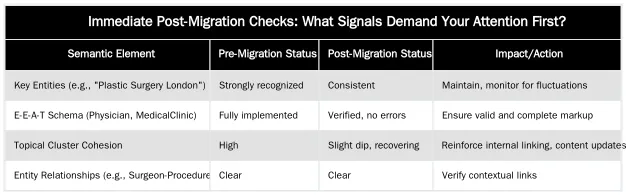
Immediate Post-Migration Checks: What Signals Demand Your Attention First?
After a website migration, confirm that core site functionality and data flow are intact. This involves verifying redirects, ensuring critical site elements are operational, and confirming analytics and search console data are collected correctly.
-
Verifying Redirects and Core Functionality
Spot-check key URLs, such as the homepage, top service pages (e.g., “Rhinoplasty London”), and high-traffic blog posts. Use Screaming Frog or Sitebulb to crawl a sample of old URLs and confirm 301 redirects are correctly implemented. Ensure critical site functions, including contact forms, online booking systems, and primary navigation, are operational. Broken internal links or incorrect redirects impact user experience and search engine crawlability.
-
Initial GSC and GA Data Flow Confirmation
Access Google Search Console (GSC) and Google Analytics (GA). In GSC, check the “Index Coverage” report for immediate spikes in errors or excluded pages. In GA, use real-time reports and recent traffic data to confirm the new site is sending data. Data discrepancies or halts indicate a problem with tracking code implementation or site configuration.
Deep Dive into Google Search Console & Analytics: Uncovering Performance Shifts
Examine Google Search Console and Google Analytics data to understand how search engines and users interact with the migrated site and to uncover performance shifts or issues.
Monitoring Index Coverage and Crawl Health
The Index Coverage report in GSC identifies errors, warnings, and valid pages. Monitor this report daily post-migration to find pages Google fails to index or excludes. Check the “Pages with redirect” and “Not found (404)” categories. Review the “Crawl Stats” report to understand Googlebot’s activity. Ensure XML sitemaps are submitted and processed correctly. Use the URL Inspection Tool to verify a page’s indexing status and identify issues.
Analyzing Traffic, Conversions, and User Behavior
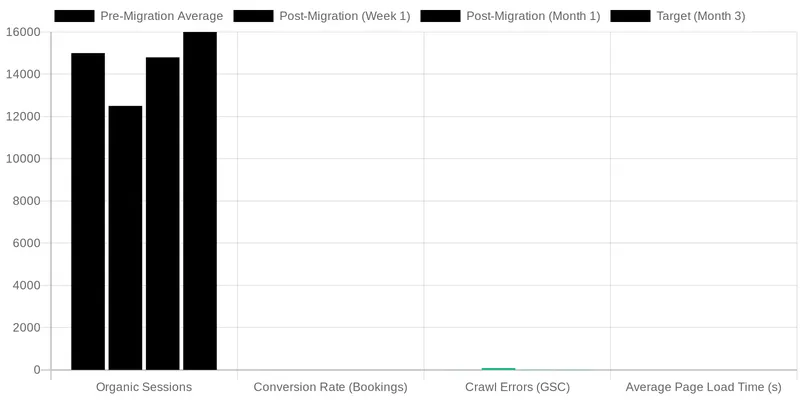
In Google Analytics, track organic traffic drops by comparing post-migration data with pre-migration benchmarks. Monitor conversion rate changes for patient acquisition metrics like appointment bookings or contact form submissions. Analyze user engagement signals like bounce rate, average session duration, and pages per session. Segmenting this data for specific procedure pages (e.g., “Breast Augmentation Harley Street”) can highlight localized issues. Unexpected shifts in these metrics often signal SEO or user experience problems.
Beyond the Basics: Advanced Monitoring for Medical E-E-A-T & Semantic Integrity
For YMYL (Your Money Your Life) medical websites, advanced monitoring extends beyond standard metrics to safeguard E-E-A-T (Experience, Expertise, Authoritativeness, Trustworthiness) signals and preserve semantic integrity, areas relevant to Abdurrahman Şimşek’s semantic engineering expertise. Migrations can disrupt these signals.
Safeguarding E-E-A-T Signals and Authoritative Content
Post-migration, monitor elements contributing to E-E-A-T. This includes verifying author profiles for medical professionals, ensuring medical review statements are present and correctly attributed, and checking schema markup integrity (e.g., `Physician`, `MedicalClinic`). A migration can strip or alter these elements, impacting perceived authority and trustworthiness. For instance, if a surgeon’s qualifications or a clinic’s accreditations are no longer visible or correctly structured, it can erode trust signals. Maintaining these signals is paramount for medical content, as outlined in Google’s Quality Rater Guidelines. Google’s guidance on helpful content emphasizes expertise and trustworthiness.
Tracking Semantic Consistency and Entity Recognition
A website migration can disrupt the semantic network defining your site’s topics and entities. Monitor if the migration affected the site’s ability to communicate key entities (e.g., ‘Rhinoplasty’, ‘Harley Street Clinic’, ‘Dr. Smith’) and their relationships to search engines. Use manual checks and tools to preserve semantic integrity. Verify that related terms and concepts are clustered correctly and that topical authority remains intact. Degradation in entity recognition can cause a loss of relevance for specific queries.
Technical Health Checks: Diagnosing Crawl Budget & Server Log Insights
Technical health checks reveal how search engines interact with your site, identifying issues that impact crawl budget and visibility. This is critical for complex medical websites.
Leveraging Server Log Analysis for Crawl Efficiency
Server log analysis shows how search engine bots like Googlebot interact with your new site. Examining log files helps identify crawl activity patterns, diagnose crawl budget issues, and detect excessive 404 errors or unexpected crawl patterns. An increase in Googlebot hitting non-existent pages or spending time on low-value content can signal a problem. This analysis helps optimize your site’s “Cost of Retrieval” (CoR), ensuring Googlebot efficiently discovers and indexes key medical content. For guidance, see our guide to log file analysis for private clinic websites. Our article on fixing crawl budget issues provides more strategies.
Identifying and Resolving 404 Errors and Broken Links
Website migrations can introduce 404 errors and broken links. Use Google Search Console’s “Pages” report to identify 404s reported by Googlebot. Run a site crawl with a tool like Screaming Frog to find broken internal links and orphaned pages. Fix these issues promptly. Implement 301 redirects for 404s to relevant new pages, update internal links, and ensure no content is orphaned. Unresolved 404 errors impact user experience and can signal to search engines that a site is poorly maintained, affecting rankings.
Proactive Troubleshooting & Long-Term Optimization: Sustaining Post-Migration Success
Proactive troubleshooting and a long-term optimization framework are essential for sustained success and recovery from initial performance dips after a migration.
Responding to Traffic Drops and Ranking Fluctuations
If traffic drops or keyword rankings fluctuate, diagnose the root causes by reviewing indexing status, checking for technical errors, analyzing content quality, and ensuring proper internal linking. Ranking stabilization post-migration typically takes a few weeks to a few months, depending on site size and migration complexity. Prioritize fixing critical issues first, like widespread indexing problems or broken redirects. Implement content or technical updates as needed and monitor their impact. For market insights, consider competitor monitoring automation to understand external factors.
Establishing an Ongoing SEO Monitoring Framework
Establish an ongoing monitoring process. Set up custom dashboards in Google Analytics and Google Search Console to track KPIs relevant to your medical clinic, such as organic traffic to service pages, conversion rates for specific procedures, and local search visibility. Configure alerts for sudden traffic drops or increases in crawl errors. Schedule regular reporting to review performance and adapt your strategy to algorithm changes or market shifts.
Partnering for Seamless Migrations & Ongoing SEO Excellence
Website migrations are critical for medical clinics. Maintaining organic visibility for YMYL sites necessitates expert oversight. Every step, from pre-planning to post-migration SEO monitoring, impacts patient acquisition. For a successful transition and sustained organic growth, partner with specialists in medical SEO and semantic engineering. Learn more about managing website migrations and redesigns for medical clinics.
Conclusion
Post-migration SEO monitoring safeguards a medical clinic’s online presence. Tracking immediate checks, Google Search Console and Analytics data, and advanced E-E-A-T and semantic integrity signals helps identify and resolve issues. Technical health checks, including server log analysis and 404 error resolution, build a solid foundation. A long-term monitoring framework sustains organic performance and patient acquisition. For guidance on migrations and semantic SEO, visit AbdurrahmanSimsek.com.
Frequently Asked Questions
What are the immediate steps for effective post-migration SEO monitoring?
The very first step in post-migration seo monitoring involves a live spot-check of critical pages and using tools like Screaming Frog to confirm 301 redirects are functioning correctly. Simultaneously, verify that Google Search Console and Google Analytics are actively receiving data from your new site to ensure continuity. This immediate verification helps catch critical issues before they impact performance significantly.
Why is the Index Coverage report in GSC so critical for successful website migration tracking?
The Index Coverage report in Google Search Console is vital because it reveals precisely which pages Google is indexing and, more importantly, any pages it struggles with. A sudden increase in “Crawled – currently not indexed” or “Not Found (404)” errors is a clear indicator of problems that require immediate investigation and resolution to maintain search visibility.
My organic traffic dropped after migration. How should I approach this during post-migration SEO monitoring?
A minor, temporary dip in organic traffic (around 10-15%) can be a normal part of the process as Google re-evaluates your site. However, a sustained or significant drop signals a deeper issue that needs urgent attention. Robust post-migration SEO monitoring enables you to swiftly pinpoint the root cause, such as redirect failures or indexing problems, and implement corrective actions to recover performance.
How can server log analysis enhance your website migration tracking efforts?
Server logs provide raw data on every interaction with your server, including those from Googlebot. Analyzing these logs offers deep insights into how Google is crawling your new website, confirming if it’s discovering new pages efficiently, and identifying if crawl budget is being wasted on broken redirects or error pages. This granular data is invaluable for optimizing crawl efficiency and ensuring smooth post-migration performance.
How long should intensive post-migration SEO monitoring continue after a site move?
Intensive post-migration SEO monitoring should continue daily for the initial two weeks following a migration, then transition to weekly checks for the subsequent 2-3 months. This extended period allows you to observe Google’s full re-crawling and re-indexing cycle, ensuring all crucial ranking signals have been successfully transferred and stabilized. Consistent monitoring helps secure long-term SEO health.
How can Abdurrahman Şimşek’s team assist with my clinic’s website migration and ongoing SEO?
Abdurrahman Şimşek and his team specialize in holistic SEO strategies for medical clinics, including meticulous website migration planning and ongoing performance reviews. We ensure your YMYL domain maintains its E-E-A-T and topical authority, particularly for Harley Street and Central London aesthetic clinics. You can reach out via the contact form on abdurrahmansimsek.com for a strategic consultation.
Ruxi Data brings together multi-model AI, automated website crawling, live indexation checks, topical authority mapping, E-E-A-T enrichment, schema generation, and full pipeline automation — from crawl to WordPress publish to social posting — all in one platform built for agencies and freelancers who run on results.