Optimize Images for LCP: Boost Core Web Vitals & Patient Trust
To optimize images for LCP on medical websites, particularly for high-resolution ‘before and after’ galleries, implement strategic image compression and next-gen formats like WebP and AVIF. This guide details methods to reduce file sizes, ensuring faster loading times and improved Largest Contentful Paint scores. By adopting responsive image techniques, strategic lazy loading, and Content Delivery Networks, plastic surgery and aesthetic clinics can enhance Core Web Vitals, improve patient experience, and boost search engine rankings. Effective image optimization directly contributes to a professional online presence and stronger E-E-A-T signals.
Abdurrahman Şimşek, a London-based Semantic SEO Strategist with 10 years of experience, specializes in building high-authority Semantic Content Networks for medical clinics. His expertise ensures technical web development aligns with holistic SEO strategies, crucial for YMYL sectors.
To explore your options, contact us to schedule your consultation.
High-resolution ‘before and after’ image galleries for plastic surgery and aesthetic clinics often hinder Largest Contentful Paint (LCP) scores. This guide provides strategies for London’s private healthcare providers to optimize images for LCP, balancing visual quality with technical performance to improve Core Web Vitals, patient experience, and search engine rankings.
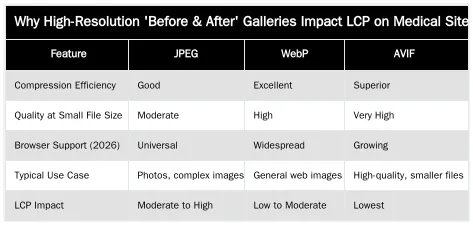
Why High-Resolution ‘Before & After’ Galleries Impact LCP on Medical Sites
The most effective way to optimize ‘before and after’ images for LCP is to right-size the image and use a modern format like WebP or AVIF. These formats offer superior compression at high quality, reducing file size compared to traditional formats and improving load time and Largest Contentful Paint.
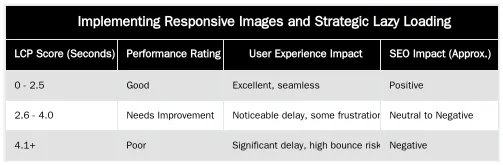
Largest Contentful Paint (LCP) measures the render time of the largest image or text block visible within the viewport. For medical websites like plastic surgery and aesthetic clinics, ‘before and after’ galleries often contain the largest visual elements. Unoptimized high-resolution images become a bottleneck, delaying LCP and negatively impacting user experience. A slow LCP can cause patient frustration, increase bounce rates, and suggest an unprofessional online presence.
The Critical Role of LCP in Patient Trust and SEO
In the YMYL (Your Money Your Life) sector, including medical websites, search engines prioritize E-E-A-T (Experience, Expertise, Authoritativeness, Trustworthiness). A fast-loading website with rapidly appearing visual content, like procedure results, signals a professional, trustworthy practice. Slow loading times erode patient trust. Prospective patients in London seeking aesthetic treatments expect fast digital experiences. A poor LCP score can harm search rankings, reducing visibility and conversion rates for Core Web Vitals for medical websites.
Mastering Image Compression & Next-Gen Formats for Optimal LCP
Image compression is fundamental to improving LCP. It reduces file size without a noticeable loss in visual quality—a crucial balance for high-resolution medical imagery where patients need clear results. Traditional formats like JPEG and PNG are less efficient than modern alternatives. Next-gen image formats reduce file sizes, leading to faster page loads and better LCP scores.
Choosing the Best Image Format for Web Speed
WebP and AVIF are modern image formats with superior compression. WebP, from Google, offers lossless and lossy compression, resulting in 25-34% smaller file sizes than comparable JPEGs. AVIF, based on the AV1 video codec, provides greater compression, often 50% smaller than JPEG, while maintaining excellent visual fidelity. As of 2026, WebP has widespread browser support, and AVIF’s support is growing across major browsers. Converting images to these formats using online tools, editors, or server-side solutions enhances loading speed and helps achieve a sub-2.0s LCP on procedure pages.
For technical details on WebP, see Google’s WebP documentation. Information on AVIF is on the AOMedia website.
Implementing Responsive Images and Strategic Lazy Loading
Responsive images deliver an image sized for the user’s device and viewport, preventing the download of unnecessarily large files. This is important for ‘before and after’ galleries viewed on devices from large desktops to small mobile screens. The `srcset` and `sizes` HTML attributes allow browsers to select the optimal image variant.
Lazy loading defers loading images until they enter the user’s viewport, improving initial page load times by reducing upfront requests and data transfer. Apply lazy loading strategically. Images that are the Largest Contentful Paint (LCP) element, visible “above the fold” without scrolling, should *not* be lazy loaded. Lazy loading these images delays their appearance and negatively impacts LCP. These critical images should be loaded eagerly or preloaded to appear quickly.
The ‘srcset’ Attribute: Delivering Perfect Image Sizes
The `srcset` attribute defines a list of image files and their intrinsic widths. The `sizes` attribute tells the browser how wide the image will be rendered at different viewport sizes. The browser uses this information to choose the most appropriate image from the `srcset` list. For ‘before and after’ galleries, this requires generating multiple image versions at various resolutions (e.g., 400px, 800px, 1200px) and implementing `srcset` and `sizes` in the HTML. This prevents mobile users from downloading desktop-sized images, reducing data transfer and improving loading speed. Understanding Lazy Loading vs. Eager Loading for Critical Medical Imagery is vital for performance.
How Do CDNs and Server-Side Optimizations Boost Image LCP?
Content Delivery Networks (CDNs) accelerate image delivery. A CDN is a distributed network of servers that caches content, including images, in various geographical locations. When a user requests an image, the CDN serves it from the closest server, reducing latency and load times. For London clinics with a diverse patient base, a CDN ensures images load quickly for users in the city, across the UK, or internationally. This global distribution contributes to a faster Largest Contentful Paint by minimizing the distance data travels.
Server-side image optimization techniques also enhance LCP. These include automated image resizing upon upload, dynamic image format conversion based on browser support, and server-level caching. These optimizations ensure images are processed and delivered efficiently. This approach is crucial for medical websites with extensive visual content.
Reducing ‘Cost of Retrieval’ with Efficient Image Delivery
Efficient image delivery from CDNs and server-side optimizations impacts the ‘Cost of Retrieval’ (CoR). CoR is the resources (time, bandwidth, processing power) search engine crawlers like Googlebot use to crawl, render, and index content. Large, unoptimized images increase CoR, which can slow the crawling of other content. Reducing image file sizes and serving them efficiently improves user experience and makes sites more crawlable. This aspect of semantic SEO ensures critical image content, like ‘before and after’ galleries, is efficiently processed by search engines. Learn more about CDNs from Cloudflare’s explanation.
Auditing and Monitoring Your Gallery’s LCP Performance
Identifying the Largest Contentful Paint element in your ‘before and after’ galleries is the first step in optimization. Tools like Chrome DevTools and Google PageSpeed Insights are essential for this. Chrome DevTools provides real-time performance analysis, highlighting the LCP element and showing a waterfall chart of resource loading. PageSpeed Insights offers lab data (simulated conditions) and field data (real user experiences) for a comprehensive view of LCP performance.
Continuous monitoring and iterative optimization are essential to maintain optimal LCP scores. Website performance requires ongoing attention. With over 10 years of experience in technical SEO for medical sites, Abdurrahman Şimşek notes that small improvements in image loading can lead to significant gains in page speed and user satisfaction. Regularly re-auditing your galleries ensures new content or website changes do not degrade performance.
Leveraging Advanced Tools for LCP Diagnostics
To use Chrome DevTools, open your website, right-click and select “Inspect,” then navigate to the “Performance” tab. Record a page load, and the “Timings” section will show the LCP event, pinpointing the element causing the delay. PageSpeed Insights provides a detailed report with recommendations like “Serve images in next-gen formats” or “Efficiently encode images.” Implementing these recommendations is crucial for medical website owners to improve their Core Web Vitals. For deeper performance checks, consider auditing image compression on ‘before & after’ galleries.
Elevate Your Clinic’s Online Presence with Expert LCP Optimization
Optimizing high-resolution ‘before and after’ image galleries for LCP is a strategic imperative for London’s private healthcare providers. Fast-loading visuals build patient trust, enhance user experience, and secure higher search rankings. By implementing image optimization, using next-gen formats, and employing strategic lazy loading, clinics can showcase results without performance compromises. This technical excellence improves patient acquisition and online growth.
For a comprehensive digital strategy, including a technical SEO framework and specialized web development, consider partnering with an expert. Abdurrahman Şimşek offers semantic SEO strategies for the London private healthcare sector. Visit abdurrahmansimsek.com to learn more.
Conclusion
Optimal Largest Contentful Paint scores for high-resolution ‘before and after’ image galleries are vital for plastic surgery and aesthetic clinics. Compressing images, adopting modern formats like WebP and AVIF, implementing responsive techniques, and managing lazy loading enhance website performance. CDNs and continuous monitoring with tools like Chrome DevTools refine this process. These efforts improve user experience, patient trust, and search engine rankings, driving qualified leads to your London practice. To ensure your website’s technical foundation supports growth, explore semantic SEO and web development services at abdurrahmansimsek.com.
Frequently Asked Questions
What is the single most effective way to optimize ‘before and after’ images for LCP?
The most effective technique involves right-sizing images and converting them to modern formats like WebP or AVIF. These formats offer superior compression at high quality, significantly reducing file size compared to older formats like JPEG. This directly improves page load time and is the best way to optimize images for LCP.
Should I lazy load the main ‘hero’ image in a gallery?
No, the primary ‘hero’ image, often the Largest Contentful Paint (LCP) element, should never be lazy-loaded. It should be eagerly loaded and potentially given `fetchpriority=’high’` to ensure it renders as quickly as possible. However, all subsequent images that appear ‘below the fold’ should be lazy-loaded to conserve bandwidth.
How does a Content Delivery Network (CDN) help with image LCP?
A CDN distributes copies of your images across servers globally. When a user accesses your site, images are served from the closest server, significantly reducing latency and delivery time. This global distribution is a crucial strategy to optimize images for LCP, especially beneficial for clinics with an international patient base.
What are responsive images and why do they matter for LCP?
Responsive images, implemented using `srcset` and `sizes` attributes, enable browsers to select and download an image size appropriate for the user’s device and screen. This prevents mobile devices from downloading unnecessarily large desktop-sized images, which is a major cause of slow loading and poor LCP scores. It ensures efficient resource usage and faster rendering.
Can I maintain high image quality while also optimizing for speed?
Absolutely. Modern image compression tools and next-gen formats like WebP allow for substantial file size reduction, often 30-50% over JPEG, with minimal perceptible loss in visual quality. The key is to strike the right balance between compression levels and the visual fidelity required for your clinical imagery.
How can London clinics specifically optimize images for LCP to enhance patient experience?
London clinics can improve patient experience by focusing on efficient image delivery, ensuring ‘before and after’ galleries load instantly. This involves using next-gen formats, responsive images, and a robust CDN tailored for local delivery. By doing so, they effectively optimize images for LCP, leading to faster page loads and a smoother user journey for prospective patients.
How can I get expert help to optimize my clinic’s image galleries for LCP?
Abdurrahman Şimşek, a London-based Semantic SEO Strategist, specializes in optimizing medical websites for Core Web Vitals and E-E-A-T. You can contact him through his website, abdurrahmansimsek.com, for tailored strategies to improve your clinic’s LCP performance and overall online presence. He offers expert guidance for Harley Street and Central London aesthetic clinics.
Ruxi Data brings together multi-model AI, automated website crawling, live indexation checks, topical authority mapping, E-E-A-T enrichment, schema generation, and full pipeline automation — from crawl to WordPress publish to social posting — all in one platform built for agencies and freelancers who run on results.