
Clinic Not on Google Maps: Enhance London Local Search Visibility
If your clinic not on Google Maps in London, it hinders patient acquisition. This guide explains common reasons for poor local visibility, such as unoptimized Google Business Profiles and inconsistent NAP data. Readers will learn strategies to improve their medical practice’s presence in the local pack, including mastering GBP optimization, building local citations, and leveraging geo-targeted content. Understanding these local SEO fundamentals is crucial for any London clinic struggling with online discoverability.
Abdurrahman Şimşek, a London-based Semantic SEO Strategist with 10 years of experience, specializes in building high-authority semantic content networks for medical clinics. His expertise helps practices dominate local organic search and attract high-value patients.
To explore your options, contact us to schedule your consultation.
Is your London clinic not on Google Maps, leaving potential patients unable to find your services? Many medical practices in the capital struggle with local visibility, impacting patient acquisition and growth. This guide explains why your healthcare facility might not be ranking on Google Maps and provides strategies to enhance your local search presence.
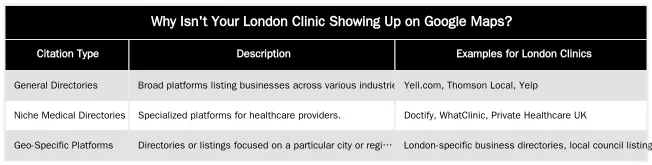
Why Isn’t Your London Clinic Showing Up on Google Maps?
A primary reason a medical practice might not appear on Google Maps is an unoptimized or incomplete Google Business Profile (GBP). Google uses this profile to understand your business, its services, and its relevance to local search queries. Without an optimized GBP, your clinic’s visibility in the local pack is hindered.
The Unoptimized Google Business Profile (GBP) Trap
An incomplete or inaccurate Google Business Profile is the most common oversight for medical clinics. Missing information, such as service lists, operating hours, or photos, signals to Google that your profile is not authoritative. Incorrectly chosen primary and secondary categories for specialized medical services can also misdirect Google’s algorithm, preventing your clinic from appearing for relevant searches.
Inconsistent NAP Data and Lack of Local Citations
Google’s algorithms prioritize consistency and trust. Inconsistent Name, Address, and Phone (NAP) data across online platforms can confuse search engines and diminish your clinic’s credibility. If your practice’s name, address, or phone number varies between your website, social media, and online directories, Google may struggle to verify your business information. A lack of local citations from reputable sources compounds this issue, signaling that your practice lacks an established online presence and authority.
Mastering Your Google Business Profile for London Medical Practices
Optimizing your Google Business Profile improves your clinic’s local search performance. For London medical practices, fill out every section with accurate and detailed information. A well-maintained GBP provides details to patients and signals relevance to Google.
Optimizing Every Section: Services, Hours, and Photos
Claim and verify your GBP. Ensure your business name is exact and consistent with your official branding. Select the most precise primary category for your practice (e.g., “Plastic Surgeon,” “Dermatologist,” “Skin Care Clinic”) and add all relevant secondary categories. Detail your medical services, treatments, and specializations. Accurately list your operating hours, including holiday variations. Upload high-resolution photos of your clinic’s exterior, interior, waiting areas, and staff (with consent) to build trust and provide a visual preview. Implement Local Business Schema on your website to enhance how search engines understand your clinic’s details.
Leveraging GBP Posts and Q&A for Patient Engagement
Google Business Profile posts engage potential patients. Use them to announce services, share health tips, highlight offers, or communicate updates. Regular posting keeps your profile active. The Q&A section is another engagement point. Monitor it for patient questions and provide prompt, informative answers. You can also proactively populate this section with frequently asked questions and expert responses to showcase your team’s knowledge and address common patient concerns.
Building Trust & Authority: Reviews, Citations, and Website SEO
For medical clinics, trust and authority are paramount in the YMYL (Your Money Your Life) sector. Google weighs these factors in its ranking algorithms. Patient reviews, consistent NAP data, a strong local citation profile, and website SEO signal to Google that your practice is reputable, which improves local visibility.
Cultivating Positive Patient Reviews and Managing Feedback
Patient reviews are social proof and a significant local ranking factor. Encourage satisfied patients to leave reviews on your Google Business Profile. Make the process easy with direct links or QR codes. Respond professionally to all reviews, both positive and negative. Acknowledge positive feedback and address negative comments constructively, demonstrating your commitment to patient care. A consistent stream of positive reviews with thoughtful responses enhances your clinic’s prominence in the local pack.
NAP Consistency & High-Quality Local Citations for London Clinics
Maintaining consistent Name, Address, and Phone (NAP) information across all online platforms is fundamental for local SEO. Audit your online presence regularly to ensure uniformity. High-quality local citations—mentions of your business on other websites—validate your clinic’s existence and legitimacy to Google. Acquire citations from reputable local directories, medical-specific platforms, and industry associations relevant to London. These signals reinforce your clinic’s authority and help Google display your practice in local search results.
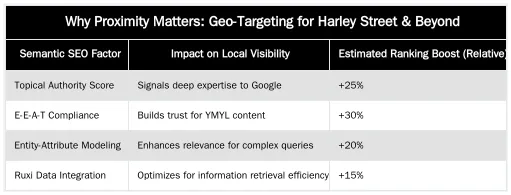
Why Proximity Matters: Geo-Targeting for Harley Street & Beyond
Proximity is a critical local search ranking factor, especially in dense urban areas like London. Google’s algorithm prioritizes businesses closest to the searcher’s location or the location in their query. For clinics in competitive areas like Harley Street, optimizing for this factor helps capture local patient traffic.
Understanding Google’s Proximity Algorithm in Dense Urban Areas
Google’s proximity algorithm determines how close your practice is to a user’s local search. In London, where clinics are clustered, a few blocks can affect local pack visibility. While physical location is fixed, clinics can maximize their reach by optimizing their Google Business Profile and building local relevance signals. This includes accurate location data, service area definitions, and consistent local information to help Google understand your clinic’s geographic footprint. The Google Maps Platform documentation explains how Google processes location data.
Crafting Geo-Targeted Content for London’s Private Healthcare Market
Your website content is important for geo-targeting. Create service pages that mention the London areas you serve, such as “Plastic Surgery Harley Street,” “Dermatology Clinic Marylebone,” or “Aesthetic Treatments Knightsbridge.” Incorporate local landmarks, transport links, and postcode references in your content. Address the healthcare needs of London-based patients. For instance, content about discreet treatments for professionals in Mayfair or skin care for residents of Chelsea can improve your local search relevance.
Beyond the Basics: Semantic SEO for Unrivaled Local Dominance
Improving local search rankings requires more than basic SEO. It requires integrating semantic SEO and building topical authority. This strategy helps Google recognize your clinic as an authority in its medical specializations, which is crucial for YMYL content.
Integrating Topical Authority with Your Local SEO Strategy
Topical authority is your website’s comprehensive coverage of a subject. For a medical clinic, this means creating content that covers all facets of your specializations, from conditions and treatments to procedures and patient education. When Google perceives your website as a definitive resource, it boosts your E-E-A-T (Experience, Expertise, Authoritativeness, Trustworthiness) signals. This authority improves your local search rankings, as Google trusts authoritative sources. Learn more about building topical authority from industry leaders.
The Abdurrahman Şimşek Approach: Semantic Engineering for Medical Clinics
Abdurrahman Şimşek specializes in building high-authority Semantic Content Networks for medical clinics, skin clinics, and plastic surgeons. This involves a semantic SEO strategy that goes beyond keywords to understand the entities and relationships within medical topics. Using techniques like Ruxi Data integration and Entity-Attribute-Value (EAV) modeling, clinics can achieve more relevance and prominence in search results. This approach optimizes for “Cost of Retrieval” (CoR), helping Google efficiently understand and rank your medical content. Semantic engineering is effective for London’s competitive private healthcare market, providing an advantage in local and organic search. Academic resources on Semantic Web technologies explain the principles of semantic search.
Ready to Dominate London’s Local Search? Partner with an Expert
Unlock Your Clinic’s Full Local Search Potential
If your medical practice is struggling with local visibility, partner with a specialist in London’s private healthcare market and semantic SEO. Abdurrahman Şimşek offers strategies to help your clinic rank for high-value searches and attract patients. Explore how a Harley Street SEO strategy can help your practice.
Conclusion
Ranking your London clinic on Google Maps is fundamental for attracting patients and sustaining growth. Optimizing your Google Business Profile, cultivating patient reviews, building a local citation profile, and crafting geo-targeted content all contribute to better local visibility. For practices in competitive areas like Harley Street, integrating semantic SEO and topical authority provides a competitive edge. To improve your clinic’s local search performance, visit abdurrahmansimsek.com.
Frequently Asked Questions
Why is my clinic not on Google Maps when I search for it in London?
A primary reason your clinic not on Google Maps is an incomplete or poorly optimized Google Business Profile (GBP). Google relies heavily on this profile to understand your services and relevance to local searches. Ensuring every section is accurately filled, including services, photos, hours, and correct medical categories, is crucial for visibility.
What are the key factors if my medical practice is not showing up on Google Maps?
Beyond an optimized Google Business Profile, key factors include patient reviews, NAP consistency, and website authority. A lack of positive reviews or inconsistent business information across online directories can significantly hinder your local search performance. This is a common reason why a clinic not on Google Maps for relevant searches.
How do patient reviews impact my clinic’s visibility if it’s not on Google Maps?
Patient reviews are extremely important for local ranking. A consistent stream of positive feedback signals to Google that your clinic is a trusted and popular local business, which can significantly improve your visibility. If your clinic not on Google Maps, actively encouraging and managing reviews should be a priority.
My Harley Street clinic is not on Google Maps despite its prime location. What could be the issue?
While proximity is a major factor, relevance and prominence also play crucial roles. Even with a prime Harley Street location, clinics with superior GBP optimization, a greater volume of positive reviews, and stronger website authority can outrank you, leading to your clinic not appearing on Google Maps.
How can my website improve my local search ranking if my practice isn’t appearing on Google Maps?
Your website significantly contributes to your local ranking by establishing topical authority and relevance. Creating geo-targeted service pages, such as ‘Dermatology in Marylebone’ or ‘Plastic Surgery in Knightsbridge’, signals to Google your specific relevance for searches in those London neighborhoods. This strengthens your overall local authority and helps your clinic appear on Google Maps.
How can I get expert help to ensure my London clinic ranks better on Google Maps?
Partnering with a specialist in medical SEO can provide a strategic advantage. An expert can conduct a comprehensive audit of your Google Business Profile, website, and local citations, then implement a tailored strategy to improve your local search presence. This ensures your clinic ranks effectively on Google Maps and attracts more patients.
Ruxi Data brings together multi-model AI, automated website crawling, live indexation checks, topical authority mapping, E-E-A-T enrichment, schema generation, and full pipeline automation — from crawl to WordPress publish to social posting — all in one platform built for agencies and freelancers who run on results.