Location in URL Local SEO: Enhancing Geographic Relevance for Clinics
While location in url local seo is not a direct ranking factor, it serves as a crucial contextual signal for search engines and users. This article explains how strategically incorporating geographic terms into URL slugs enhances geo-targeting and improves user experience for medical clinics. It details best practices for structuring URLs for single and multi-location practices, including city landing pages and service area pages. Understanding this indirect signal helps reinforce other local SEO ranking factors, contributing to better visibility in local search queries and higher click-through rates for practices in competitive areas like Harley Street.
Abdurrahman Şimşek, a Semantic SEO Strategist, provides expert insights into optimizing digital footprints for medical clinics. His 10+ years of experience in semantic engineering and medical SEO ensures strategies are built on robust, data-driven principles for sustained local search dominance.
To explore your options, contact us to schedule your consultation. You can also reach us via: Book a Semantic SEO Audit, Direct WhatsApp Strategy Line: +90 506 206 86 86
For London’s private healthcare clinics, including location in url local seo is a contextual signal that enhances user experience and search engine understanding of geographic relevance. This helps medical practices attract local patients and establish a digital footprint in competitive areas like Harley Street.
Is Location in URL a Direct Ranking Factor for Local SEO?
No, including a location in the URL is not a direct local SEO ranking factor. It is a contextual signal providing geographic relevance to users and search algorithms. This signal helps search engines understand a page’s target area, which can indirectly influence visibility and user engagement in local search results.
Understanding Direct vs. Indirect Local SEO Signals
Direct local SEO ranking factors include searcher proximity, business relevance, and prominence (e.g., reviews, links). URL structure is an indirect signal that contributes to the clarity and consistency of geographic information, reinforcing other local signals to help search engines associate your medical practice with specific locations.
How Location in URLs Impacts User Experience and CTR
A clear location in the URL communicates geographic relevance to a local searcher. A URL like yourclinic.com/london/harley-street/ shows the content pertains to that area. This transparency improves user experience, reduces bounce rates, and increases click-through rates (CTR) from search results. Higher CTR can signal to search engines that your page is relevant for local queries, indirectly boosting its visibility.
Crafting Geo-Targeted URLs: Best Practices for Medical Clinics
For local SEO, medical clinic URLs should incorporate location to create clear, concise, and consistent slugs. These slugs must be user-friendly, provide geo-targeting signals, and accurately reflect the clinic’s physical or service presence on city and service area pages.
Single Location vs. Multi-Location URL Structures
URL structure varies for single versus multi-location clinics. For more detail, see our article on URL Structure Best Practices for Medical Websites.
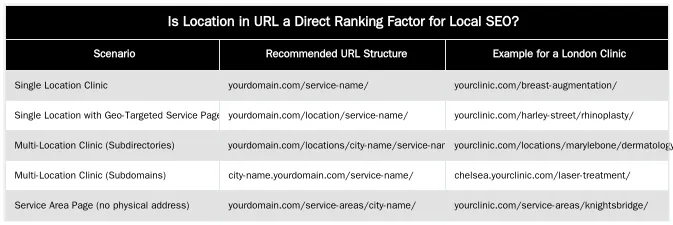
Subdirectories are preferred for consolidating domain authority, but subdomains can be effective for distinctly branded or large, independent clinic branches. Consistency and a logical hierarchy are key.
Integrating Geo-Modified Keywords Effectively
Integrate geo-modified keywords like “plastic surgeon London” naturally into URL slugs to reinforce geographic relevance without keyword stuffing. For example, use yourclinic.com/london/plastic-surgery/ instead of yourclinic.com/london-plastic-surgeon-best-clinic/. The URL should be descriptive, readable, and concise, signaling both the service and location.
Structuring URLs for Multi-Location & Service Area Pages in London
Medical clinics with multiple branches, or those targeting London boroughs without a physical presence, require URL planning for multi-location SEO. Create distinct, geo-targeted service area pages for local search queries while avoiding duplicate content. This strategy is important for clinics targeting postcodes like Harley Street, Marylebone, and Kensington.
Hierarchical URL Structures for London Boroughs
A hierarchical URL structure improves crawlability and user navigation for multiple locations and service areas. For clinics targeting various London locations, nest specific areas under a ‘London’ directory:
yourclinic.com/london/harley-street/procedure-name/yourclinic.com/london/kensington/procedure-name/yourclinic.com/london/chelsea/procedure-name/
This structure defines the geographic scope of each page and helps search engines understand the relationship between clinic locations. It allows for expansion into new areas. For specific strategies, see our Harley Street SEO strategy guide.
Avoiding Duplicate Content Issues with Geo-Targeted Pages
To avoid duplicate content issues on geo-targeted pages, ensure each page offers unique value even if the core service is the same. Implement these strategies:
- Unique Content: Tailor introductory and concluding paragraphs, patient testimonials, and FAQs to each location.
- Local Specifics: Include unique directions, local landmarks, public transport options, and details about team members or facilities at that location.
- Local Imagery: Use photos of the specific clinic location, local team, or local area landmarks.
- Local Testimonials: Feature reviews and testimonials from patients from that borough.
- Internal Linking: Link between related local pages and to a central medical directory SEO page, if applicable, to distribute authority.
Distinct, locally relevant content makes each geo-targeted page a unique resource for searchers in that area, signaling its purpose to search engines and aligning with Google’s helpful content guidelines.
What Are the Long-Term Benefits of Strategic Location-Based URLs?
Enhanced Local Search Visibility and Patient Acquisition
Clear location signals in URLs improve visibility in local pack and organic search results. When search engines associate your clinic with specific areas, your pages are more likely to appear for queries like “dermatologist near me” or “plastic surgeon Harley Street.” This increased visibility drives qualified traffic from users searching for local medical services, who are more likely to convert into patients.
Building a Robust Local SEO Foundation for Future Growth
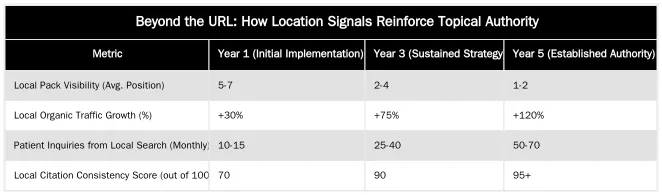
A strategic approach to location-based URLs creates a foundation for future local SEO. Consistently signaling geographic relevance across your website, Google Business Profile, and local schema builds a trustworthy local digital presence. This makes your site more resilient to algorithm changes and effective in future marketing campaigns. The compounding effect of consistent local signals helps establish your clinic as an entity in its service areas, fostering organic growth and patient loyalty.
Optimize Your Clinic’s Local Presence with Semantic SEO
For London medical clinics and plastic surgeons, local SEO requires expertise in semantic SEO and web development. Abdurrahman Şimşek offers strategies to build semantic content networks for local organic search in areas like Harley Street and other London postcodes. This approach can improve a clinic’s digital presence and attract patients through local search optimization.
Conclusion
Incorporating location into URLs is a contextual signal for local SEO, not a direct ranking factor. It enhances user experience, improves click-through rates, and provides geographic relevance to search engines. Harmonizing URL structures with Google Business Profile, local schema, and using a hierarchical approach for multi-location clinics builds a local digital footprint. This strategy, integrated with semantic SEO, can lead to better local search visibility, more patient leads, and long-term growth. To optimize your clinic’s local SEO, Book a Semantic SEO Audit. For strategic discussions, contact the Direct WhatsApp Strategy Line: +90 506 206 86 86.
Frequently Asked Questions
Is including the location in url local seo a direct ranking factor?
While not a direct ranking factor, incorporating the location in url local seo acts as a strong contextual signal. It helps search engines understand the geographic relevance of your page, improving visibility and user engagement for local searches. This clarity can lead to higher click-through rates from patients in your target area.
What are best practices for structuring URLs with geographic targeting for medical clinics?
For clinics with multiple locations, using subdirectories like `clinic.com/locations/harley-street/` is recommended. This structure consolidates SEO authority on your main domain while creating distinct, geo-targeted pages. It ensures each location has a dedicated, optimized presence without diluting overall domain strength.
Can improper use of location in URLs negatively impact local SEO?
Yes, improper implementation can harm your SEO. Keyword-stuffing URLs with multiple city names (e.g., `/london-harley-street-marylebone-clinic/`) appears spammy to both users and search engines, leading to a poor user experience. The key is to maintain clean, logical URLs focused on one primary location per page.
For a Harley Street surgeon, how important is including the specific location in url local seo for service pages?
For a Harley Street surgeon, strategically including the specific location in url local seo for service pages is highly effective. A URL like `/procedures/rhinoplasty-harley-street/` clearly signals the service and the high-value area you are targeting. This strengthens your local relevance and helps attract specific patient demographics from that competitive market.
Should the location in a URL align with my Google Business Profile for optimal local SEO?
Yes, consistency is crucial for local SEO. The URL for a specific location page should directly correspond to the landing page linked from that location’s Google Business Profile. This alignment creates a seamless user journey and reinforces critical NAP (Name, Address, Phone Number) consistency signals, which are vital for local search rankings.
How can Abdurrahman Şimşek help optimize my clinic’s local presence with URL strategies?
Abdurrahman Şimşek specializes in Semantic SEO, helping clinics strategically integrate location signals across their digital presence, including URL structures. We optimize your content network to ensure search engines accurately understand your geographic relevance and service areas. To discuss a tailored strategy for your London clinic, you can book a Semantic SEO Audit.
Ruxi Data brings together multi-model AI, automated website crawling, live indexation checks, topical authority mapping, E-E-A-T enrichment, schema generation, and full pipeline automation — from crawl to WordPress publish to social posting — all in one platform built for agencies and freelancers who run on results.