
Semantic HTML Medical SEO: Enhancing AI Overviews and Accessibility
Semantic html medical seo is crucial for medical clinics aiming for superior search visibility and AI Overview presence. This article details how semantic HTML provides unambiguous context to search engines and AI models, forming a foundational layer for enhanced digital presence and accurate information retrieval. By using HTML5 semantic elements, medical websites improve machine readability, reduce the cost of retrieval for AI, and bolster E-E-A-T. This structured content approach ensures medical information is precisely understood, boosting chances for featured snippets and accessibility for all users.
Abdurrahman Şimşek, a Semantic SEO Strategist, emphasizes the strategic importance of clean, machine-readable code for medical websites. Implementing semantic HTML is a core technical SEO practice that future-proofs content, ensuring long-term relevance and authority in evolving search landscapes.
To explore your options, contact us to schedule your consultation. You can also reach us via: Book a Semantic SEO Audit, Direct WhatsApp Strategy Line: +90 506 206 86 86
Understanding semantic html medical seo is critical for medical clinics aiming for superior search visibility in 2026. This guide explores how semantic HTML provides unambiguous context to search engines and AI models, forming a foundational layer for AI Overviews and enhanced digital presence. We will detail the specific elements, their practical application for medical websites, and their profound impact on machine readability, accessibility, and future-proofing your online content.
What is Semantic HTML and Why is it Crucial for Medical SEO?
Semantic HTML involves using HTML tags that convey meaning about the content they enclose, rather than just dictating its presentation. For medical SEO, this is paramount because it provides clear, machine-readable content, which is essential for YMYL (Your Money Your Life) topics and establishing E-E-A-T (Experience, Expertise, Authoritativeness, Trustworthiness). It ensures search engines and AI models accurately interpret complex medical information, improving the chances of content appearing in AI Overviews and other rich results.
Beyond Divs: Giving Meaning to Your Medical Content
Traditional HTML often relies heavily on non-semantic tags like <div> and <span>, which offer no inherent meaning to machines. Semantic tags, conversely, explicitly describe the type of content they contain. For instance, an <article> tag clearly indicates a self-contained piece of content, while a <nav> tag signifies navigation links. This distinction is vital for medical websites, where precision in information retrieval directly impacts patient trust and search engine ranking. By using appropriate tags, you communicate the purpose and hierarchy of your content, making it easier for algorithms to understand and categorize.
This structured approach to content is a cornerstone of effective semantic HTML for SEO, particularly in specialized fields like medicine. It helps search engines grasp the context of medical procedures, doctor qualifications, and treatment outcomes, which is crucial for accurate information delivery to users.
How Semantic HTML Powers AI Overviews & Reduces Cost of Retrieval
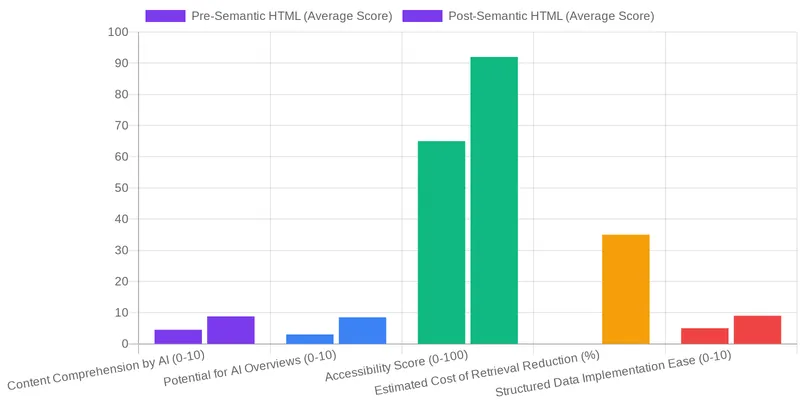
Semantic HTML directly influences how AI models, including those powering AI Overviews, process and present information. By providing clear structural cues, semantic tags enable AI to efficiently identify and extract key data points from medical content. This structured content reduces the “Cost of Retrieval” for search engines, meaning less computational effort is required to crawl, parse, and understand a webpage. For medical sites, where accuracy and speed of information delivery are critical, minimizing this cost translates to improved indexing and higher visibility.
When content is semantically structured, search engines can quickly discern the main subject of a page, its supporting sections, and ancillary information. This efficiency is particularly beneficial for complex medical topics, allowing AI to pinpoint specific details like procedure risks, recovery times, or surgeon credentials without extensive processing. This foundational work is key to an advanced technical SEO framework, ensuring your medical content is not only found but also understood deeply by algorithms.
Structuring for Machine Comprehension: The AI Advantage
Semantic tags act as clear signals for AI, making it simpler to identify and summarize relevant information for direct answers and AI Overviews. For example, an AI model can quickly distinguish a surgeon’s biography within an <article> tag from a list of related procedures in an <aside>. This unambiguous context is invaluable for generative AI, which relies on precise information to formulate accurate responses. Well-defined content blocks allow AI to confidently extract facts about procedure details, doctor qualifications, and patient testimonials, directly contributing to the quality of AI-generated summaries. This approach is fundamental for optimizing for Generative Engine Optimization (GEO) in medicine, ensuring your content is primed for the future of search.
For more insights into how structured content impacts AI Overviews, explore resources on structuring content for AI Overviews in 2026.
Essential HTML5 Semantic Elements for Medical Websites
Implementing essential HTML5 semantic elements correctly is a practical step to enhance your medical website’s SEO and user experience. These elements provide a clear structural hierarchy, making your content more digestible for both human readers and search engine crawlers. Understanding their specific purposes allows for precise content organization, which is crucial for conveying complex medical information effectively.
Applying <article>, <section>, <aside>, and More to Clinical Content
Each HTML5 semantic element serves a distinct purpose, guiding the interpretation of content. For instance, <header> and <footer> define introductory and concluding content, respectively. <nav> designates navigation links, while <main> encapsulates the dominant content of the <body>. The <article> tag is ideal for self-contained content like a blog post about a procedure or a surgeon’s profile. <section> groups related content within an article, such as different stages of a treatment. <aside> is perfect for tangential content, like related articles or patient testimonials. <figure> and <figcaption> are used for images, diagrams, or videos with their captions, ensuring visual content is semantically linked to its description. The <time> element can mark dates for publication or last review, vital for E-E-A-T in medical content.
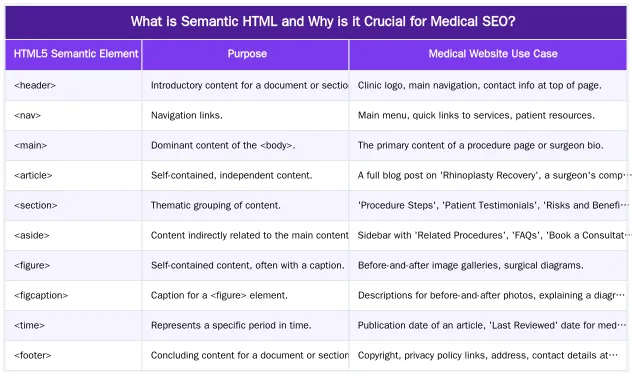
Proper application of these html5 semantic elements ensures that your medical content is not only visually appealing but also structurally sound for optimal search engine understanding.
Integrating Semantic HTML with Structured Data & EAV for Medical SEO
Semantic HTML provides the essential structural foundation for advanced SEO strategies, including structured data (Schema.org) and Entity-Attribute-Value (EAV) modeling. This integration creates a robust, machine-readable knowledge base for medical entities. By clearly defining content blocks with semantic tags, you prepare your website for the precise application of Schema markup, which further enhances search engine comprehension and the potential for rich snippets and featured snippets in search results. This layered approach ensures that every piece of medical information is not only present but also explicitly defined for algorithms.
The synergy between semantic HTML and structured data is particularly powerful for medical websites. It allows clinics to communicate complex relationships between doctors, procedures, and conditions in a format search engines can easily consume. This precision is vital for building topical authority and ensuring that your medical content is accurately represented in the knowledge graph.
From Semantic Tags to Rich Snippets and Knowledge Graph Entries
Well-structured semantic HTML simplifies the implementation of relevant Schema.org types, such as MedicalBusiness, Physician, and MedicalProcedure. For example, using an <article> tag for a surgeon’s biography makes it straightforward to apply Physician Schema markup to that specific content block. This direct mapping helps search engines understand the attributes of an entity, such as a surgeon’s specialty, qualifications, and clinic affiliation. This aligns perfectly with the EAV model for surgical procedures, where semantic tags can map directly to attributes like ‘recovery time’ or ‘anesthesia type’ for a specific procedure entity. This structured approach not only aids in generating rich snippets but also contributes to building a comprehensive knowledge graph entry for your medical practice, enhancing its visibility and credibility in search.
Future-Proofing Your Medical Website: An Expert’s Perspective
Adopting a holistic semantic approach is a long-term investment in your medical website’s resilience and performance. As a Semantic SEO Strategist and Semantic Engineer, Abdurrahman Şimşek emphasizes that clean code and a well-defined information architecture are not just best practices; they are necessities for navigating the evolving search landscape. This strategy improves accessibility for all users, enhances maintainability for developers, and provides a strong defense against unpredictable algorithm updates. By building a website on a semantic foundation, medical clinics ensure their content remains relevant and discoverable, regardless of future changes in search engine technology.
The integration of advanced tools like Ruxi Data further amplifies these benefits. Ruxi Data automates the creation of topical maps and EAV modeling, ensuring that the semantic structure of your content is continuously optimized for search engine comprehension. This proactive approach to web development and SEO positions medical practices at the forefront of digital innovation.
The Abdurrahman Şimşek Framework: Semantic Engineering for Harley Street Clinics
Abdurrahman Şimşek’s methodology integrates semantic HTML as a foundational layer for building high-authority Semantic Content Networks. This framework is specifically designed to optimize for Generative Engine Optimization (GEO), which is crucial for London’s competitive medical market, including Harley Street clinics. The emphasis is on creating a robust information architecture with clean code that clearly communicates the expertise and authority of medical practitioners. This structured approach not only boosts visibility but also establishes a clinic’s digital presence as a trusted source of medical information. By leveraging semantic engineering, medical websites can achieve superior rankings, attract high-value patients, and maintain a leading edge in the digital health space. This ensures that every piece of content, from surgeon bios to detailed procedure pages, contributes to a cohesive and powerful online presence.
For further reading on the importance of semantic structure in information retrieval, consult resources from reputable academic institutions or organizations like W3C.
Unlock Your Clinic’s Full Search Potential with Semantic SEO
The strategic implementation of semantic HTML is an indispensable component of modern medical SEO. It directly impacts your clinic’s visibility, patient acquisition, and long-term digital resilience. By ensuring your content is machine-readable, accessible, and primed for AI Overviews, you establish a powerful foundation for sustained organic growth. Embracing a comprehensive semantic approach means your medical website is not just present online, but truly understood and valued by search engines and prospective patients alike. This is the pathway to dominating local organic search and attracting high-value patients.
To transform your medical content into a powerful, algorithm-proof asset, partner with an expert in semantic engineering. Book a Semantic SEO Audit with Abdurrahman Şimşek today, or reach out directly via WhatsApp Strategy Line: +90 506 206 86 86.
Conclusion
Embracing semantic HTML is no longer optional for medical websites aiming for top search visibility. It’s the foundational layer for machine comprehension, AI Overviews, and a superior user experience. By meticulously structuring your content with semantic tags, you provide search engines with the clarity needed to accurately interpret and rank your medical information, significantly reducing the cost of retrieval. This strategic investment in semantic html medical seo ensures your clinic builds robust topical authority and remains competitive in a rapidly evolving digital landscape. Partner with Abdurrahman Şimşek to transform your medical content into a powerful, algorithm-proof asset. Book a Semantic SEO Audit, or connect directly via WhatsApp Strategy Line: +90 506 206 86 86.
Frequently Asked Questions
What is the primary benefit of using semantic html medical seo?
The primary benefit of semantic html medical seo is providing unambiguous context to search engines and AI models. Using tags like <article> or <aside> tells machines exactly what content is, which is crucial for AI Overviews and building a reliable knowledge graph. This clarity helps search engines accurately interpret and categorize medical information.
How does semantic html medical seo improve a surgeon’s online profile?
For a surgeon’s bio, using <header> for their name, <section> for qualifications, and <footer> for contact info provides clear, machine-readable context. This structured approach, central to semantic html medical seo, ensures search engines accurately understand and present their expertise. It helps in building a robust entity profile for medical professionals.
How does semantic HTML relate to the ‘Cost of Retrieval’ for medical websites?
Semantic HTML makes your page structure instantly understandable to crawlers, reducing the computational power (the ‘cost’) needed to parse content. This efficiency is a positive signal for search engines, benefiting medical sites by making their information more accessible. It streamlines the indexing process, improving overall site performance.
Will implementing semantic html medical seo help my site rank higher in AI Overviews?
Yes, it is a key factor. AI models prioritize well-structured, authoritative content for summaries. A semantically correct HTML structure, a core component of semantic html medical seo, makes your content a prime candidate for inclusion in these AI-generated answers. This significantly boosts visibility in evolving search landscapes.
Is it difficult to convert an existing medical website to use semantic HTML?
It can be a significant task for an existing site, often requiring a theme or template overhaul. This is why Abdurrahman Şimşek’s methodology ensures new client websites are built with a semantic-first approach from the ground up. This establishes this foundational SEO element from day one, avoiding costly retrofits.
How can I begin optimizing my medical website with semantic SEO strategies?
You can book a Semantic SEO Audit with Abdurrahman Şimşek to assess your current structure and develop a tailored strategy for your medical practice. Alternatively, reach out directly via WhatsApp at +90 506 206 86 86 for immediate strategic guidance. This will help unlock your clinic’s full search potential.
Ruxi Data brings together multi-model AI, automated website crawling, live indexation checks, topical authority mapping, E-E-A-T enrichment, schema generation, and full pipeline automation — from crawl to WordPress publish to social posting — all in one platform built for agencies and freelancers who run on results.