
Keyword Rich Urls: Optimizing Medical Treatment Pages for SEO
Clean, keyword rich urls are essential for optimizing medical treatment pages, enhancing search engine visibility and user experience. This article details how to craft effective URL slugs by including primary keywords and avoiding unnecessary words, which is crucial for medical SEO and E-E-A-T. Properly structured URLs improve entity recognition, strengthen topical authority within a semantic content network, and ultimately boost click-through rates for clinics. Understanding URL best practices ensures permalinks are concise, descriptive, and readable, directly supporting patient acquisition strategies.
Abdurrahman Şimşek, a Semantic SEO Strategist with over 10 years of experience, emphasizes that optimized URLs are vital signals in building high-authority semantic content networks for medical clinics. His expertise focuses on leveraging URL structure to enhance entity recognition and topical authority, crucial for medical SEO success.
To explore your options, contact us to schedule your consultation. You can also reach us via: Book a Semantic SEO Audit, Direct WhatsApp Strategy Line: +90 506 206 86 86
Clean, keyword rich urls are fundamental to on-page SEO for medical treatment pages, where clarity and search engine visibility are critical. Optimized URLs enhance search performance and user experience, impacting how search engines rank content and influencing patient acquisition for medical practices.
What Defines Clean, Keyword-Rich URLs for Medical Treatments?
A clean, keyword-rich URL is a concise, descriptive web address with primary target keywords and no unnecessary words. It indicates the page’s content to search engines and users. For medical treatment pages, this means including the procedure name and location, making the URL understandable and relevant. This improves search engine understanding, user experience, and search visibility.
The Core Components of an SEO-Friendly URL Slug
An effective URL slug is concise, descriptive, readable, and includes primary keywords like “rhinoplasty” or “liposuction london.” Conciseness avoids truncation in search results. Descriptiveness indicates the page’s topic. Readability helps users grasp the URL’s meaning, fostering trust and clicks. For instance, /treatments/rhinoplasty-london is more informative than /pages/id=123.
For more detail, see these URL structure best practices for medical websites.
Why URL Optimization is Crucial for Medical SEO & E-E-A-T
URL optimization influences how search engines perceive a clinic’s expertise, authoritativeness, and trustworthiness (E-E-A-T). A well-structured URL reinforces content legitimacy. Semantic SEO Strategist Abdurrahman Şimşek states that URLs are critical signals in a semantic content network, helping search engines understand relationships between entities and topics.
Enhancing Entity Recognition and Topical Authority
Clear, descriptive URLs help search engines identify and categorize medical entities like procedures (e.g., “breast augmentation”) and their providers. A URL that names a treatment signals the page’s core topic, strengthening the site’s topical authority. This entity recognition builds a semantic content network that demonstrates the clinic’s expertise and aids in reducing Cost of Retrieval for search engines, making websites more efficient to crawl and index.
Improving User Experience and Click-Through Rates
Descriptive URLs provide context to users in search engine results pages (SERPs). A URL like /plastic-surgery/facelift-london inspires more confidence than a generic string, increasing click-through rates. This transparency builds trust, which is critical for medical treatments. Google’s documentation offers more on URL structure best practices.
Crafting SEO-Friendly URLs: Best Practices for Treatment Pages
Optimizing URLs for medical treatment pages requires strategic keyword integration, length, and formatting. This ensures permalinks are search engine- and user-friendly, improving visibility and patient engagement.
Strategic Keyword Integration and URL Length
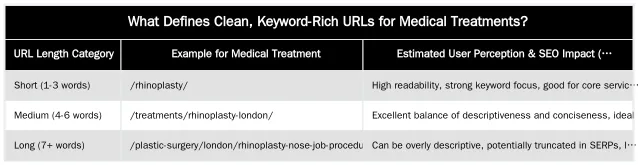
Integrate the primary keyword for each treatment page, such as “rhinoplasty london” or “dermal fillers harley street,” into the URL slug. Shorter, concise URLs are preferred for readability and shareability. Aim for URLs that are descriptive without being excessively long. The table below illustrates the impact of URL length on user perception and potential SEO benefits.
Hyphens vs. Underscores and Removing Stop Words
Use hyphens (-) to separate words in URLs. Google treats hyphens as word separators, allowing it to interpret individual words. Underscores (_) can concatenate words, making them harder for search engines to parse. For example, rhinoplasty-london is clearer than rhinoplasty_london. Remove common “stop words” (e.g., “a,” “the,” “in,” “for”) from URLs. They add little semantic value and make URLs unnecessarily long. Removing them focuses the URL on the most important keywords, such as /breast-augmentation-london instead of /the-breast-augmentation-in-london.
| URL Element | Best Practice | Reasoning |
|---|---|---|
| Word Separator | Use hyphens (-) | Google treats hyphens as spaces, improving readability for search engines. |
| Stop Words | Remove them | Increases conciseness and keyword focus, reducing noise for algorithms. |
| Case Sensitivity | Use lowercase | Avoids potential duplicate content issues and ensures consistency. |
| Special Characters | Avoid them | Can cause technical issues and are not SEO-friendly. Stick to alphanumeric and hyphens. |
Common URL Mistakes & How to Avoid Them on Clinic Websites
URL construction errors can hinder search performance. Common mistakes include over-optimization and a lack of descriptive clarity.
Avoiding Keyword Stuffing and Dynamic Parameters
Stuffing URLs with too many keywords is detrimental, can appear spammy, and may lead to penalties. A URL like /london-best-rhinoplasty-surgeon-clinic-price-cost is an example of keyword stuffing. Focus on one or two primary keywords. Dynamic URLs with parameters like ?id=123&category=treatment are also problematic. They are difficult to crawl and index and offer no descriptive value. Use static, descriptive URLs that state the procedure and modifiers, such as /treatments/liposuction-marylebone.
The Pitfalls of Generic or Underscriptive URLs
Generic URLs like /page-123 or /treatments/service provide no context. This lack of descriptiveness negatively impacts search engine understanding and user perception for Your Money Your Life (YMYL) content. Users are less likely to click an ambiguous link. Every URL should describe the page’s content, such as /dermatology/acne-treatment, so algorithms and patients understand its relevance.
Implementing & Maintaining Optimized Permalinks for Your Clinic
Setting up SEO-friendly permalinks requires ongoing management of URL changes to preserve SEO value and user experience. This involves configuring your Content Management System (CMS) and using redirects correctly.
Configuring SEO-Friendly Permalinks in WordPress and Other CMS
Most CMS platforms, like WordPress, offer flexible permalink settings. For medical clinic websites, select a “Post name” or “Custom Structure” option that includes keywords. In WordPress, setting the permalink structure to /%category%/%postname%/ or /%postname%/ allows for clean, descriptive URLs. Prioritize a structure that allows manual control over the URL slug to incorporate treatment names and locations. A consistent permalink strategy supports an organized site structure, efficient crawling, and helps avoid crawl budget issues.
Managing URL Changes and 301 Redirects Effectively
When a URL changes, a 301 redirect is critical. A 301 (permanent) redirect tells search engines a page has moved, passing most of its SEO value to the new URL. Without proper redirects, you risk broken links, lost rankings, and a poor user experience. During site updates or content restructuring, audit all changed URLs and set up corresponding 301 redirects. Tools like Google Search Console can help identify crawl errors, ensuring your redirect strategy maintains site authority. For complex migrations, consult an SEO specialist.
Elevate Your Clinic’s Online Presence with Semantic URL Strategy
Creating clean, keyword rich urls is a strategic part of a semantic SEO framework. Optimized URLs enhance online visibility, patient experience, and E-E-A-T signals. This foundational practice builds a digital presence for search engines and prospective patients. For guidance on integrating advanced semantic strategies, consider a specialized Semantic SEO audit.
To discuss how a specialist medical SEO services approach can transform your clinic’s online performance, Book a Semantic SEO Audit. Direct WhatsApp Strategy Line: +90 506 206 86 86.
Conclusion
Crafting clean, keyword-rich URLs enhances a medical clinic’s online visibility, user experience, and E-E-A-T signals. This practice is integral to a semantic content strategy, providing clarity to search engines, reinforcing topical authority, and building patient trust. For guidance on implementing advanced semantic SEO strategies, contact us. We build Semantic Content Networks for medical clinics to reach the right audience.
Book a Semantic SEO Audit, Direct WhatsApp Strategy Line: +90 506 206 86 86
Frequently Asked Questions
What defines effective keyword rich urls for medical treatments?
Effective keyword rich urls are concise, descriptive web addresses that clearly communicate the page’s content using primary target keywords. For medical treatment pages, this means including the procedure name and location, making the URL instantly understandable to both search engines and users. This clarity significantly improves search engine understanding, user experience, and overall search visibility for your clinic.
Why is it important to remove stop words from URLs for better optimization?
Removing stop words like ‘a’, ‘the’, or ‘in’ is crucial for creating concise and focused URLs. This practice ensures that the URL primarily highlights the most important keywords, making it more impactful for search engine algorithms and easier for users to read. A streamlined URL contributes to better search engine optimization by emphasizing the core topic.
What is the recommended word separator for creating keyword rich urls?
For creating keyword rich urls, it is always recommended to use hyphens (-) to separate words. Google officially states that hyphens are treated as word separators, helping search engines correctly interpret the individual terms within your URL. In contrast, underscores (_) can sometimes be seen as word joiners, potentially hindering the recognition of distinct keywords and impacting SEO performance.
What is the ideal length for an SEO-friendly URL slug?
An ideal URL slug should be concise, typically aiming for 3-5 words, while remaining highly descriptive of the page’s content. The goal is to provide enough information for both users and search engines to understand the page’s topic at a glance. Keeping URLs short and focused improves readability and can positively influence click-through rates.
What are the implications of changing existing URLs that are not keyword rich urls?
While you can change existing URLs, it requires careful implementation of 301 redirects from the old address to the new one to preserve SEO value. Failing to do so can result in lost link equity, broken links, and a negative impact on your search rankings. It is always best practice to establish a well-optimized URL structure, including keyword rich urls, from the outset to avoid these complex and potentially damaging issues.
How can Abdurrahman Şimşek help my clinic optimize its URL structure and overall SEO?
Abdurrahman Şimşek specializes in building high-authority Semantic Content Networks for medical clinics, including optimizing URL structures for maximum search visibility. By leveraging a holistic SEO strategy and semantic engineering, he helps clinics craft effective permalinks and enhance their online presence. To get started, you can book a Semantic SEO Audit to assess your current strategy and identify areas for improvement.
Ruxi Data brings together multi-model AI, automated website crawling, live indexation checks, topical authority mapping, E-E-A-T enrichment, schema generation, and full pipeline automation — from crawl to WordPress publish to social posting — all in one platform built for agencies and freelancers who run on results.