
📊

Request Our SEO Success Stories

Get our 2026 case study featuring 10 medical practices with verified Google Search Console data — delivered straight to your inbox.

    Local SEO

    How Long Does It Take to Build Topical Authority in a Competitive Medical Niche?

    How Long to Build Topical Authority: Realistic Timelines for Medical SEO

    Understanding how long to build topical authority in competitive medical niches is crucial for effective SEO strategy. Initial authority in fields like plastic surgery in London typically requires 6-9 months of consistent, high-quality content production. Achieving sustained page-one rankings and market dominance extends this timeline to 12-18 months or more. This duration is influenced by content velocity, competitive analysis, and the depth of your semantic content network. Prioritizing E-E-A-T signals and comprehensive topic cluster planning is essential for establishing a trusted online presence.

    Abdurrahman Şimşek, a Semantic SEO Strategist, emphasizes that strategic content planning and a deep understanding of search intent are vital for accelerating authority building. This approach focuses on creating comprehensive content networks that satisfy both user needs and Google’s E-E-A-T requirements.

    To explore your options, contact us to schedule your consultation. You can also reach us via: Book a Semantic SEO Audit, Direct WhatsApp Strategy Line: +90 506 206 86 86

    Building topical authority is required for a competitive online presence in medical niches like plastic surgery. For clinic directors and marketing managers in markets like London, a key question is: how long to build topical authority? This guide explains the timeline, factors, and strategies to establish your clinic as an expert.

    Understanding Topical Authority: More Than Just Keywords

    Establishing initial topical authority in a competitive medical niche like plastic surgery in London takes 6 to 9 months of consistent, high-quality content production. Achieving page-one rankings and sustained dominance extends this timeline to 12-18 months or more. This duration is influenced by content velocity, competitive analysis, and the depth of your semantic content network.

    What is Topical Authority and Why Does it Matter for Medical SEO?

    Topical authority is a website’s comprehensive expertise on a subject, beyond individual keywords. For Google, it means a site covers a topic so thoroughly it becomes a trusted resource. This is paramount in You Money Your Life (YMYL) fields like medicine. Google’s algorithms prioritize E-E-A-T (Experience, Expertise, Authoritativeness, Trustworthiness) signals, and a topical footprint contributes to this. For plastic surgeons in London, demonstrating authority on a procedure—from patient education to recovery protocols—builds trust with patients and search engines.

    Building topical authority involves creating an interconnected web of content addressing every relevant sub-topic and related entity, unlike ranking for a few keywords. This signals to Google that your clinic is a definitive information source that can answer diverse patient queries. This depth is critical for visibility in a competitive market.

    Realistic Timelines: How Long Does it Take to Build Topical Authority in Medical SEO?

    For a competitive niche like plastic surgery in London, initial recognition takes 6 to 9 months. This phase involves consistent content creation, technical optimization, and foundational E-E-A-T building. During this period, you may see increased indexing, improved rankings for long-tail queries, and more organic traffic.

    Achieving sustained dominance—ranking on page one for core terms and attracting patient inquiries—requires 12 to 18 months or longer. This duration allows Google to process and trust your content network, especially when competing with established domains. Competition in the London private healthcare market, content velocity, and the depth of your content plan impact this duration.

    Initial Recognition vs. Sustained Dominance: Setting Expectations

    Initial recognition means Google acknowledges your website as a relevant contributor to a topic. Your content will be indexed, appear for less competitive long-tail searches, and may gain initial organic traffic. For more on this concept, explore Why Topical Authority is Non-Negotiable for Medical Practices.

    Sustained dominance implies your website has become a go-to resource. Your core topic pages rank highly, capture significant organic traffic for broad and specific queries, and your clinic is perceived as an authority. This phase requires continuous content refinement, adaptation to algorithm updates, and ongoing technical excellence.

    Key Factors Accelerating or Delaying Your SEO Timeline

    Several factors dictate how quickly a medical practice can establish online authority, including content, technical foundation, and the competitive landscape.
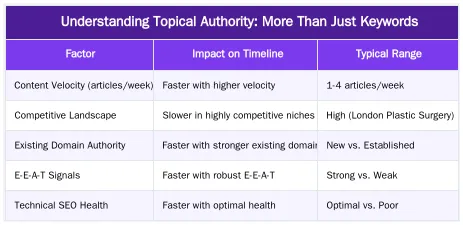
    Understanding Topical Authority: More Than Just Keywords — How Long Does It Take to Build Topical Authority in a Competitive Medical Niche?

    Content Velocity, Quality, and Strategic Topic Cluster Planning

    A consistent content velocity of 2-4 high-quality, in-depth articles per week is crucial for building a semantic network. Each piece must contribute to a defined topic cluster. Topic cluster planning ensures content addresses a subject from multiple angles, interlinking articles to demonstrate expertise. This signals to Google that your site offers deep coverage, reducing the time needed to recognize your authority. For more on scaling content, see Content Velocity Optimization: How to Scale Quality Content Production.

    Traditional vs. Semantic SEO Approach to Content
    Aspect Traditional Keyword-Centric SEO Semantic SEO (Topical Authority)
    Focus Individual keywords, search volume Entities, topics, user intent
    Content Structure Disparate articles targeting keywords Interconnected topic clusters, content hubs
    Goal Rank for specific terms Become the definitive resource on a topic
    Timeline Impact Often slower, less resilient to updates Accelerated, more algorithm-proof

    The Role of E-E-A-T and Technical SEO in Expediting Authority

    In YMYL niches, E-E-A-T signals are non-negotiable. Surgeon bios, detailed qualifications, patient testimonials, and transparent practice information build trust with users and search engines. Google scrutinizes these signals to ensure medical information is credible. A strong technical SEO foundation is also vital. This includes optimizing Core Web Vitals, implementing medical schema markup, and ensuring a clean site architecture. These technical elements improve crawl efficiency and help Google understand your content’s context, shortening the time required to assess your site’s value.

    Leveraging Semantic SEO and Ruxi Data for Rapid Authority Building

    Abdurrahman Şimşek’s methodology integrates Semantic SEO with the Ruxi Data semantic engine. This strategy reduces Google’s ‘Cost of Retrieval’ (CoR), making it faster for search engines to understand content depth and relevance. This provides a competitive edge for London’s private healthcare sector.

    Automating Topical Maps and EAV Modeling with Ruxi Data

    Ruxi Data identifies topical gaps and opportunities traditional keyword research misses. It automates creating topical maps for a holistic content strategy. Ruxi Data also facilitates constructing Entity-Attribute-Value (EAV) models for surgical procedures. This involves defining entities (e.g., “Rhinoplasty”) and their attributes (e.g., “recovery time,” “anesthesia type,” “ideal candidate”). Structuring content around EAV models helps clinics produce comprehensive, algorithm-proof information. This approach streamlines topic cluster planning and resource allocation, ensuring all content contributes to the semantic network. For a practical application, see Automating Medical Topical Maps with Ruxi Data: A Case Study for Clinics.

    This data-driven strategy ensures your website addresses the full spectrum of patient queries and related concepts, not just keywords. Google seeks this semantic understanding when evaluating expertise. For more on semantic search, see Wikipedia’s entry on Semantic Search.

    Optimizing for Generative AI: Future-Proofing Your Medical Content

    With Generative AI and AI Overviews, search engines increasingly rely on factual, structured, and contextually rich information. A semantic approach, prioritizing clear, factual, and attributed content, positions your practice for Generative Engine Optimization (GEO). Building a semantic content network makes your clinic’s information a candidate for AI-generated summaries and answers. This solidifies your authority and future-proofs your digital presence against evolving search paradigms. Learn how search engines process information from Google Search Central.

    Measuring Progress: Are You Building True Topical Authority?

    Measuring a topical authority strategy’s impact extends beyond keyword ranking checks to include broader online presence and business outcomes.

    Beyond Rankings: Key Performance Indicators for Topical Authority

    Focus on a suite of KPIs beyond rankings. Track organic traffic growth, particularly to new topic cluster pages. Monitor visibility for more long-tail queries, which indicates Google’s expanded understanding of your expertise. Improved engagement metrics (higher time on page, lower bounce rates, increased CTR) signal that your content resonates with users. The most critical metric is patient acquisition: more qualified leads and consultation bookings from organic search. These indicators clarify your growing semantic footprint and its impact on clinic growth.

    Auditing Your Semantic Footprint for Continuous Growth

    Building topical authority is an ongoing process. Regular content network audits are essential to identify topical gaps and opportunities. This involves analyzing content for completeness, identifying competitor gains, and mapping new sub-topics. This auditing process ensures your content remains fresh, comprehensive, and aligned with patient needs and search trends. It allows for strategic resource allocation to maintain and expand your authority, ensuring sustained growth.

    Ready to Dominate Your Medical Niche with Semantic SEO?

    Building topical authority in London’s competitive private healthcare sector requires a specialized approach. Abdurrahman Şimşek, a London-based Semantic SEO Strategist, specializes in creating Semantic Content Networks for medical clinics, skin clinics, and plastic surgeons. Use his decade of expertise to improve your online presence and attract patients.

    Conclusion

    Building topical authority in a competitive medical niche is a long-term strategy. Initial recognition can be achieved in 6-9 months, but sustained dominance requires 12-18 months or more of consistent, high-quality content and a semantic SEO strategy. Focusing on E-E-A-T, optimizing content velocity, and using tools like Ruxi Data for topic cluster planning and EAV modeling can accelerate a medical practice’s path to online authority. Book a Semantic SEO Audit or connect via WhatsApp Strategy Line: +90 506 206 86 86.

    Frequently Asked Questions

    What is a realistic timeframe for how long to build topical authority in a competitive medical niche?

    In highly competitive medical niches like plastic surgery in London, establishing initial topical authority typically takes 6 to 9 months. This timeline for how long to build topical authority assumes a consistent output of 2-4 high-quality, in-depth articles per week within a focused topic cluster. Achieving significant page-one rankings and sustained dominance often extends this period to 12 months or more.

    What is the biggest factor determining how long to build topical authority effectively?

    The most significant factor is content velocity combined with its quality and depth. Rapidly publishing comprehensive, expert-written content on a specific topic accelerates the process. A clinic consistently publishing 10 in-depth articles on a single topic in one month will establish authority much faster than one publishing one article a month for ten months, directly impacting how long to build topical authority.

    Does technical SEO health influence how long to build topical authority for my website?

    Yes, technical health significantly impacts the timeline for how long to build topical authority. A technically sound website with fast page speed, a clean internal linking structure, and proper schema markup allows search engines to efficiently crawl and understand your content. Poor technical SEO can create significant roadblocks, slowing down the recognition of your growing authority and extending the overall timeline.

    How many articles are typically needed to form a robust topic cluster?

    A robust topic cluster generally consists of one main pillar page supported by 15-25 detailed cluster pages. The precise number of articles depends on the breadth and depth of the specific topic you aim to cover. The goal is to comprehensively address the subject, ensuring no informational gaps for your target audience.

    Can leveraging semantic SEO tools like Ruxi Data accelerate the process of establishing authority?

    Absolutely, utilizing semantic infrastructure like Ruxi Data can dramatically shorten the timeline for building authority. It automates the creation of precise topical maps and entity-attribute-value models, ensuring your content strategy is perfectly aligned with search engine algorithms from the outset. This data-driven approach eliminates guesswork and optimizes resource allocation for maximum impact.

    How can I get started with a semantic SEO strategy for my medical clinic?

    To begin building robust topical authority for your medical clinic, you can book a Semantic SEO Audit with Abdurrahman Şimşek. This audit will provide a tailored strategy to enhance your online presence. Alternatively, you can reach out directly via WhatsApp for a strategy discussion at +90 506 206 86 86.


    Ruxi Data brings together multi-model AI, automated website crawling, live indexation checks, topical authority mapping, E-E-A-T enrichment, schema generation, and full pipeline automation — from crawl to WordPress publish to social posting — all in one platform built for agencies and freelancers who run on results.


    Continue Reading

    Why a Multi-Model AI Approach Outranks Single-Model Content in 2026

    Medical Directory SEO: How Entity Optimization Drives Patient Bookings

    Instagram Marketing for Cosmetic Clinics: A Patient-Centric Strategy