
Remove Fake Google Review: Safeguarding Your Clinic’s Reputation
To remove fake Google review content, UK doctors must understand Google’s specific content policies, which define violations like spam, impersonation, or conflicts of interest. This guide details how to identify reviews eligible for removal, differentiating them from legitimate negative feedback. It outlines a step-by-step reporting process via Google Business Profile, emphasizing the importance of documenting evidence. Proactive online reputation management strategies are also crucial for safeguarding patient trust and maintaining positive brand sentiment.
Abdurrahman Şimşek, a Semantic SEO Strategist, provides expert guidance on digital trust and online visibility. This content leverages strategic insights to help medical professionals protect their digital presence and manage brand sentiment effectively.
To explore your options, contact us to schedule your consultation.
For UK doctors, a fake Google review can damage a clinic’s reputation and patient trust. This guide provides steps to identify, report, and remove fake Google review content. It covers Google’s policies, the reporting process, and proactive strategies for online reputation management to safeguard your professional integrity.
Understanding Google’s Review Policies: What Constitutes a “Fake” Review?
A “fake” Google review violates its content policies, unlike a negative opinion. Violations include spam, fabricated engagement, impersonation, conflicts of interest, and off-topic posts. Understanding these policies is necessary to identify reviews eligible for removal.
Common Violations: Spam, Conflict of Interest, Off-Topic Content
Google’s Prohibited Content policies define reviews as fake or inappropriate for several reasons. These include spam and fake engagement from bots, paid individuals, or those with no genuine experience. Impersonation, where a reviewer pretends to be someone else, is a violation. Reviews from current or former employees, competitors, or those with a direct financial interest constitute a conflict of interest. Off-topic content, like personal rants or political commentary, is also grounds for removal. Google’s official guidelines provide detailed examples of these violations.
The Difference Between a Bad Review and a Policy Breach
Differentiating between a negative review and a policy violation is essential. Google protects freedom of expression, so a patient can share a poor experience even if the clinic disagrees. A review is only eligible for removal if it breaches a policy, such as containing hate speech, harassment, or being demonstrably fake. Disliking a review’s content does not make it a policy violation. For a successful removal request, clinics must focus on reviews that fall into prohibited content categories.
Step-by-Step: How to Report a Fake Google Review for Your Clinic
Reporting a review that violates Google’s policies requires a structured approach. UK doctors can report reviews directly from their Google Business Profile. Provide Google with clear information and supporting evidence that the review is not genuine or breaches guidelines. This increases the likelihood of a successful removal.
Documenting Evidence: Screenshots, Patient Records, and Timelines
Before reporting, gather all evidence. Take screenshots of the review, noting the reviewer’s name and date. Cross-reference the reviewer’s name with your patient records; a non-match is strong evidence. Document any communication suggesting the review is fabricated or malicious. A clear timeline of events is also helpful. In your report, concisely explain which policy the review violates (e.g., “fake engagement” or “conflict of interest”) and reference your evidence.
Navigating the Google Business Profile Dashboard for Reporting
To report a review, sign in to your Google Business Profile and go to the “Reviews” section. Locate the review, click the three-dot menu (vertical ellipsis), and select “Report review” or “Flag as inappropriate.” Choose the most appropriate reason from the list (e.g., “Off-topic,” “Spam,” “Conflict of interest”). You cannot always upload documents at this stage, but your selection informs Google’s review team. Google may contact you via email if more evidence is required. This flagging is the first step to remove fake Google review content.
What Happens After Reporting? Google’s Review Process & Appeals
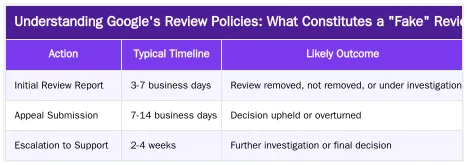
After you report a review, Google’s moderation team assesses it against their content policies. The initial review can result in removal, a decision to keep it, or further investigation. Understanding these stages and the appeals process is important. Persistence and clear communication are often necessary.
Typical Timelines for Review Resolution and Initial Outcomes
Google’s review timelines vary by case complexity and report volume. An initial review typically takes a few days to several weeks. Monitor the status in your Google Business Profile dashboard under “Reviews” or “Support”. Outcomes are: review removed, review not removed (no policy violation found), or review under investigation. If not removed, clinics can appeal. Consistent review monitoring is essential for local SEO and to optimise your Google Business Profile.
Crafting a Strong Appeal: Key Information to Include
If your initial removal request is denied, you can appeal through Google Business Profile support or an appeal form. Provide new or more detailed evidence not included in the initial report. Reiterate which specific Google policy the review violates. Maintain a professional, factual tone and avoid emotional language. Strengthen your case by referencing dates, screenshots, and patient record checks. For instance, explicitly state if you have no record of the patient. A structured appeal with compelling evidence increases the chance of Google reconsidering its decision. Industry experts advise thorough documentation for appeals.
Beyond Removal: Proactive Reputation Management for UK Doctors
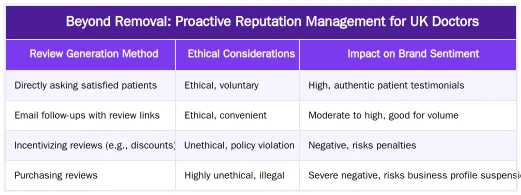
Addressing fake reviews is reactive; a proactive online reputation management strategy is better. For UK doctors, this involves monitoring and responding to feedback and building a positive digital footprint. A strong positive presence dilutes the impact of negative or fake reviews and builds patient trust.
Ethical Strategies for Generating Positive Patient Testimonials
Building a base of genuine patient testimonials is important. Ethical strategies include asking satisfied patients for a review after a positive experience. This can be done verbally, via a follow-up email with a link to your Google Business Profile, or through in-clinic signage. The process must be voluntary and never incentivized, as this violates Google’s policies. Platforms like Doctify and Trustpilot also offer structured ways for patients to leave verified feedback. Quality care leads to authentic positive feedback.
Monitoring Your Online Presence: Tools and Best Practices
Monitor your online presence to detect new reviews. Set up Google Alerts for your clinic’s and your own name. Regularly check your Google Business Profile. Use online reputation management tools that aggregate reviews from platforms like Google, Doctify, Trustpilot, and niche sites like Realself for aesthetic practices. Responding promptly and professionally to all reviews influences brand sentiment and shows commitment to patient care.
Legal Recourse & Expert Support: Protecting Your Clinic’s Digital Trust
While Google’s reporting is the first line of defense, some situations may warrant legal action or specialized digital PR for doctors. Understanding the UK legal landscape for fake reviews and knowing when to seek expert SEO support helps protect your clinic’s reputation.
Is it Illegal to Post a Fake Review in the UK? Understanding Defamation Law
Yes, posting fake reviews has legal ramifications in the UK. The Consumer Protection from Unfair Trading Regulations 2008 makes it illegal for businesses to post or procure fake reviews, or for individuals to post misleading information that harms consumers. A fake review with false statements that damages your professional reputation could constitute defamation under UK law. While legal action is costly and time-consuming, it is an option for severe cases where Google’s removal process fails and significant harm occurs. Consult a legal professional specializing in media or defamation law for specific cases. The UK government provides guidance on these regulations.
Why Specialist Medical SEO is Crucial for Online Reputation Management
For medical clinics, online reputation management is linked to search engine optimization (SEO). Specialist medical SEO, particularly for the London private healthcare sector, focuses on building E-E-A-T (Experience, Expertise, Authoritativeness, Trustworthiness) and topical authority. A semantic SEO expert can configure your digital presence to reduce the impact of negative content. By establishing a semantic content network and optimizing for YMYL (Your Money Your Life) searches, a clinic can protect its digital trust. This approach helps your positive, authoritative content rank prominently, pushing down fake reviews in search results. Integrating review management into an E-E-A-T strategy is essential for digital resilience. Learn more about E-E-A-T for YMYL in 2026.
Secure Your Clinic’s Reputation: Partner with a Semantic SEO Expert
Managing your clinic’s online reputation and removing fake Google reviews requires specialized knowledge. Abdurrahman Şimşek, a London-based Semantic SEO Strategist, offers solutions for medical clinics, skin clinics, and plastic surgeons. Using semantic engineering and E-E-A-T optimization, he protects your clinic’s digital presence and positions it for growth and authority. Partner with an expert who understands the challenges of the medical sector.
Conclusion
Managing Google reviews is part of online reputation management for UK doctors. By understanding Google’s policies, documenting evidence, and following reporting procedures, clinics can challenge and remove fake Google reviews. Proactive strategies like ethical review generation and online monitoring build a resilient digital presence. For complex cases or to integrate review management into a digital strategy, specialist medical SEO expertise can safeguard your clinic’s reputation and patient trust.
For expert guidance on online reputation management and building a digital presence for your medical clinic, visit abdurrahmansimsek.com.
Frequently Asked Questions
What is the most effective way to remove a fake Google review?
The most effective method to remove a fake Google review is to flag it directly from your Google Business Profile dashboard, providing a clear, concise reason why it violates Google’s policies. Documenting all evidence, such as a lack of patient records or factual inaccuracies, is crucial for a successful appeal.
Should I respond publicly when trying to remove a fake Google review?
It is generally advised not to engage in a lengthy public argument. A calm, professional response stating that you have no record of the individual as a patient and that you take patient feedback seriously can be appropriate while you await Google’s decision. This shows other potential patients that you are proactive and professional.
How can I prove a review is fake to Google to facilitate its removal?
Proving a review is fake often involves demonstrating a lack of records for the reviewer’s name in your patient database. If the review contains factually incorrect information about your services, staff, or clinic operations, you should point this out in your report to Google to support your request to remove the fake Google review.
What proactive strategies can help prevent the need to remove fake Google reviews?
The best defense is a strong offense. Implementing a systematic process to encourage genuine, satisfied patients to leave positive reviews will dilute the impact of any single fake negative review. This builds a strong base of positive social proof that is more resilient to attacks and enhances your clinic’s overall online reputation.
Beyond Google, how can clinics manage their online reputation effectively?
A comprehensive reputation strategy involves monitoring and encouraging reviews on key medical platforms like Doctify and Realself, relevant to your specialty. It also includes building a strong brand through high-quality content and digital PR, making your clinic the authoritative source of information, which inherently builds trust and diminishes the impact of negative sentiment.
How can London Private Healthcare SEO Service assist clinics with online review management?
London Private Healthcare SEO Service specializes in YMYL & E-E-A-T optimization for surgeons, helping clinics in Harley Street and Central London build topical authority. We can guide you through effective review management strategies and implement proactive measures to protect your digital trust and reputation, ensuring your clinic maintains a positive online presence.
Ruxi Data brings together multi-model AI, automated website crawling, live indexation checks, topical authority mapping, E-E-A-T enrichment, schema generation, and full pipeline automation — from crawl to WordPress publish to social posting — all in one platform built for agencies and freelancers who run on results.