
Fix Index Bloat: Enhance Medical Content Visibility
To fix index bloat on medical content hubs, strategic technical SEO is essential. This guide details how to diagnose and eliminate low-value, duplicate pages that waste crawl budget and dilute E-E-A-T signals. Learn to identify common culprits like faceted navigation and thin content, then implement solutions such as canonical tags and the noindex directive. Effectively managing your site’s index improves topical authority and ensures valuable medical content ranks higher, optimizing search engine resource allocation. This approach helps medical sites achieve greater visibility and trust.
Abdurrahman Şimşek, a Semantic SEO Strategist specializing in medical content networks, offers expert guidance on optimizing YMYL sites. His 10+ years of experience in semantic engineering and technical web development ensures authoritative strategies for complex healthcare domains.
To explore your options, contact us to schedule your consultation.
To fix index bloat on medical content hubs, one must understand its causes and implement technical SEO strategies. This guide defines index bloat, explains its effects on YMYL (Your Money Your Life) websites, and provides strategies for diagnosis and remediation. Addressing index bloat maximizes content visibility, strengthens E-E-A-T (Expertise, Experience, Authoritativeness, Trustworthiness) signals, and optimizes search engine resource allocation.
What is Index Bloat and Why Does It Harm Medical SEO?
Index bloat is when search engines index many low-value, duplicate, or irrelevant pages from a website. For medical content hubs, this includes pages with minimal unique value, such as filtered doctor profiles, minor procedure variations, or internal search results. This over-indexing hinders a site’s search performance.
Understanding Index Bloat in a Medical Context
Medical websites often have complex structures with numerous doctor profiles, procedure page variations, patient resources, and booking systems. Index bloat occurs when search engines index low-value or duplicate pages generated by these systems, such as multiple URLs for the same doctor profile from filtering options, or auto-generated pages for image attachments. This dilutes the authority of valuable medical content.
The Detrimental Impact on Crawl Budget and E-E-A-T
Low-quality pages waste Google’s crawl budget—the number of pages Googlebot crawls on a site in a given time. When Googlebot crawls irrelevant pages, it has less capacity to index valuable content like procedure guides or surgeon biographies, preventing critical information from ranking. A bloated index also dilutes E-E-A-T signals because Google struggles to discern authoritative content from low-value pages, which is critical for YMYL sites. This impacts topical authority.
Identifying the Root Causes of Index Bloat on Your Clinic’s Site
Diagnosing index bloat involves identifying which pages consume crawl budget and dilute site authority. Medical websites have challenges like dynamic content and intricate navigation.
Common Culprits: Auto-Generated & Low-Quality Pages
Faceted navigation for filtering doctors by specialty or location often creates unique URLs for each filter combination, leading to thousands of low-value indexed pages. URL parameters like tracking codes or session IDs can generate multiple URLs for the same content. Thin content on tag or category pages, attachment pages (e.g., direct URLs to images), and duplicate content from slight variations of procedure pages also contribute to index bloat. For instance, a single procedure’s “overview,” “benefits,” and “recovery” pages could be consolidated.
Leveraging Google Search Console and Site Operators for Diagnosis
Use Google Search Console (GSC) to identify these issues. The ‘Index Coverage’ report shows indexed pages, errors, warnings, and excluded URLs. Check the “Excluded” section for reasons like “Crawled – currently not indexed” or “Discovered – currently not indexed,” which indicate crawl budget issues. A `site:yourdomain.com` search on Google reveals unexpected indexed URLs, like auto-generated or low-quality pages. Log file analysis shows what Googlebot is crawling, confirming if crawl budget is spent on irrelevant pages. For guidance, see our article, A Guide to Log File Analysis for Private Clinic Websites.
Strategic Solutions: How to Fix Index Bloat Effectively
Fixing index bloat requires technical directives and content management strategies to guide search engines to valuable content and prevent indexing of low-quality or duplicate pages.
Implementing Canonical Tags and Noindex Directives
For duplicate content, the canonical tag tells search engines the preferred URL version of a page. On a medical site, this is useful for varied procedure pages (e.g., “Rhinoplasty London” vs. “Rhinoplasty UK”) or printable article versions. The `noindex` directive tells search engines not to index a page. This is for pages with no search value, like internal search results, old doctor profiles, or thank you pages. These directives help maintain a clean index.
Content Pruning: Eliminating Thin & Duplicate Content
Content pruning is the process of identifying and then improving, consolidating, or removing low-value content. For medical sites, this means auditing pages for thin content, outdated information, or redundant procedure descriptions. Improving content can mean expanding short articles into guides; consolidation merges similar topics into one authoritative page. Removing irrelevant pages signals quality to search engines. This process reinforces E-E-A-T by maintaining site quality and relevance. Learn more in our guide on content pruning for SEO.

Optimizing Crawl Budget and E-E-A-T: An Advanced Perspective for Medical Hubs
Managing index bloat is about optimizing Google’s ‘Cost of Retrieval’ and reinforcing E-E-A-T signals for YMYL medical websites.
Index Bloat as a ‘Cost of Retrieval’ Challenge
Index bloat increases Google’s ‘Cost of Retrieval’. When Googlebot crawls low-value pages, it has less budget for high-value content like procedure pages and surgeon bios. This hinders the discovery and ranking of key assets. Abdurrahman Şimşek, a London-based Semantic SEO Strategist, states that reducing this cost is critical for complex medical sites. Streamlining your index directs crawl budget towards content that matters, improving Google’s ability to understand your site’s core entities and topical authority. Learn more about Optimizing ‘Cost of Retrieval’ for Complex Medical Websites and strategies for reducing Cost of Retrieval.
Reinforcing E-E-A-T Through a Clean Index
A lean, high-quality index signals strong E-E-A-T to Google. Removing low-value pages amplifies the E-E-A-T signals of core medical content, helping search engines recognize the site’s authority on specific medical entities and topics. For example, a site presenting only well-researched, expert-authored content on plastic surgery builds a stronger semantic profile. This clarity improves topical authority and trust in the YMYL space, improving entity recognition and ranking.
Preventing Future Bloat: Best Practices for Scalable Medical Content
Proactive architectural and content governance practices prevent recurring index bloat and ensure long-term SEO health.
Proactive Site Architecture and Content Governance
A well-planned site architecture minimizes the creation of low-value pages. This means planning how categories, tags, and filters are implemented to prevent duplicate content. For instance, faceted navigation using AJAX or JavaScript to filter results without creating new indexable URLs prevents bloat. Clear content governance policies are also vital. These include guidelines for creating new pages, auditing existing content for quality, and defining when to use canonical or noindex directives. Regular content audits identify and address thin or outdated content before it causes index bloat. This maintains a high-quality, lean index.
Managing URL Parameters and XML Sitemaps
Manage URL parameters in Google Search Console. Configure how Google handles specific parameters, telling it to ignore those that don’t change content. This prevents Google from crawling and indexing multiple versions of the same page. Maintain a clean XML sitemap. Include only pages you want Google to index, excluding low-value or noindexed pages. Regularly update your sitemap and submit it to GSC to guide Googlebot. Learn more about crawl efficiency in our article on fixing crawl budget issues.
Monitoring and Measuring Your Index Bloat Remediation
After implementing index bloat strategies, continuous monitoring is needed to assess effectiveness and ensure long-term site health. Track key metrics and review search engine behavior.
Key Metrics for Tracking Index Health
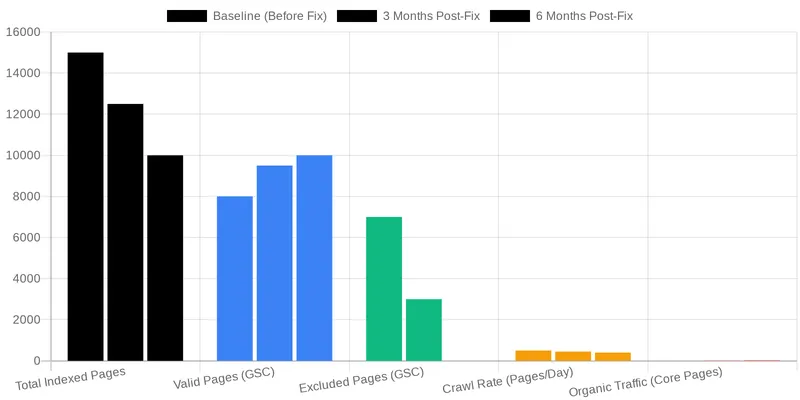
Monitor index health with Google Search Console’s ‘Index Coverage’ report. Track the number of valid indexed pages, noting increases in “Excluded” pages, especially those marked “noindexed by user” or “duplicate, Google chose different canonical.” A healthy trend is a decrease in low-value indexed pages and stability or an increase in high-value pages. Monitor crawl stats to confirm Googlebot is spending less time on irrelevant URLs. Log file analysis shows Googlebot’s activity, confirming crawl budget reallocation. Observe organic traffic and keyword rankings for core medical content; improvements indicate a cleaner index is improving visibility.
Regular Audits and Adaptations
Index bloat management is an ongoing process. Conduct regular technical SEO audits (quarterly or bi-annually) to identify new sources of bloat, like new features or content types. Adapt your index management strategy as your site evolves. Follow Google’s algorithm updates and best practices for YMYL sites. Adapt your canonicalization, noindex, and content pruning strategies as needed. This ensures your site maintains a lean, high-quality index and maximizes organic visibility and patient acquisition.
Conclusion
Index bloat threatens the SEO performance and E-E-A-T signals of medical content hubs. By understanding its causes, diagnosing issues with tools like Google Search Console, and implementing solutions like canonical tags, noindex directives, and content pruning, clinics can manage their indexed pages. This optimizes crawl budget, reinforces topical authority, and enhances visibility for medical content. London-based private healthcare clinics can benefit from expert guidance to dominate local search and attract patients. Visit abdurrahmansimsek.com to learn about building high-authority semantic content networks for medical practices.
Frequently Asked Questions
What is the primary cause of index bloat on medical websites?
Index bloat on medical content hubs is primarily caused by search engines indexing numerous low-value, duplicate, or irrelevant pages. This often includes auto-generated pages like tag archives, attachment URLs, or parameterized URLs from internal search filters, which dilute the site’s overall quality signals. These pages consume crawl budget and can hinder the visibility of your valuable medical content.
How can I quickly diagnose and fix index bloat on my clinic’s site?
To quickly diagnose index bloat, use Google’s “site:” search operator (e.g., “site:yourclinic.com”). If the number of results vastly exceeds your valuable content, it’s a strong indicator. Further investigation using the ‘Pages’ report in Google Search Console will help identify specific low-value URLs that need to be addressed to fix index bloat.
Is using the ‘noindex’ tag an effective way to fix index bloat?
Yes, applying the ‘noindex’ directive is a highly effective and direct method to fix index bloat for pages that offer no search value. It explicitly instructs search engines not to include these pages in their index, thereby consolidating your site’s authority onto your high-quality, relevant medical content. This helps Google focus on the pages that truly matter for your E-E-A-T.
Will fixing index bloat improve my rankings for important medical keywords?
Absolutely. When you fix index bloat, you prevent search engines from wasting crawl budget on low-quality pages, directing their attention to your most authoritative and valuable content. This strategic consolidation of ranking signals often leads to improved organic visibility and higher rankings for your core medical services and procedure pages, enhancing your overall SEO performance.
How does a proper robots.txt file help prevent future index bloat?
A well-configured robots.txt file is crucial for preventing future index bloat by disallowing search engine crawlers from accessing non-essential or low-value areas of your website. This proactive measure stops the problem at its source, ensuring that only valuable, relevant content is considered for indexing and preserving your crawl budget.
How can Abdurrahman Şimşek help my London clinic address index bloat and improve SEO?
Abdurrahman Şimşek specializes in holistic SEO strategies for medical clinics, including diagnosing and resolving complex technical issues like index bloat. With expertise in YMYL and E-E-A-T optimization, he can develop a tailored plan to clean your site’s index, enhance topical authority, and drive significant organic growth. You can learn more or schedule a consultation via his website to discuss your specific needs at abdurrahmansimsek.com.
Ruxi Data brings together multi-model AI, automated website crawling, live indexation checks, topical authority mapping, E-E-A-T enrichment, schema generation, and full pipeline automation — from crawl to WordPress publish to social posting — all in one platform built for agencies and freelancers who run on results.