
Cost of Retrieval SEO: Optimizing Medical Site Efficiency
Optimizing cost of retrieval seo is crucial for medical websites to enhance Googlebot efficiency and improve E-E-A-T signals. This article details how managing the computational resources Google expends on crawling and indexing your site directly impacts visibility for critical medical content. Learn to diagnose and resolve issues like index bloat and crawl budget waste through strategic site architecture and information retrieval techniques. Efficient cost of retrieval seo ensures your expertise is discovered and ranked effectively, especially for complex YMYL domains.
Abdurrahman Şimşek, a Semantic SEO Strategist, specializes in building high-authority semantic content networks for medical clinics. His expertise in holistic SEO strategy and information retrieval optimization helps healthcare providers achieve superior organic search performance.
To explore your options, contact us to schedule your consultation.
For London’s medical clinics and plastic surgeons, optimizing cost of retrieval seo is strategic for dominating organic search. CoR is critical for E-E-A-T and crawl budget. A semantic SEO approach can reduce the resources Google expends on your site, improving visibility and patient acquisition. Managing this metric ensures your medical content is efficiently discovered and indexed.
What is ‘Cost of Retrieval’ (CoR) and Why it Matters for Medical Websites?
Cost of Retrieval (CoR) is the computational resources—time, processing power, and bandwidth—Google expends to crawl, render, and index a page. For YMYL (Your Money Your Life) medical websites, efficient retrieval is paramount. A high retrieval cost can hinder Google’s ability to process your medical expertise, impacting E-E-A-T signals and ranking potential. CoR influences how effectively Googlebot discovers and evaluates health information across your site.
Information retrieval involves Googlebot crawling pages, rendering them by executing JavaScript, and indexing the processed content. Each step consumes resources. Medical sites often have extensive content, imagery, and interactive elements, making resource management crucial. An optimized CoR ensures Google can efficiently access and interpret medical information, from surgeon bios to procedure explanations, without bottlenecks. This efficiency improves visibility in search results for competitive terms in the London private healthcare market.
How Complex Site Architecture & Content Impact CoR for Surgeons
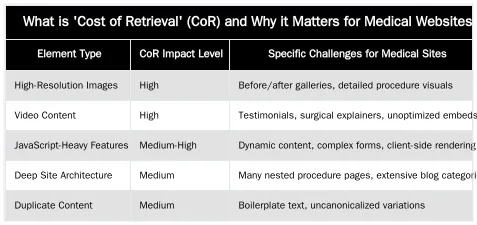
Medical websites for plastic surgeons and aesthetic clinics often have elements that increase Google’s processing effort. Large image galleries, high-definition video testimonials, and extensive procedure pages are common. Unoptimized, these elements increase retrieval cost. A deep site architecture complicates Googlebot’s task, potentially leading to crawl budget waste and index bloat.
With inefficient resource usage, Googlebot may crawl fewer pages or less frequently. This delays indexing of new medical content or updates. This inefficiency directly impacts visibility for specific procedures or surgeon profiles. Understanding these components is key to building an advanced technical SEO framework that supports user experience and search engine efficiency.
The Hidden Costs of High-Resolution Medical Imagery and Video
Before-and-after galleries are crucial for plastic surgery websites to demonstrate results and build patient trust. Unoptimized, high-resolution images and embedded videos consume significant crawl budget and rendering resources. Each large file requires more time and bandwidth for Googlebot to download and process. This slows page loading, impacting user experience and signaling a resource-intensive page to search engines.
Navigating Deep Site Structures and JavaScript Rendering Challenges
Complex navigation menus, numerous content categories, and many layers of procedure-specific pages create a deep site structure. This depth makes it harder for Googlebot to discover and process all pages efficiently. Medical websites often use JavaScript for dynamic content, forms, and user interfaces. Client-side rendering requires Googlebot to execute JavaScript, a resource-intensive process that can delay content discovery and indexing.

Strategies to Optimize CoR and Enhance Googlebot Efficiency
Reducing retrieval cost involves technical optimizations and strategic content structuring. These efforts make your site more efficient for Googlebot and enhance user experience, a key E-E-A-T factor. Streamlining content delivery helps Google assess your medical information’s authority and relevance.
Effective strategies include optimizing media, refining code, and structuring your site to guide Googlebot. These improvements save Google’s resources, leading to more frequent, comprehensive crawling. This benefits medical sites that regularly update content like procedure details, research, or testimonials. Optimized architecture and efficient content delivery are fundamental for competitive search presence.
Technical Optimizations for Media-Rich Medical Procedure Pages
Medical procedure pages often feature high-resolution images and videos to educate patients. To reduce their retrieval cost, implement image compression, use modern image formats like WebP, and lazy load media outside the viewport. For videos, use efficient hosting or optimized embeds. These techniques improve page speed and Core Web Vitals for Surgeons, improving the experience for users and Googlebot. Optimizing JavaScript delivery and minimizing render-blocking resources is crucial for pages with dynamic elements.
Streamlining Site Architecture and Internal Linking for Better Crawl Flow
A logical, flat site architecture helps Googlebot discover content efficiently. Organize medical content into clear categories, making important E-E-A-T pages accessible within a few clicks from the homepage. A planned internal linking strategy guides Googlebot to authoritative content, distributing link equity and signaling the importance of medical entities. This reduces wasted crawls and helps Googlebot prioritize core services and surgeon profiles. An E-E-A-T-driven internal linking architecture enhances crawl flow and topical relevance.
The Semantic SEO Advantage: Reducing CoR with Entity-Based Architecture
As a Semantic SEO Strategist with over 10 years of experience, Abdurrahman Şimşek specializes in building high-authority semantic content networks for medical clinics. This approach reduces retrieval cost. Structuring content around entities (e.g., ‘Rhinoplasty’, ‘Dr. Smith’, ‘Harley Street Clinic’) and their attributes presents Googlebot with an organized, unambiguous data model. This clarity makes retrieval more efficient, as Google spends less effort deciphering context and relationships.
A semantic approach focuses on the meaning and relationships of concepts, not just keywords. This is powerful for medical content, where precision and authority are paramount. Defining entities and their attributes provides Google a structured knowledge base that is easier to crawl, render, and index. This optimizes retrieval cost and strengthens topical authority and E-E-A-T signals, crucial for ranking in the London private healthcare sector. This strategy is a core component of semantic SEO for surgeons.
How Semantic Engineering Guides Googlebot to Key Medical Entities
Semantic engineering creates a content architecture based on Entity-Attribute-Value (EAV) models. Each piece of information is an entity (e.g., a medical procedure) with defined attributes (e.g., ‘recovery time’, ‘cost’, ‘associated surgeon’). On a structured site, Googlebot can quickly identify and understand medical entities and their relationships. This reduces linguistic processing and contextual inference, lowering retrieval cost. This approach is fundamental to implementing medical schema for entity recognition and building an EAV model for surgical procedures.
Leveraging Ruxi Data for Data-Driven CoR Optimization and Content Prioritization
Tools like Ruxi Data are pivotal for semantic SEO and retrieval cost optimization. Ruxi Data analyzes crawl patterns, content performance, and entity relationships to identify where Googlebot’s resources are underutilized or wasted. This insight allows for content prioritization, focusing optimization on pages with the highest business value and impact on retrieval cost. Understanding how Google processes your site helps clinics enhance crawl efficiency and improve organic visibility. This complements website migration and redesign strategies, ensuring CoR is considered from the outset.
Ready to Optimize Your Medical Website’s Performance?
Optimizing your medical website’s retrieval cost yields significant returns: improved search rankings, stronger E-E-A-T recognition, increased organic traffic, and more patient inquiries for your London clinic. Ensuring Google can efficiently access your medical content positions your practice for growth.
Frequently Asked Questions
What is cost of retrieval seo and why is it important?
Cost of Retrieval (CoR) refers to the computational resources Google expends to crawl, render, and index your website pages. Optimizing cost of retrieval seo makes it easier and more efficient for search engines to process your site, which can positively impact your search visibility and rankings. This efficiency is crucial for maintaining a healthy crawl budget.
Why is optimizing cost of retrieval seo critical for complex medical websites?
Medical websites often feature extensive content, intricate navigation, and rich media, which can significantly increase the resources Google needs to process them. High cost of retrieval seo can lead to wasted crawl budget and incomplete indexing, especially for crucial procedure or physician profiles. By optimizing this metric, we ensure Google efficiently discovers and ranks your most valuable medical content.
What is the first step in auditing your site’s cost of retrieval seo?
The initial step involves a thorough log file analysis. This process reveals precisely how Googlebot interacts with your site, pinpointing frequently crawled URLs, identifying wasted crawl budget on low-value pages, and detecting server errors. Understanding these interactions is crucial for effective cost of retrieval seo optimization.
Can improving Core Web Vitals reduce the overall retrieval cost for a domain?
Yes, directly. A faster Largest Contentful Paint (LCP) and quicker server response time reduce the computational resources Google needs to render a page. This enhanced efficiency is a key factor in lowering the overall cost of information retrieval for your domain, making your site more appealing to search engines.
How does a flat site architecture contribute to better information retrieval?
A flatter, more logical site architecture minimizes the number of clicks Googlebot needs to access any given page. This streamlined pathfinding substantially lowers the computational expense of discovering and indexing your entire content network. It ensures critical medical information is easily accessible to search engines, improving crawl efficiency.
How can Abdurrahman Şimşek help optimize my medical website’s retrieval efficiency?
Abdurrahman Şimşek specializes in semantic SEO strategies that significantly reduce your website’s retrieval burden for search engines. By implementing entity-based architecture and technical optimizations, we ensure Google efficiently processes your content, improving E-E-A-T and organic visibility. Contact us to discuss a tailored strategy for your Harley Street clinic and enhance your site’s performance.
Ruxi Data brings together multi-model AI, automated website crawling, live indexation checks, topical authority mapping, E-E-A-T enrichment, schema generation, and full pipeline automation — from crawl to WordPress publish to social posting — all in one platform built for agencies and freelancers who run on results.