
Search Intent Patient Journey: Optimizing Healthcare Content for Conversion
The search intent patient journey is crucial for healthcare providers to attract and convert high-value patients. This article details how to align user search goals with specific patient journey stages, from initial awareness to final consultation. It outlines the distinct informational and transactional keyword types relevant to each phase, enabling a targeted healthcare content strategy. By understanding the evolving needs across awareness, consideration, and decision stages, clinics can optimize their medical SEO efforts and build an effective content funnel that guides prospective patients toward treatment. This strategic mapping enhances user experience and boosts conversion rates.
Abdurrahman Şimşek, a Semantic SEO Strategist, specializes in developing precise content strategies that bridge user intent with business objectives. This expertise ensures healthcare clinics can effectively navigate complex patient journeys, leveraging organic search to connect with individuals actively seeking medical solutions. The insights provided are grounded in practical application for enhanced digital visibility.
To explore your options, contact us to schedule your consultation. You can also reach us via: Book a Semantic SEO Audit, Direct WhatsApp Strategy Line: +90 506 206 86 86
Mapping the search intent patient journey is a foundational strategy for private healthcare clinics in London to attract and convert high-value patients. This article provides a blueprint for a healthcare content strategy that aligns user goals with patient stages, optimizing content for each step of the decision-making process.
Understanding Search Intent and the Patient Journey in Healthcare SEO
Search intent is the goal behind a user’s search query. The patient journey is the path from recognizing a health need to receiving treatment. For medical SEO, understanding their intersection is essential to guide patients to relevant information. This alignment ensures content addresses specific needs at precise moments, improving user experience and conversion potential.
What is the difference between search intent and the patient journey?
The patient journey is the non-linear progression from initial symptom awareness or desire for an elective procedure through research, consideration, decision-making, and treatment. It encompasses a broad timeline and emotional landscape. Search intent is the immediate purpose behind a single search query. For example, a patient in the “awareness” stage might have “informational” intent (“what causes fine lines”), while a patient in the “decision” stage has “transactional” intent (“book botox consultation London”). Mapping these two bridges user needs with clinic objectives, optimizing the user intent mapping process for patient acquisition.
The Patient Journey Stages & Corresponding Search Intent Types
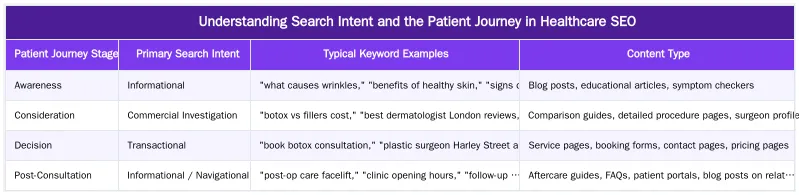
The patient journey has four stages: Awareness, Consideration, Decision, and Post-Consultation. Each stage has different patient needs and search queries. Aligning content with these stages and their associated search intents is fundamental for a high-value patient acquisition funnel. The four main search intent types are Informational, Navigational, Commercial Investigation, and Transactional. This alignment is crucial for elective procedures, as patients conduct extensive research before committing.
Aligning Intent with Each Stage: A Strategic Overview
At the Awareness stage, patients identify a problem or desire. Their search intent is primarily Informational, with queries like “symptoms of sagging skin” or “benefits of cosmetic surgery.” Content is educational, broad, and problem-focused, such as blog posts or guides. For elective procedures, this stage may involve exploring aesthetic goals without specific solutions.
The Consideration stage involves researching solutions and providers. Search intent is often Commercial Investigation, with queries like “facelift vs. non-surgical options” or “best plastic surgeons London reviews.” Content offers detailed comparisons, procedure guides, surgeon credentials, and patient testimonials to help patients evaluate options. The awareness consideration decision framework becomes actionable here.
In the Decision stage, patients are ready to choose a clinic. Their search intent is Transactional. Queries are specific: “book breast augmentation consultation Harley Street” or “cost of rhinoplasty London.” Content facilitates conversion with service pages, booking forms, pricing information, and calls-to-action. Navigational intent is also present, as patients may search directly for a clinic’s name.
The Post-Consultation stage involves patients seeking aftercare information or considering additional treatments. Informational and Navigational intent are common. Content includes aftercare guides, FAQs, and information on complementary procedures to foster long-term patient relationships.
Mapping Keywords to the Patient Journey for High-Value Patients
Effective keyword mapping involves understanding the intent behind search terms and aligning them with the patient’s stage. For private healthcare in competitive markets like London’s cosmetic surgery sector, this precision is vital for attracting high-value patients. The process matches keywords, categorized by intent, to the appropriate content and journey stage.
Practical Steps for Intent-Driven Keyword Research
1. Identify Core Patient Needs: Understand the problems, desires, and questions patients have at each stage, such as aesthetic concerns, recovery expectations, or financial considerations for elective procedures.
2. Brainstorm Seed Keywords: Use broad terms related to your services (e.g., “liposuction,” “dermatologist London”).
3. Expand with Intent Modifiers: Use tools to find variations and long-tail keywords with modifiers that indicate intent:
- Informational: “what is,” “how to,” “causes of,” “benefits of,” “symptoms,” “guide.”
- Commercial Investigation: “best,” “reviews,” “vs,” “comparison,” “cost of,” “options,” “types of.”
- Transactional: “book,” “appointment,” “clinic near me,” “price,” “consultation,” “surgeon.”
4. Analyze SERP Features: Examine the search engine results pages (SERPs) for target keywords. The types of content that rank (featured snippets, People Also Ask, local packs) provide insight into Google’s interpretation of user intent. For example, “how-to” videos suggest informational intent, while local business listings suggest transactional or navigational intent.
5. Categorize and Map: Group keywords by intent and assign them to the relevant patient journey stage to create targeted content. Differentiating informational vs transactional keywords is critical. Long-tail keywords are valuable for niche procedures as they indicate refined intent.
6. Monitor and Refine: Keyword intent can evolve. Regularly review keyword performance and adjust your content strategy based on trends or algorithm updates to ensure your cosmetic surgery marketing remains effective.
Crafting Content for Each Stage: From Awareness to Consultation
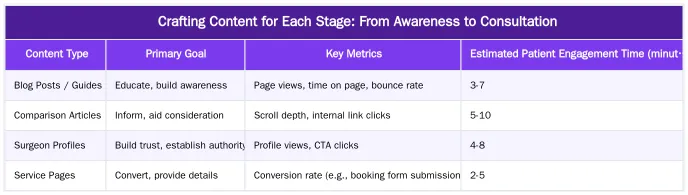
A content funnel addressing each stage of the patient journey is essential for private clinics to attract and convert high-value patients. Content must be tailored to the patient’s stage and search intent to provide value, build trust, and establish E-E-A-T signals.
Optimizing for Transactional Intent: Driving Consultations
For the decision/consultation stage, content must be conversion-focused. Service pages should detail procedures, expected outcomes, and patient suitability. Key elements include:
- Clear Calls-to-Action (CTAs): Prominently display accessible “Book a Consultation,” “Request a Quote,” or “Contact Us” buttons.
- Surgeon Profiles: Detailed surgeon bios that highlight qualifications, experience, specializations, and patient testimonials build trust and demonstrate expertise.
- Booking Forms: Forms should be intuitive, mobile-friendly, and require minimal steps. Integrate online scheduling tools where possible.
- Pricing Transparency: Providing clear pricing ranges or explaining consultation fees manages patient expectations and reduces friction.
- Trust Signals: Integrate patient testimonials, before-and-after galleries, accreditation logos, and media mentions on service and contact pages to reinforce credibility.
- Location Information: For London clinics, provide clear address details, maps, and directions.
Effective lead nurturing at this stage provides all necessary information to alleviate concerns and support the patient’s readiness to book a consultation.
Why Semantic SEO & E-E-A-T Elevate Your Patient Journey Strategy
In the Your Money Your Life (YMYL) private healthcare sector, mapping the search intent patient journey is insufficient. A semantic SEO approach with strong E-E-A-T (Expertise, Experience, Authoritativeness, Trustworthiness) signals amplifies content effectiveness and ranking potential. This strategy, used by semantic engineers like Abdurrahman Şimşek, moves beyond keyword matching to understand relationships between entities, reducing the ‘Cost of Retrieval’ for search engines and enhancing relevance for patients.
Using semantic engineering principles, clinics can structure content to show a comprehensive understanding of medical topics, procedures, and patient concerns. This involves Entity-Attribute-Value (EAV) modeling, where medical entities (e.g., “Rhinoplasty”) are defined with attributes (e.g., “recovery time,” “anesthesia type,” “ideal candidate”). This structured data helps search engines interpret and present information for complex medical queries.
Tools like Ruxi Data automate topical map creation and EAV modeling to identify semantic gaps and opportunities, ensuring content covers all facets of a topic. This data-driven approach creates authoritative content networks to establish a clinic’s digital authority in London’s private healthcare market. This improves organic visibility and builds patient confidence by demonstrating an understanding of their needs and the medical field.
Building Trust and Authority at Every Patient Touchpoint
E-E-A-T is paramount for medical content. Google’s Quality Rater Guidelines emphasize Expertise, Experience, Authoritativeness, and Trustworthiness for YMYL topics. For private clinics, this means:
- Expertise: Content authored or reviewed by qualified medical professionals (e.g., surgeons, dermatologists). Clearly display author bios with credentials.
- Experience: Showcasing the practical experience of surgeons through detailed procedure pages, patient stories, and before-and-after galleries.
- Authoritativeness: Building a strong backlink profile from reputable medical sites, being cited as a source, and having a comprehensive topical authority state for healthcare domains.
- Trustworthiness: Ensuring data privacy (GDPR & HIPAA compliance), transparent pricing, clear contact information, and positive patient reviews.
Integrating these signals throughout the patient journey impacts patient confidence and conversion rates. For instance, a detailed surgeon biography with patient testimonials on a procedure page reinforces trust at the decision stage. This approach to content and technical SEO helps clinics rank and convert high-value patients.
Transforming Patient Journeys into Clinic Growth: Your Next Steps
Mapping the patient journey to search intent is a strategy for private healthcare clinics seeking sustainable growth. It guides prospective patients from initial curiosity to booking a consultation. Using semantic SEO principles and prioritizing E-E-A-T builds a digital foundation to attract and convert high-value patients. For London’s medical practices, this can lead to a competitive advantage in local organic search.
To implement an intent-driven SEO strategy for your clinic, Book a Semantic SEO Audit to uncover your opportunities. For immediate strategic discussions, use the Direct WhatsApp Strategy Line: +90 506 206 86 86.
Frequently Asked Questions
What is the core concept of mapping the search intent patient journey?
The patient journey outlines the path a person takes from recognizing a health need to receiving treatment. Search intent represents the user’s specific goal behind a query. Mapping the search intent patient journey involves aligning your content with these goals at each stage, guiding potential patients effectively through their path to treatment.
How do you identify ‘Consideration’ stage search intent within the patient journey for a surgical procedure?
‘Consideration’ stage intent is often signaled by queries involving comparisons, costs, or specifics, such as “rhinoplasty vs septoplasty” or “how much does a facelift cost in London.” Recognizing this intent allows clinics to provide detailed, transparent, and expert-led content that addresses specific concerns during this crucial stage of the search intent patient journey.
Why do many medical websites fail to effectively map the search intent patient journey?
Many clinics focus heavily on bottom-of-funnel, transactional pages (e.g., ‘Book a Consultation’) while neglecting top-of-funnel informational content. This oversight means they miss the vast majority of potential patients in the awareness and consideration stages, failing to build trust and authority early in their search intent patient journey.
What is the best content format for the ‘Awareness’ stage within the search intent patient journey?
Blog posts, guides, and articles that answer broad “what is” or “how does” questions are ideal for the ‘Awareness’ stage. For example, an article titled “What is Blepharoplasty? A Guide to Eyelid Surgery” captures users at the very beginning of their search intent patient journey.
Can a single piece of content effectively cover multiple stages of the search intent patient journey?
Yes, a comprehensive pillar page can. For instance, a definitive guide to a procedure can have sections for awareness (what it is), consideration (types, costs, risks), and decision (why choose our clinic, surgeon bios), effectively guiding a user through the entire funnel on one page of their search intent patient journey.
How can I get expert help to map my clinic’s search intent patient journey?
Abdurrahman Şimşek, a Semantic SEO Strategist, specializes in medical and plastic surgery SEO for London clinics. You can book a Semantic SEO Audit through his website or directly contact him via WhatsApp at +90 506 206 86 86 for a personalized strategy to optimize your search intent patient journey. This will help align your content with every stage of the patient’s path.
Ruxi Data brings together multi-model AI, automated website crawling, live indexation checks, topical authority mapping, E-E-A-T enrichment, schema generation, and full pipeline automation — from crawl to WordPress publish to social posting — all in one platform built for agencies and freelancers who run on results.