
Medical E-e-a-t Framework 2026: Architecting Surgeon Website Authority
This article outlines a technical medical e-e-a-t framework 2026 for surgeon websites, focusing on achieving Google search dominance in competitive markets like London private healthcare. Readers will learn to implement advanced strategies for YMYL SEO, including architecting algorithmic authorship and leveraging physician schema. The framework emphasizes entity reconciliation and knowledge graph integration to enhance medical accuracy and information retrieval. It details content configuration best practices to build robust topical authority, ensuring compliance with Google Quality Rater Guidelines. This medical e-e-a-t framework 2026 provides actionable steps for future-proofing medical practice online visibility.
Abdurrahman Şimşek, a Semantic SEO Strategist, offers expertise in building high-authority semantic content networks for medical clinics. His approach focuses on technical E-E-A-T signals and advanced content configuration to secure top organic search positions for private healthcare providers.
To explore your options, contact us to schedule your consultation.
Google’s E-E-A-T guidelines are critical for YMYL websites. This article provides a technical medical e-e-a-t framework 2026 for building infrastructure for surgeon websites to dominate search for London private healthcare.
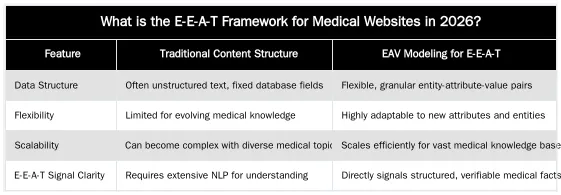
What is the E-E-A-T Framework for Medical Websites in 2026?
The E-E-A-T framework from Google’s Quality Rater Guidelines stands for Experience, Expertise, Authoritativeness, and Trustworthiness. For 2026, ‘Experience’ is a critical addition, requiring content creators in YMYL medical fields to demonstrate direct, real-world practice and firsthand knowledge.
The Critical Role of ‘Experience’ in YMYL Medical SEO
Google’s ‘Experience’ component requires content from individuals with verifiable, practical engagement in the subject. For Your Money Your Life (YMYL) medical websites, surgeons must showcase clinical practice, patient interactions, and procedural history. Search engines use this to assess credibility, prioritizing content from practitioners who perform the procedures they describe. Real-world experience is as crucial as academic credentials for online authority.
Why Google Prioritizes Surgeon E-E-A-T More Than Ever
The emphasis on E-E-A-T for surgeons reflects Google’s commitment to patient safety and accurate medical information. In competitive markets like London private healthcare, Google surfaces content from the most qualified medical professionals. A strong E-E-A-T profile differentiates expert surgeons from less credible sources, improving patient trust and search result quality.
Technical E-E-A-T Signals: Content Configuration & Information Retrieval
Beyond schema, the technical configuration of content and its impact on information retrieval signal medical accuracy. This involves how medical data is structured and presented to users and crawlers so authoritative information is accessible and understood.
Optimizing Content Configuration for Medical Accuracy
Effective medical content structure conveys expertise. Use clear headings, concise summaries, and link to authoritative sources like peer-reviewed journals or government health organizations. Regularly update content to reflect the latest medical consensus and attribute information to the expert surgeon. For automation strategies, explore automated E-E-A-T content generation.
EAV Modeling and Cost of Retrieval (CoR) Optimization
Entity-Attribute-Value (EAV) modeling is a semantic engineering approach to organize complex medical data. Unlike rigid database tables, EAV allows flexible, granular representation of entities (a surgical procedure) and their attributes (recovery time, success rate). This structured data improves Google’s ability to retrieve and understand information, reducing the “Cost of Retrieval” (CoR). Lower CoR signals well-organized content, boosting E-E-A-T.
Measuring E-E-A-T Success: What to Expect in 2026 and Beyond
Implementing an E-E-A-T framework yields measurable results. Tracking key performance indicators (KPIs) is essential to understand the impact of these strategies and ensure continuous improvement for surgeon practices.
Key Metrics for E-E-A-T Performance
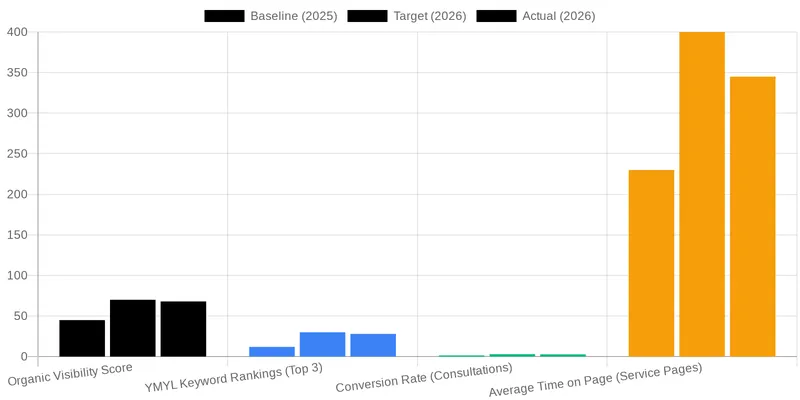
E-E-A-T success is measured by metrics including increased organic visibility for YMYL terms, higher rankings, improved traffic quality (longer time on page, lower bounce rates), and higher conversion rates for patient consultations. For instance, increased impressions for specific surgical procedures in London indicates growing topical authority.
Future-Proofing Your Medical Website for Algorithmic Shifts
E-E-A-T optimization is an ongoing process. Google’s algorithms evolve, so maintaining a strong E-E-A-T profile requires consistent attention to content quality, technical infrastructure, and semantic engineering. A medical e-e-a-t framework 2026 provides a foundation to adapt to algorithmic shifts and maintain search dominance. Continuous refinement of entity reconciliation and content configuration ensures relevance and authority.
Secure Your Practice’s Future: Partner with a Medical SEO Expert
E-E-A-T and semantic SEO require specialized expertise for medical websites in competitive markets like London. Partnering with a professional helps meet current guidelines and anticipate future algorithmic changes.
Transform Your Online Presence in London’s Competitive Healthcare Market
Abdurrahman Şimşek offers specialized semantic SEO and web development for plastic surgeons, aesthetic clinics, and private healthcare providers in London. With a decade of experience, he builds high-authority semantic content networks to establish your practice as a leader. Using advanced strategies in content architecture, topical authority, and technical E-E-A-T optimization, your website can attract high-value patients and dominate local organic search across Harley Street and premium London postcodes. For a medical e-e-a-t framework 2026 tailored to your practice, contact Abdurrahman Şimşek.
Conclusion
An E-E-A-T infrastructure is a requirement for medical websites in 2026. By implementing Physician and Author schema, optimizing content for information retrieval, and building topical authority, surgeons can enhance their online presence. These strategies ensure Google rewards genuine E-E-A-T. For practitioners in London’s private healthcare market, an expert-driven approach is necessary for growth. Partner with a specialist: abdurrahmansimsek.com.
Frequently Asked Questions
What is the new ‘E’ in E-E-A-T and how does it impact the medical e-e-a-t framework 2026?
The new ‘E’ stands for ‘Experience’, emphasizing firsthand knowledge. For medical content, Google prioritizes information from qualified professionals with demonstrable, real-world practice. Integrating this is crucial for any effective medical e-e-a-t framework 2026.
How can technical elements support a robust medical e-e-a-t framework 2026 for surgeons?
Technical elements like structured data (e.g., Physician and Author schema) are vital. They link content directly to a surgeon’s verified online profiles and credentials, a process known as algorithmic authorship. This verifiable connection is a cornerstone of a robust medical e-e-a-t framework 2026.
What is the most overlooked aspect of implementing a medical e-e-a-t framework 2026?
Content configuration and ongoing maintenance are frequently neglected. Ensuring all medical information remains current, accurate, and regularly reviewed by a qualified expert is a critical, continuous process. This vigilance is essential for sustaining high E-E-A-T signals over time.
How does an ‘About Us’ page contribute to a strong E-E-A-T profile for medical practices?
The ‘About Us’ page is fundamental for establishing credibility. It should meticulously detail the surgeon’s qualifications, experience, publications, and professional memberships. Providing links to external authoritative sources that verify this information significantly strengthens the site’s overall trustworthiness.
How does this advanced E-E-A-T approach protect medical websites against future Google updates?
By aligning with Google’s core objective of providing verifiable expertise and trustworthy information in YMYL search, this framework builds resilience. It ensures your site meets the highest standards for quality and reliability, making it less susceptible to algorithm changes. This proactive strategy helps secure long-term organic visibility.
How can I get started with building a strong medical e-e-a-t framework 2026 for my practice?
To begin, consider partnering with a specialist in medical SEO and semantic engineering. An expert can assess your current digital presence and develop a tailored strategy to implement the necessary technical and content infrastructure. This ensures your website meets the stringent requirements of the medical e-e-a-t framework 2026.
Ruxi Data brings together multi-model AI, automated website crawling, live indexation checks, topical authority mapping, E-E-A-T enrichment, schema generation, and full pipeline automation — from crawl to WordPress publish to social posting — all in one platform built for agencies and freelancers who run on results.